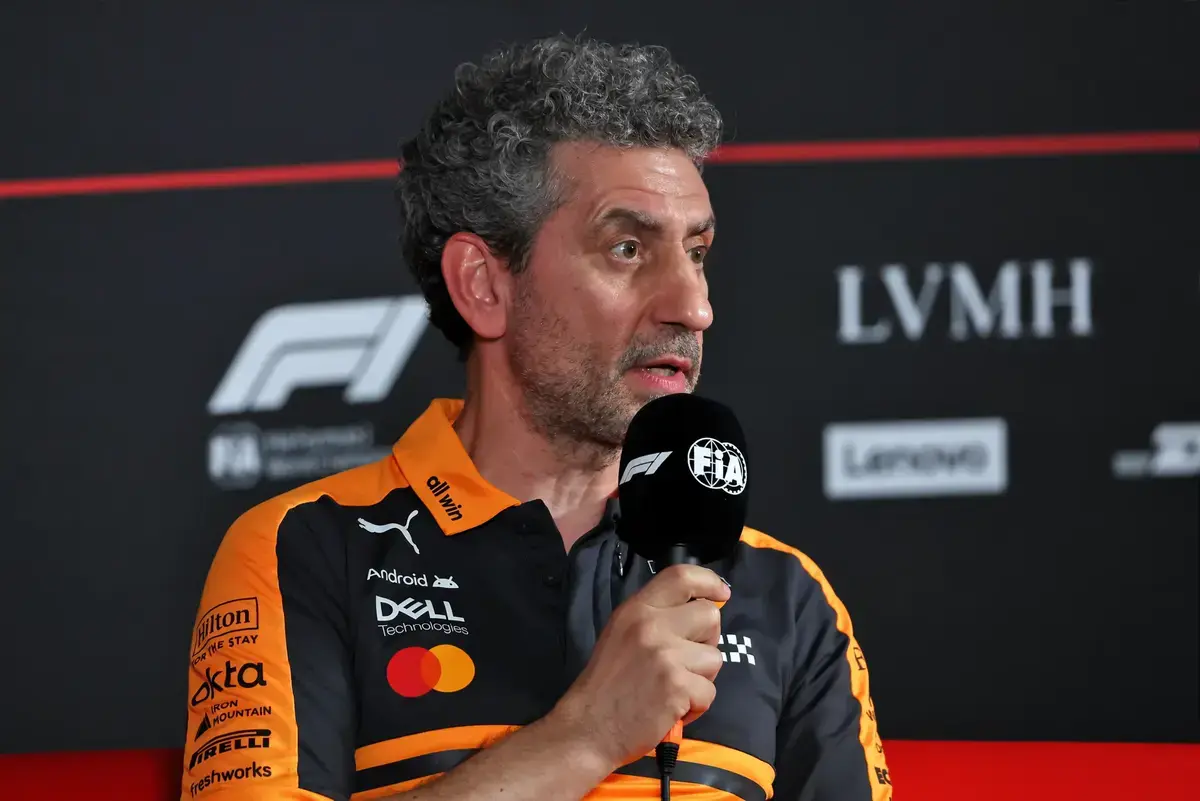

Nothing focuses a team boss’s mind on regulatory reform quite like being on the winning side of a three-month legal saga. Andrea Stella wants the FIA to overhaul its Right of Review system, and he’s picked a rather convenient moment to say so: right after McLaren and Red Bull successfully used that exact system to strip Pierre Gasly of his Monaco podium.
The background is by now familiar to anyone who has followed this saga since the summer. Gasly’s time penalties from Monaco were rescinded, then reinstated after McLaren and Red Bull took their case to the FIA International Court of Appeal. The process dragged on for months after the chequered flag fell, and it ended with Alpine boss Flavio Briatore accusing one of the judges of bias towards McLaren in a press conference that got considerably more heated than anything that happened on track that weekend.
Stella Fields the Accusations, Then Pivots to Reform
Stella had to defend his team against what he called insulting accusations before turning the conversation towards the system itself. Asked by PlanetF1.com what the drawn-out process, which concluded three months after the chequered flag in Monaco, means for how the Right of Review should work going forward, Stella didn’t hold back on the need for change.
“I think in the statement of the FIA it’s highlighted how this was a case that will bring some positive outcome, because it will give the drive to review some of the ways in which regulations are enforced.” – Andrea Stella
He broke his argument into three parts, starting with sympathy for the stewards themselves, an interesting move given his team had just spent months arguing they’d got the original call wrong.
“First of all, the stewards, they do a difficult job. They have to make decisions within a limited time frame. We know as competitors what it means when time is a variable, when pressure is up. The stewards won’t be different. It won’t be different for them.” – Andrea Stella
Fine words, though it’s worth noting McLaren didn’t extend quite so much sympathy when they were busy building the case that overturned those same stewards’ decision to rescind the penalty in the first place. Stella’s second point cut closer to the actual controversy: when should a Right of Review even be granted, and when should it be knocked back before it ever reaches a hearing room?
“I think we need to consider the conditions in which a Right of Review should be received and should go ahead, and when that is not the case.” – Andrea Stella
The third strand is arguably the most substantial, and it’s the one that should worry the paddock most: consistency of measurement. Stella pointed to the various things F1 measures constantly, pit lane speed, car weight on the scales, and argued there’s a real question about whether those measurements are applied the same way every time.
“There are many things we measure: the speed in pit lane; likewise, we use scales to measure car weight. So, there are many measurements that happen, and I think there’s an interesting topic related to the consistency of this sort of measurement.” – Andrea Stella
Vasseur Takes the Less Combustible Route
Where Stella and Briatore were happy to turn a press conference into a public argument, Ferrari‘s Fred Vasseur mostly sat this one out, though even he couldn’t resist a gentle prod at the process. He was careful to distinguish a Right of Review from a straightforward appeal, arguing the system exists precisely because stewards don’t always have the full picture thirty minutes after a session ends.
“I’m not sure that I want to go on this field, but to come back on the Right of Review, I think it’s not an appeal. The right of review is that when you have new evidence, because quite often when you are going to the stewards 30 minutes after the end of the session, we didn’t have time to look after the data, but the same for the stewards.” – Fred Vasseur
Vasseur’s take is more measured than Stella’s, but it’s also more revealing about where the real problem sits. He admitted to being torn on the substance of the Gasly case itself, sympathetic to the argument that a driver shouldn’t be penalised for barely crossing a limit, but equally sympathetic to the principle that a served penalty has to apply equally to everyone.
“This case, honestly, I was a little bit on both sides because I can understand the frustration when you are not overshooting the limit to get the penalty, and I can understand also the fact that if someone served the penalty, it has to be for everybody.” – Fred Vasseur
His conclusion was considerably calmer than Briatore’s shouting match, but it still amounts to an admission that the sport got lucky rather than got it right.
“Now, I think this case, it happened once. I hope that it won’t happen again, but the process is quite robust.” – Fred Vasseur
A Robust Process That Took Three Months to Resolve One Penalty
Call it robust if you like, but a system that takes three months, two rounds of stewarding, an International Court of Appeal, and a paddock shouting match to settle a single set of time penalties is not what most people would call working pretty well. Vasseur’s defence of the process rests on the idea that new evidence justified reopening the case. Fine. But if the conditions for reopening a case are so loose that this sort of saga can drag on for a full quarter of a season, then Stella’s second point, about tightening when a Right of Review should even be granted, is doing a lot of quiet work underneath the polite language.
The Gasly saga has already been picked apart in detail elsewhere, including how Charles Leclerc dodged a grid penalty of his own for Madrid after his Monza crash, a reminder that stewarding consistency is very much a live issue heading into this weekend’s Spanish Grand Prix in Madrid. Nobody in that press conference disagreed that something needs fixing. The disagreement is over how much of the blame belongs to the stewards, how much belongs to the process, and how much simply belongs to a sport that keeps discovering its own rulebook has gaps only after someone has already lost a podium over it.
Stella is right that the measurement consistency question matters more than anyone in that room seemed willing to dwell on. But it’s hard to shake the sense that had this appeal gone the other way, with Gasly keeping his podium and McLaren left fuming on the sidelines, we’d have heard a very different tone about how robust the system actually is.