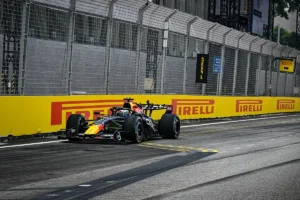
Formula 1’s governing body has managed to turn a routine red flag into a full-blown fairness crisis, and this time Aston Martin isn’t just shrugging it off. The team is still weighing whether to protest the result of sprint qualifying at the Singapore Grand Prix after a race control blunder left several cars down on power, with the FIA’s own apology doing little to calm things down in the paddock.
A Red Flag, a Forgotten Button, and a Wrecked Session
The chaos began innocently enough. SQ1 at Marina Bay was red-flagged to clear debris from Sergio Perez‘s front wing, the kind of stoppage that happens most weekends without consequence. This one was different. When the session resumed, race control failed to reactivate Overtake Mode, the electric power boost that’s supposed to run throughout qualifying by default. Several drivers immediately reported their cars felt oddly flat, and it turned out they were right to be suspicious.
Once the penny dropped, a race control official switched Overtake Mode back on, but only for 27 seconds, before switching it off again. The result was a session where some drivers banked their best laps with the full boost before the red flag, while others were stuck trying to find time afterwards with noticeably less power on tap.
Aston Martin Keeps Its Options Open
Several teams were hit by the fallout, but Aston Martin is the one refusing to let it go quietly. According to Motorsport.com, the team is still considering its options depending on whether the FIA takes any further action to put things right before Saturday’s sprint. Aston Martin wants a grid that actually reflects a fair playing field, though even the team seems to doubt whether the FIA has any clean way of untangling the mess without creating fresh grievances elsewhere on the grid.
That’s the real problem here. There’s no obvious fix. Williams reportedly asked race control after SQ1 to let all 22 cars through to SQ2 on a clean slate, essentially wiping the slate of the botched segment. The stewards turned that down, apparently unsure whether they even had the regulatory power to do it. A request to simply re-run SQ1 met the same fate, this time blocked by a shortage of available tyre sets. So the governing body broke the session, admitted it broke the session, and then discovered it couldn’t actually repair the damage it had caused. That’s not an edge case, that’s institutional failure dressed up as bad luck.
Williams and Racing Bulls Fume but Won’t Fight
Arvid Lindblad, Lance Stroll and both Williams drivers were among those hit hardest, all eliminated in SQ1 as a direct consequence of the power discrepancy. Williams and Racing Bulls are, by all accounts, extremely frustrated. Yet neither team is currently planning to protest, which says something about how pointless that road is generally considered to be once the FIA has already admitted fault but declined to offer a remedy.
Williams team principal James Vowles didn’t hide his frustration, as reported by RaceFans.
“A very frustrating evening. After the red flag in the first session of Sprint qualifying there was an issue with the way overtake mode was activated which definitely had an impact on our lap times. We are confident this will be fully investigated by the FIA.” – James Vowles
Lance Stroll confirmed he’d been caught out on exactly the lap that mattered. “I didn’t have overtake mode available on my second push lap so missed out on any chances of fighting to get through to Q2,” he said.
The FIA’s Apology, in Full
The governing body did at least own up to the error, rather than pretending nothing had happened. Its statement read in full:
“During the first period of Sprint Qualifying there was a human error in Race Control unrelated to the timing issue also encountered in SQ1. This issue in question meant Overtake Mode was not available after the red flag period during SQ1. When it became apparent that Overtake Mode was not active after the restart, it was then activated for a period of 27 seconds before being deactivated again. The FIA acknowledges that this unfortunate human error had an impact on the performance of certain cars based on the timing of their run and their position around the lap. The second and third periods of Sprint Qualifying were not affected.” – FIA statement
An admission of fault is one thing. Actually fixing the consequences is another, and the FIA couldn’t manage the second part. To make matters murkier still, this power glitch wasn’t even the only technical gremlin loose in SQ1. A separate timing issue, this one controlled by F1 management rather than the FIA, failed to register several lap times during the same segment, leaving drivers unsure whether they’d done enough to advance even before anyone worked out the power discrepancy existed. Two unrelated faults, stacked on top of each other, in the same session. Singapore’s qualifying hour has rarely looked less competent.
FIA’s Single-Seater Director Steps In
Nikolas Tombazis, the FIA’s single-seater director, met with the affected teams and drivers as the governing body tried to manage the fallout. It’s the sort of meeting that exists to project the appearance of accountability, though whether it produces anything beyond reassurance remains to be seen given the FIA has already admitted it may lack the regulatory tools to properly correct the result.
This is also the second significant technical failure to disrupt a competitive session inside a fortnight. The start of the Bahrain Grand Prix in Malaysia was delayed by roughly an hour due to a software glitch in the power unit control systems, a fault that prompted its own round of complaints when the FIA opted to restart the race in the original grid order rather than the scrambled positions the regulations technically called for. Different fault, same governing body, same grumbling in the paddock about whose interests get protected when the systems break down.
What Happens Next
With the sprint itself due at 09:00 UTC on Saturday and qualifying for the main race following at 13:00 UTC, the FIA has precious little runway to show it’s actually learned something rather than just apologised for it. Aston Martin’s willingness to keep its protest option alive suggests at least one team isn’t satisfied with a statement as the final word. Whether that pressure produces any concrete correction before lights out is now entirely in the FIA’s hands, and its track record over the last two race weekends doesn’t inspire much confidence.
For now, the sprint grid stands as set, flawed power delivery and all, with the FIA’s own words serving as the only acknowledgement that it got this one wrong.