
Charles Leclerc slammed into the Parabolica tyre barrier at more than 230km/h, subjected his SF-26 to deceleration north of 50G, and somehow walks away from it with nothing worse than a new gearbox casing. No grid penalty. No fresh power unit. Just a very relieved Ferrari and a driver who gets to start the Spanish Grand Prix at Madrid from wherever he qualifies rather than from the back.
A Crash That Should Have Cost More
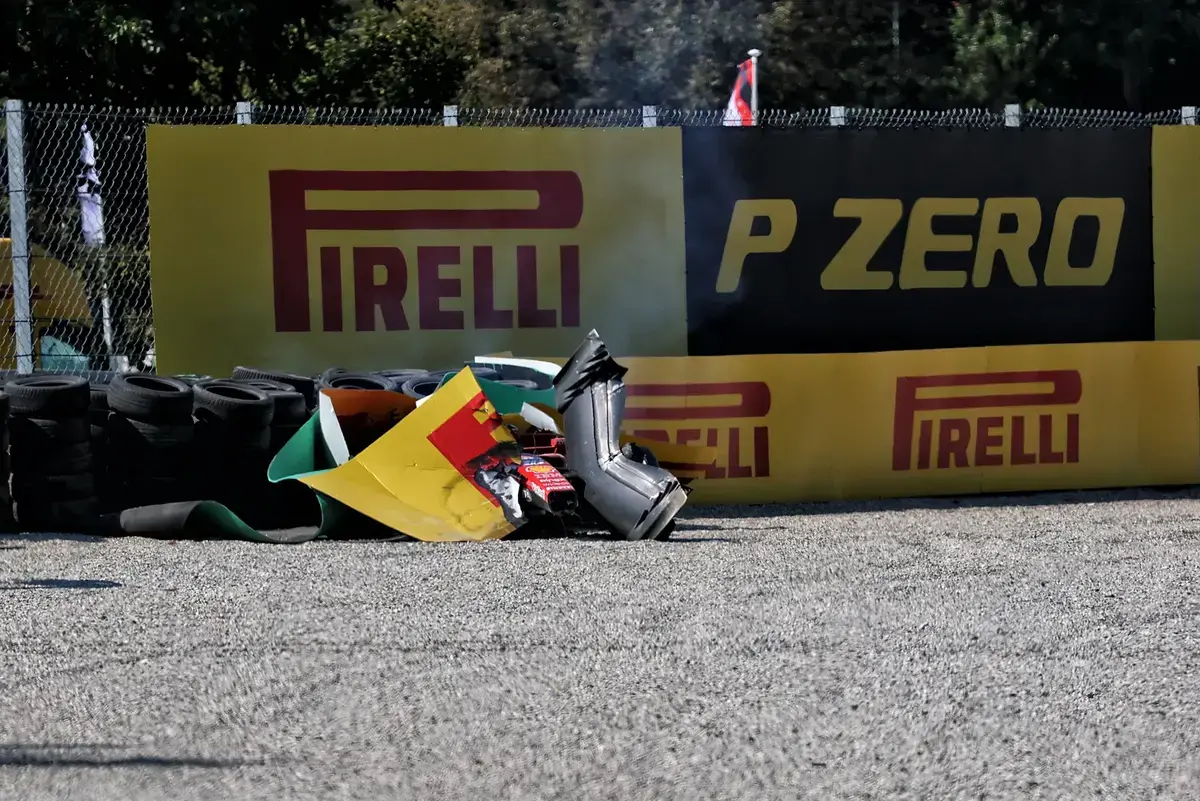
Leclerc’s race lasted all of two laps at Monza. Defending against Oscar Piastri‘s McLaren, he bounced over a water drain, lost the rear, and speared off through the Parabolica at a speed that would flatten most road cars into scrap. The Ferrari chassis took the hit and, remarkably, held together well enough to be declared usable. Only the transmission casing needs replacing before Madrid, a repair that carries no grid drop under the regulations.
That the engine itself survived is the genuinely surprising part. Impacts at that speed do not tend to be forgiving to power units, and the fact Leclerc did not immediately switch the car off after the crash meant the engine kept turning over for some time afterwards, hardly the ideal conditions for a component that had just absorbed a 50G hit. Ferrari ran checks at Maranello and, according to Motorsport.com, found nothing that points to lasting damage. The final word only comes once the unit is back under load and racing at Madrid, but the factory news is as good as Ferrari could have hoped for.
The Reprieve Nobody Should Get Too Excited About
Here is the thing worth remembering before anyone starts calling this good fortune a turning point: Ferrari is not out of the penalty woods for the rest of the season. There is a separate question hanging over the team about whether it will eventually need to fit a fresh example of the ADUO 2 engine at some point, a decision that would have nothing to do with the Monza crash but would land Leclerc with a grid penalty regardless. Surviving one crash without punishment does not mean the power unit situation at Ferrari is settled. It just means this particular bullet has been dodged.
And the ADUO upgrade itself, the very engine spec Leclerc was running when he crashed, has not delivered what Ferrari hoped. The team debuted it at Monza expecting a step forward and got the opposite: a chaotic weekend where Leclerc squeezed his own teammate Lewis Hamilton into the gravel at the start, before retiring himself a couple of laps later. Ferrari has been careful to describe the upgrade as no “game changer,” which in this context reads less like modesty and more like managing expectations downward before anyone asks the obvious question: what was the point?
Monza Was a Wipeout, Not a Blip
Strip the crash out of the equation and Monza was still a miserable weekend for Ferrari. Eight points from the entire race, all of them courtesy of Hamilton’s sixth place. Leclerc’s retirement means the team’s home-soil rival, Mercedes, got to celebrate a home win of its own kind: Kimi Antonelli took victory at Monza to become the first Italian to win his home race since Ludovico Scarfiotti back in 1966. Rubbing Ferrari’s nose in it on their own doorstep is precisely the kind of theatre this sport specialises in.
The championship table makes for grim reading in Maranello. Ferrari now sits 122 points adrift of Mercedes at the top of the constructors’ standings, a gap that has only grown as Mercedes rolls out further engine improvements while Ferrari’s own upgrade fails to move the needle. Hamilton’s recent form of P6, P4 and P5 across the last three rounds is solid without being spectacular, and Leclerc’s own sequence of DNF, P5 and P4 tells its own story: a driver who is either not finishing or finishing in the mid-pack, never troubling the podium. For a team that started this season with genuine title pretensions, that trajectory is closer to embarrassing than reassuring.
Madrid Is a Chance, Not a Cure
Madrid represents an opportunity for Ferrari to try the ADUO upgrade again, this time without a first-lap collision and a high-speed shunt getting in the way of actually seeing what the thing can do. It is also the first genuine test for Leclerc’s repaired power unit under racing load, the moment where Ferrari’s factory checks either get validated or blow up in spectacular fashion. Given how well the ADUO debut went at Monza, nobody in the Ferrari garage should be treating this as a formality.
A Lucky Escape, Nothing More
Leclerc gets to line up in Madrid with his grid slot intact, and that is worth having after a crash of that severity. But it changes nothing about the bigger picture: Ferrari’s engine upgrade has not delivered, the points gap to Mercedes keeps widening, and there is still a separate engine decision looming that could hand Leclerc a penalty later in the year regardless of what happened at Monza. One dodged bullet does not make a recovery.