
Forget the racecraft narrative for a second. Charles Leclerc didn’t out-brake Lando Norris into Turn 1 through sheer bottle alone, he did it because the McLaren driver was sitting there with an empty battery and nowhere to hide. That’s not a compliment to Leclerc’s bravery, it’s an indictment of McLaren’s energy strategy on a weekend where it mattered most.
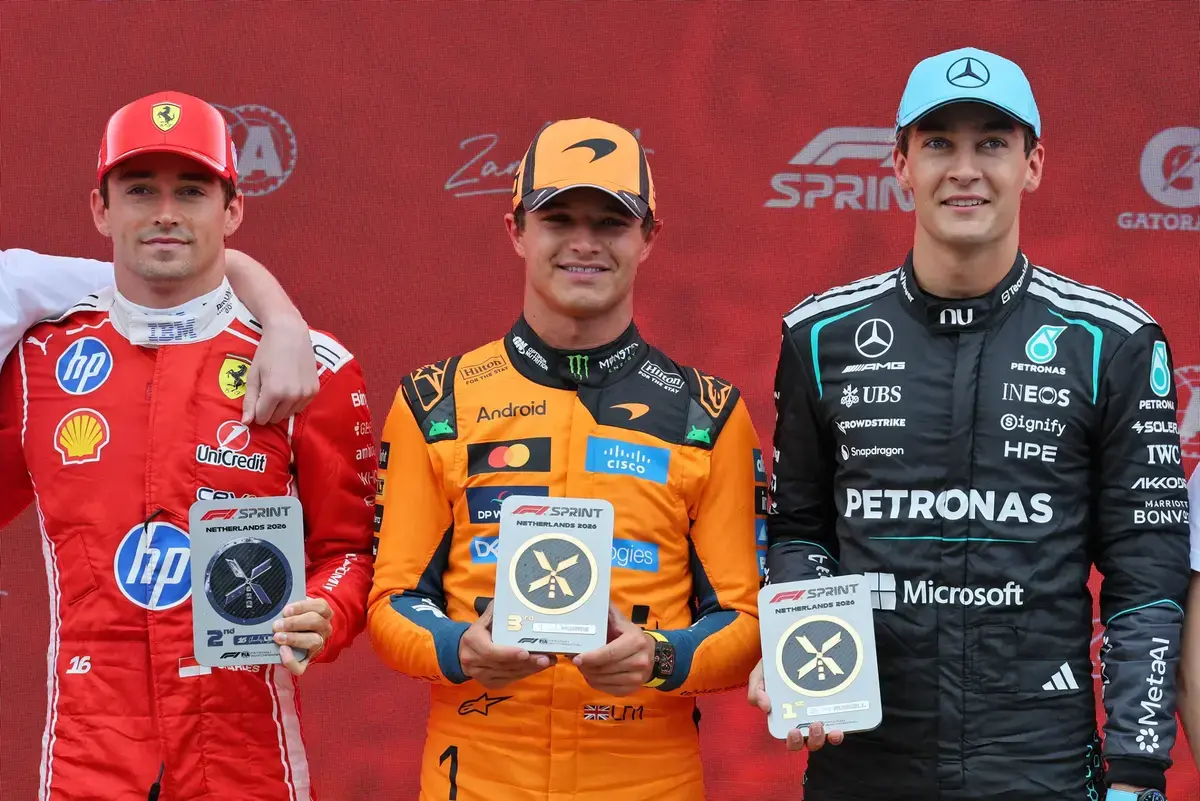
George Russell won Saturday’s sprint at Zandvoort with Charles Leclerc and Lando Norris completing the podium, a result already covered in detail elsewhere on this site. What deserves its own spotlight is the mechanism behind the only overtake inside the top ten all race, because it says plenty about how fragile these 2026 cars are when the electrical side of the power unit goes wrong.
Norris caught with his batteries down
Leclerc was blunt about it. Norris simply didn’t have the electrical deployment to defend on the Zandvoort straight, and the Ferrari driver knew it.
“Lando on the main straight was quite slow. He didn’t have the deployment that I had. So, I knew there was an opportunity there after the first two laps.” – Charles Leclerc
That’s a driver openly admitting he spotted a mechanical weakness in a title rival’s car and simply waited for the right lap to exploit it. No divine right of racecraft, no wheel-to-wheel brilliance, just patience and a rival running on fumes. As reported by RacingNews365, Leclerc confirmed he had to maximise his own deployment to close the gap, only for the two cars to arrive at the braking zone “more or less at the same level”, at which point it was game over for Norris.
Why this matters more than one overtake
In 2026’s new regulations, energy deployment is arguably a bigger differentiator than raw horsepower. These cars run on a knife edge between combustion and electrical power, and get the battery management wrong for even a lap and you’re a sitting duck on the straights. Zandvoort’s short run to Turn 1 doesn’t leave much margin, but even a tenth or two of deployment advantage is often the difference between defending a place and watching it disappear in your mirrors.
Leclerc himself pointed out just how rare passing has become this year. “It’s close to impossible to overtake” at Zandvoort, he said, adding that his move on Norris was the only one that happened inside the top ten all race. That’s not a small detail, it’s the entire story of 2026 so far: identical strategies, identical tyres, and processions unless somebody makes a genuine error. Norris made one, whether McLaren wants to frame it that way or not.
Ferrari’s tyre gamble deserves credit too, but don’t get distracted
Yes, Leclerc started on soft tyres while almost the entire field, bar Haas rookie Oliver Bearman, went with mediums. Yes, that gamble paid off handsomely and let him hold station late in the race. But Leclerc himself was refreshingly honest that the tyre choice wasn’t really what won him the position. He expected the softs to help him gain ground at the start, not the finish, and admitted his start “wasn’t good”. The overtake on Norris came down to one thing: a straight-line deployment mismatch that had nothing to do with compound choice.
It’s worth remembering this happened on a weekend already messy for McLaren. As covered separately, Norris has openly admitted McLaren has no fix for its slow-corner weakness, and Zandvoort’s technical, twisty layout was never going to flatter the MCL40. Add a deployment shortfall into that mix and you get a car that’s vulnerable everywhere except the bits of the lap that don’t decide races.
Convergence is coming, but not fast enough for Norris
Both Leclerc and Russell expect these deployment gaps to shrink before Sunday’s Grand Prix, once teams have had a proper look at their setups under parc ferme conditions. Leclerc noted that the season’s opening rounds saw plenty of overtaking simply because nobody had settled on the “right” energy strategy yet, and now the grid appears to be converging again.
“Yeah, I think everyone’s going to converge from tomorrow. And it will probably be a bit challenging to overtake until you get that tyre advantage.” – George Russell
If that’s true, Sunday’s race could revert to the procession Zandvoort has become notorious for on its farewell weekend, a point already made when discussing why the circuit’s future died largely because nobody wanted to keep paying for it. But for one sprint at least, a battery flat spot turned into the moment that decided second and third place, and Norris was the one left holding nothing.
The uncomfortable conclusion for McLaren
McLaren will point to strong underlying pace and blame the slow corners, the tyre degradation, anything but a straightforward deployment miscalculation. But Leclerc didn’t need excuses. He spotted a weakness, waited two laps, and took it. If McLaren can’t explain why Norris ran out of electrical punch exactly when Ferrari didn’t, that’s a bigger problem than losing one place in a sprint nobody will remember by Christmas. Qualifying for the Grand Prix gets underway at 14:00 UTC, check the calendar for your local time, and it will be fascinating to see whether McLaren has actually fixed anything or just got lucky that nobody else noticed.