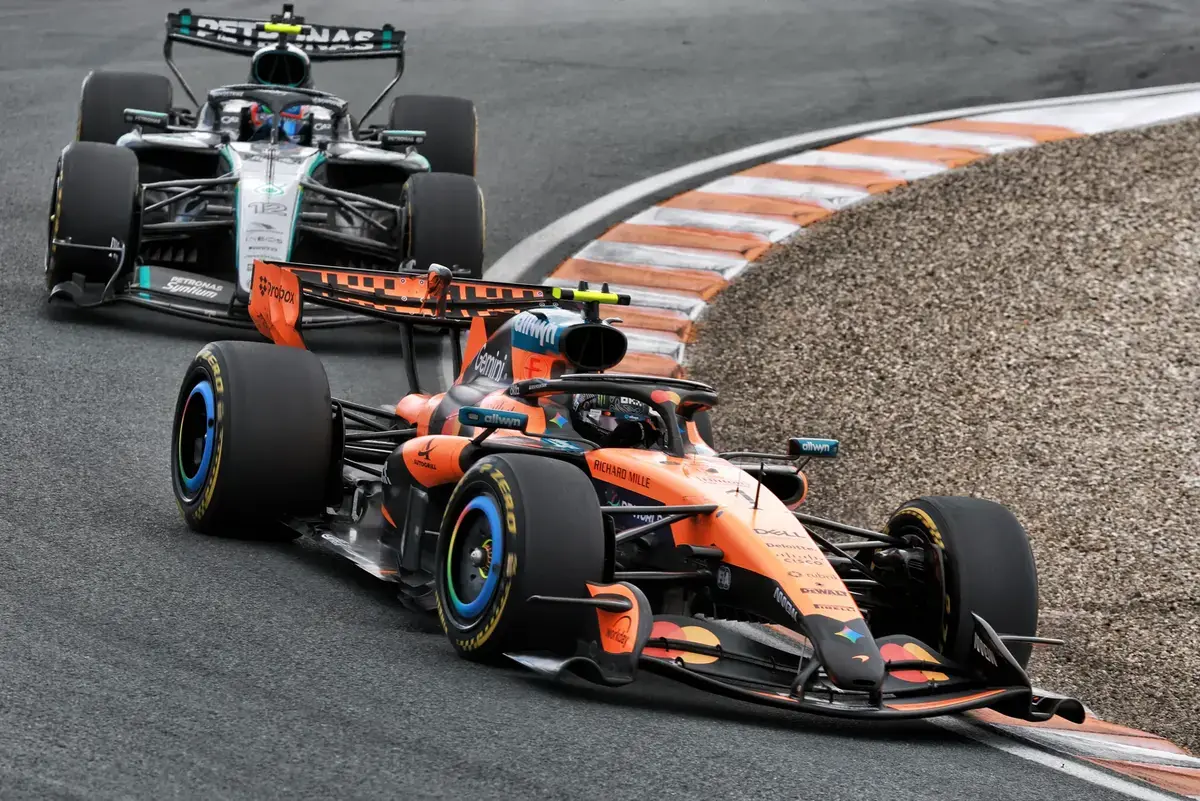

George Russell won Saturday’s Dutch Grand Prix sprint at Zandvoort, but the real story isn’t the podium, it’s Lando Norris standing on it and openly admitting his title-winning car has a hole in it that nobody at McLaren knows how to plug.
Third place should read as a solid recovery from a driver whose championship rival keeps banking points. Instead, Norris used his post-sprint interview to deliver one of the bleaker driver assessments you’ll hear all season, essentially conceding that McLaren’s slow-speed weakness is now a permanent fixture rather than a temporary bug.
The Admission That Should Worry McLaren
Norris kept Russell honest for the opening laps of the 24-lap sprint before fading badly, eventually losing second place to Charles Leclerc in the closing stages. Afterwards he didn’t reach for the usual diplomatic waffle about “areas to work on”. He went for something far more damning.
“Just don’t have the pace in general, especially the slow-speed corners. We just struggle so much compared to the others. There’s nothing we can do. The car’s very good in high speed, and it’s just nowhere near good enough in slow-speed.” – Lando Norris
That’s not a driver managing expectations. That’s a driver telling you, in plain English, that his team has identified a problem it cannot currently solve. For a reigning world champion sitting fifth in the standings on 128 points, some 91 behind runaway leader Kimi Antonelli, that’s not a throwaway line. It’s a confession.
Leclerc Knew Exactly Where to Strike
What makes Norris’s admission sting even more is that his rivals had already worked out the weakness before he’d finished explaining it. Leclerc’s overtake into Turn 1 on lap 18 wasn’t a lucky punt up the inside, it was a calculated strike on a known vulnerability.
“I knew Lando didn’t have much deployment on the main straight, so I knew I had to maximise that. But we still arrived at the braking point more or less at the same level, and it worked out.” – Charles Leclerc
Leclerc had gambled on soft tyres, one of only two drivers to do so alongside Haas’s Oliver Bearman, banking on those tyres surviving 24 laps rather than falling off a cliff. He admitted he expected the softs to pay off at the start, not the finish, calling it a case of “either very right or very wrong”. This time it was right, and Norris paid the price twice over: once to the tyre gamble, and once to a straight-line deployment weakness that had nothing to do with strategy and everything to do with the car itself.
Upgrades That Worked, Just Not Enough
Here’s the uncomfortable bit for McLaren: this isn’t a team that’s stood still. They brought a fresh round of updates to Zandvoort after winning in Hungary, and Norris was adamant those upgrades did exactly what they were designed to do. The problem is they were designed to fix medium and high-speed performance, not the slow-speed deficit that’s now been exposed at circuit after circuit.
Norris was refreshingly blunt about the limits of what an upgrade package can paper over. He suggested that if McLaren went back to Monaco, a circuit that’s essentially one long procession of slow corners, they’d be “just as shocking” as before. That’s not a hypothetical worry, that’s a driver mentally writing off entire race weekends before they’ve even happened.
The wider picture is that McLaren’s competitiveness now appears to be entirely track-dependent in a way title challengers can’t afford. Budapest suited them because it rewarded medium and high-speed characteristics. Zandvoort, with its tight, cambered, slow-speed corners, exposed the opposite end of the car’s window. A team fighting for a championship needs a car that’s merely competent everywhere, not brilliant in patches and hopeless elsewhere.
Why This Matters More Than the Result
Norris’s frustration wasn’t really about finishing third. It was about the manner of it: spending the sprint defending for survival rather than attacking for the win. As he put it himself, he wanted to be “fighting for top spot… rather than trying to survive in every slow-speed corner and fighting for my life.” That’s the language of a driver who knows the car beneath him isn’t currently built to win a title fight, no matter how well he drives it.
With Antonelli romping clear at the top of the standings and Mercedes dominating the constructors’ table, McLaren cannot afford a car with a known, unfixed weakness heading into the second half of the season. Fixing high-speed corners while slow-speed performance stagnates is like renovating the roof while the foundations crumble. It looks like progress. It isn’t.
The Bigger Question
So what happens now? McLaren has already declared its Zandvoort upgrades a success on their own terms, which conveniently allows the team to sidestep the more awkward question: what exactly is the plan for slow-speed corners, and how long will it take? Norris didn’t get an answer, and neither did anyone else. For a team that talked itself into title contention on the back of one strong weekend in Budapest, that silence should be more alarming than any single sprint result. Full Dutch GP sprint report can be found via our earlier coverage of Russell’s win at Zandvoort.
Qualifying for Saturday’s Dutch Grand Prix gets underway at 14:00 UTC, check the calendar for your local time, and it will offer the first real test of whether McLaren’s slow-speed problem is a Zandvoort quirk or, as Norris fears, simply how the car is “for the time being”.