
McLaren has finally stopped fiddling in the garage and committed to racing its rotating rear wing this weekend. It is called the H-Wing, it flips 180 degrees between cornering and straight-line mode, and it is arriving at precisely the circuit built for it. Convenient, that.
Let’s not pretend this is some flash of Woking genius. McLaren watched Ferrari roll out its own rotating wing concept during winter testing, quietly went away to build a version of its own, and is now presenting it at Monza as if it invented the wheel. It didn’t. It just built a nicer one, allegedly.
What the H-Wing Actually Does
The concept itself is straightforward enough on paper, even if the engineering behind it clearly isn’t. The wing rotates between two states: one for cornering, where it behaves like a normal rear wing generating downforce, and one for the straights, where it flattens out to cut drag. At a place like Monza, where the cars spend an eternity at full throttle with barely a corner to trouble them, shaving off drag on the straights is worth real lap time.
McLaren first brought a prototype to the Austrian Grand Prix but bottled the FP1 debut after running into an issue in the garage. Sensible, given what happened next door at Red Bull. The team then quietly tested a revised version during Hungarian Grand Prix practice, with reserve driver Leonardo Fornaroli running it on Oscar Piastri‘s car for a session of controlled aero and braking checks before it was stripped off again ahead of qualifying. McLaren boss Andrea Stella called that a “positive sign-off” at the time, which in team-speak means: it didn’t spin, didn’t break, and didn’t scare anyone. Bar has been set low in this department lately.
Why Monza and Why Now
Monza is the obvious venue for a device engineered purely to reduce drag. It is the lowest-drag circuit on the calendar, the one where teams strip wings bare and pray the straight-line speed holds up under braking. If a rotating rear wing is ever going to earn its keep, it is here, where every tenth in top speed genuinely separates grid positions rather than just looking impressive on a trace.
McLaren’s technical director Neil Houldey confirmed the team is going all in, running the H-Wing on both cars rather than tiptoeing in with a single-car trial.
“This weekend, we have brought what we believe is needed to be competitive, including a new low-drag rear wing specification, including the first use of our H-Wing, alongside some small aerodynamic and low-drag options that we will evaluate before deciding the final specification for qualifying.” – Neil Houldey
Translated from the technical director dialect, that means Monza gets the full toolkit and McLaren will spend practice figuring out which bits actually stay on the car come Saturday.
“Overall, we know there is still more performance to unlock from the MCL40, both through maximising the package we already have and through further upgrades planned for the races ahead.” – Neil Houldey
Reassuring for McLaren fans, mildly terrifying for everyone else given the car has just won the last two races.
About That Name
McLaren insists the H-Wing has nothing to do with Star Wars, despite what every fan on social media clearly hoped. Instead it nods to the letter H in the Etihad Airways branding plastered across the back of the MCL40’s rear wing, the same spot where the straight-mode actuator sits. It is a deliberate echo of the team’s famous F-duct from 2010, named after the F in the old Vodafone livery beside the nose. McLaren clearly has a soft spot for turning sponsor logos into engineering folklore. Fine, if a little self-congratulatory for a device that started life as somebody else’s idea.
The Cautionary Tale Sitting Next Door
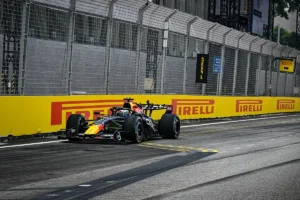
Ferrari brought the original version of this concept to pre-season testing, and Red Bull followed suit soon after. Red Bull’s experience should give McLaren some pause: the design was shelved following a series of high-speed spins for Max Verstappen. Nothing quite says “back to the drawing board” like your championship contender pirouetting down a straight at 300 km/h because a wing decided to have an opinion of its own.
That McLaren tested its version cautiously, first with a prototype that never even saw FP1 action, then with a controlled Hungary run using a reserve driver rather than either race driver, suggests the team has clocked the risk. Rotating aero devices sound elegant in a briefing room and considerably less elegant when they destabilise a car mid-corner at speed. McLaren clearly wants the benefit without the drama Red Bull got.
Perfect Timing, or Just Lucky
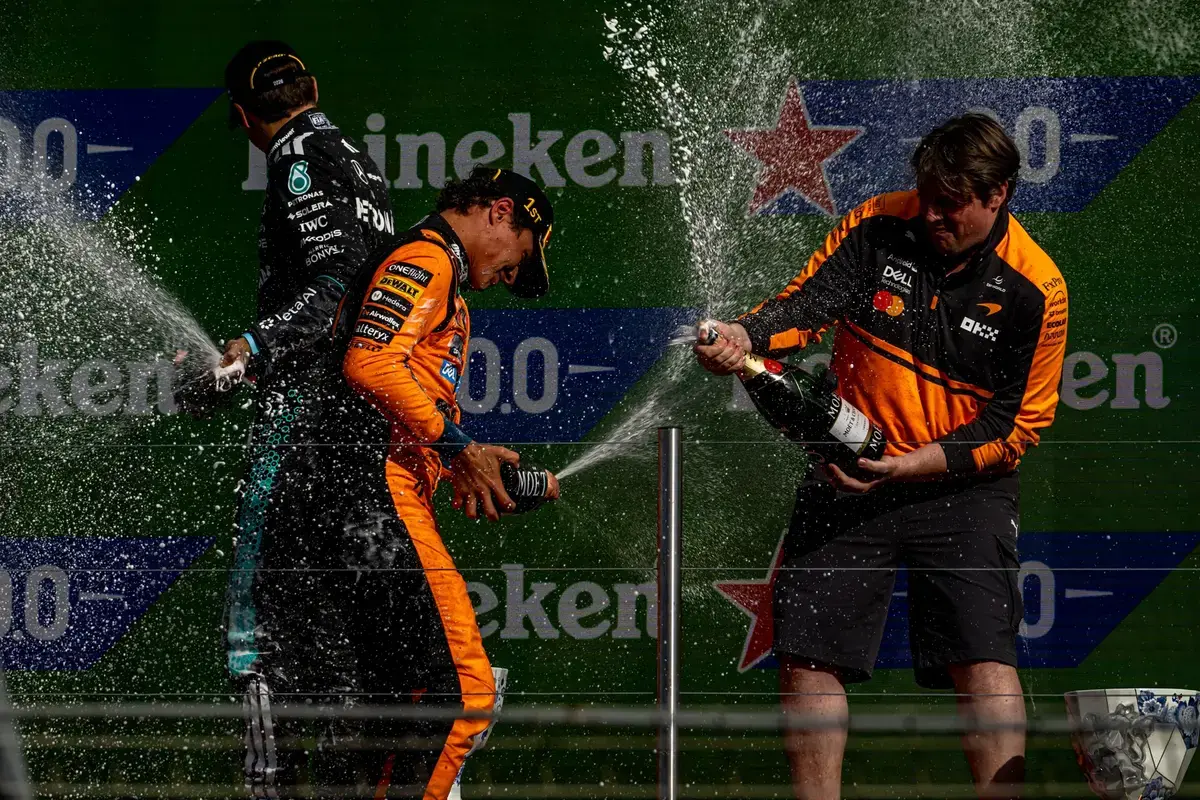
McLaren arrives at Monza on the back of consecutive wins for Lando Norris at the Hungarian and Dutch Grands Prix, both from pole, and sitting third in the constructors’ championship on 263 points, chasing Ferrari’s 338 and Mercedes’ 425. Norris himself trails championship leader Kimi Antonelli by 83 points with 11 races remaining, a gap that recent form is chipping away at, with Antonelli scoring 58 points to Norris’ 56 over the last three races.
Bringing a brand new, unproven aero concept into that kind of momentum is either shrewd or reckless, depending on how the weekend goes. If the H-Wing behaves itself and does what a low-drag rear wing is supposed to do at Monza, McLaren extends its advantage at the exact moment it matters. If it doesn’t, and Red Bull’s spin count is any guide to the risk involved, McLaren will have handed a gift to rivals who are only too happy to point out that copying someone else’s homework doesn’t guarantee a better grade.
McLaren will also run a tweaked livery at Monza and next week’s Spanish Grand Prix to promote its OKX partnership, which is the kind of detail nobody at the team will care about if the wing spits Norris into the gravel on Friday.