
Everyone assumes Lando Norris won in Budapest and Zandvoort because his car was quick and his tyres behaved. Andrea Stella says that’s only half the story, and the other half has nothing to do with a stopwatch.
McLaren’s team boss reckons Norris has quietly sorted out two specific weaknesses since his 2025 title triumph, and neither of them is about raw speed. One is understanding the car and the situation better. The other is how he works away from the garage, overnight, on the data, on himself. Stella thinks that combination is now the difference between Norris scrapping for wins and Norris simply taking them.
Two Wins, One Very Different Story
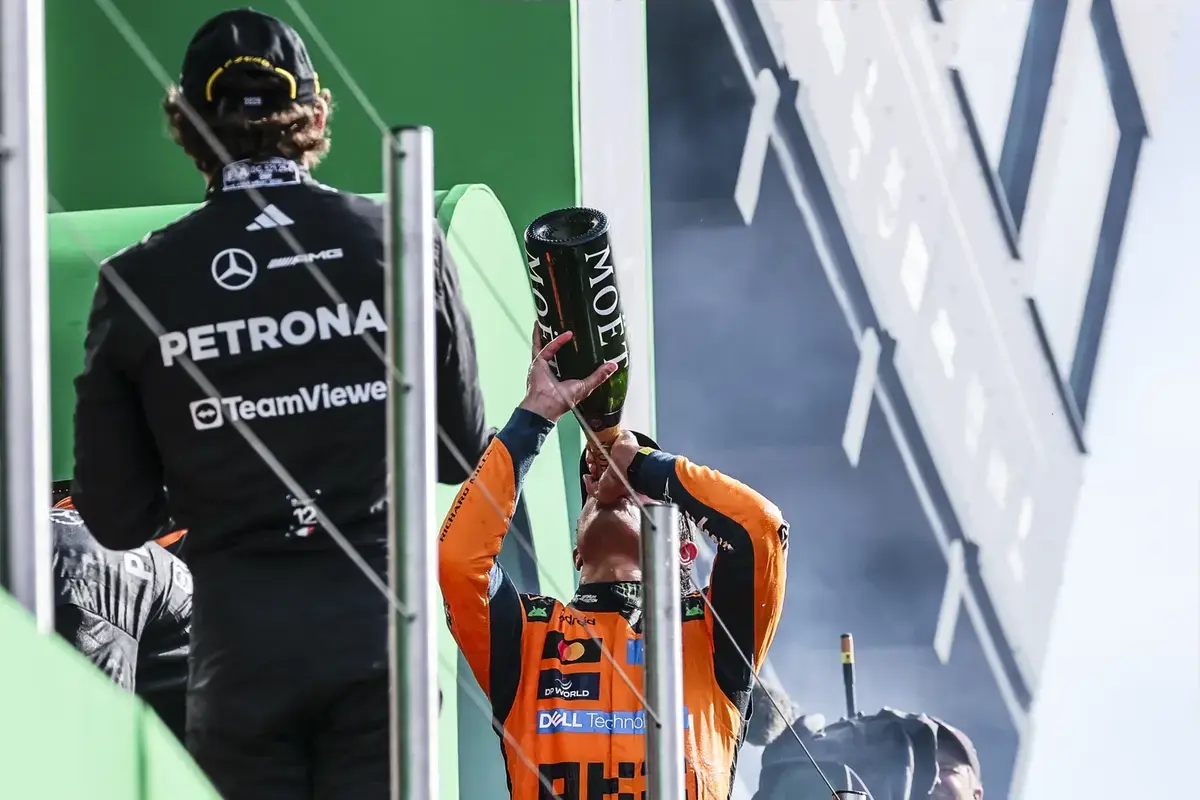
Lando Norris has strung together victories in Hungary and at Zandvoort, and on paper they look similar: Norris wins, championship gap narrows slightly, McLaren celebrate. Dig a little deeper and the two results were built completely differently. In Budapest, McLaren‘s straightforward pace advantage let Norris dispatch Oscar Piastri for the lead and vanish into the distance. At Zandvoort it was scrappier: Norris spent seven laps building a tyre delta before he could even think about attacking Kimi Antonelli, then had to actually execute the overtake once he got there.
That second win is the one Stella keeps coming back to, because it wasn’t handed to Norris. It was engineered, lap by lap, through tyre management that had nothing to do with outright pace and everything to do with patience and feedback.
Stella’s Two-Part Diagnosis
Speaking to media including PlanetF1.com after the Dutch Grand Prix, Stella was blunt about where he thinks Norris has genuinely levelled up since becoming champion.
“I think Lando is driving and operating at a very high level, in the absolute sense in relation to Formula 1. I think he’s driving at the level of a world champion.” – Andrea Stella
Stella isn’t handing out generic praise here, he’s pointing at a specific mechanism. He says something clicked for Norris around the start of 2025, and it wasn’t a one-off adjustment but a working method, one McLaren are now trying to transplant onto Piastri’s side of the garage as well.
“This approach has led Lando to continuous improvements. It’s almost like I see him getting stronger and stronger race by race, because I think this weekend was nowhere near a weekend in which we could fight for the victory for granted, especially after having seen the performance in the sprint.” – Andrea Stella
That’s a notable admission from a team boss. Stella is essentially conceding that McLaren shouldn’t have won at Zandvoort on pure competitiveness, and that they only got there because Norris and the engineers found something in tyre exploitation that the sprint result gave no hint of. Whether Piastri’s side of the garage found the same gains is, in Stella’s own words, still an open question, given the “question mark” he raised over the Australian’s second stint.
The Skill Nobody Puts on a Stat Sheet
Stella’s second point is the one that should worry Norris’s rivals more than any single lap time. He isn’t just talking about confidence, he’s talking about a driver who has apparently fixed a genuine technical weakness from a year ago.
“If we think back to the start of 2025, this had become a bit of a concern that he overcame. When you have conditions in which the car slides in the race, there’s not much grip, he is the master in these kinds of conditions.” – Andrea Stella
A driver who once struggled when the car got loose is now, according to his own boss, the best on the grid in exactly those conditions. That’s not a small shift. That’s the kind of gap that shows up in wet races, in tyre degradation battles, in exactly the sort of scrap Norris just won at Zandvoort.
Norris Agrees, and Explains the Boring Bit
Norris himself isn’t shy about confirming Stella’s theory, and he frames it in a way that sounds almost deliberately unglamorous. Forget car control masterclasses, he says the real work happens in meeting rooms and data reviews.
“I do believe I’m able to understand situations better, to understand the car in a better way. It’s still just horrible to drive, but I’m doing a better job at just understanding this, relaying this to my team, figuring stuff out.” – Lando Norris
He goes further, drawing a direct line between a specific qualifying session and the race that followed it, which is about as concrete an example as a driver ever gives for something usually dismissed as vague “improvement”.
“For me, yesterday to today is a perfect example of the work we put in overnight transformed our race and gave me the opportunity to win. So, the work we put in away from the track is certainly a huge part of that.” – Lando Norris
It’s a refreshingly honest admission from a driver who has previously been candid about his own self-doubt. Now the confidence has swung the other way, and Norris seems entirely comfortable saying so out loud.
Why This Matters More Than the Points Gap Suggests
Norris trails Kimi Antonelli by 83 points with 11 races still to run, a gap that no amount of overnight data crunching closes on its own. Realistically that number puts a second consecutive title out of reach barring a total Mercedes collapse. But Stella’s comments explain why McLaren aren’t treating these two wins as flukes squeezed out of a tightening midfield. They’re treating them as evidence that Norris has fixed something structural in how he operates, which matters regardless of where the championship maths ends up this year.
The uncomfortable subplot for McLaren is what happens on the other side of the garage. If Norris really has unlocked a working method that only he and his engineers currently use, and it’s now being ported over to Piastri “in particular”, as Stella put it, that’s an admission that Piastri has been operating at a disadvantage for a while now. McLaren can dress that up as progress. It also reads like confirmation that their second driver has been playing catch-up on something far more basic than tyre compounds.
None of this fixes McLaren’s wider issue, the slow-corner deficit to Mercedes that Norris himself has flagged as the real barrier to closing the gap. But it does explain why McLaren head into this week’s Italian Grand Prix weekend at Monza with more confidence in their lead driver than the raw points table would suggest. Improvement that happens overnight and away from the cameras is harder to quantify than a fast lap, but on this evidence it might be worth more.