
Lewis Hamilton has found the diplomatic way of saying what Ferrari fans have been shouting at their televisions for weeks: the car is good enough, the team keeps blowing it. Ask him what Ferrari needs to fix before it can seriously trouble Mercedes, and he doesn’t point at downforce or the power unit. He points at execution.
It’s a polite word for a repeated problem. Ferrari has built a car capable of winning grands prix, Hamilton and Charles Leclerc have both proven that this season, yet the Scuderia keeps leaving points scattered across the tarmac through slow pit stops, mistimed team orders and qualifying sessions that go sideways at the worst possible moment.
Buoyant Mood, Same Old Problem
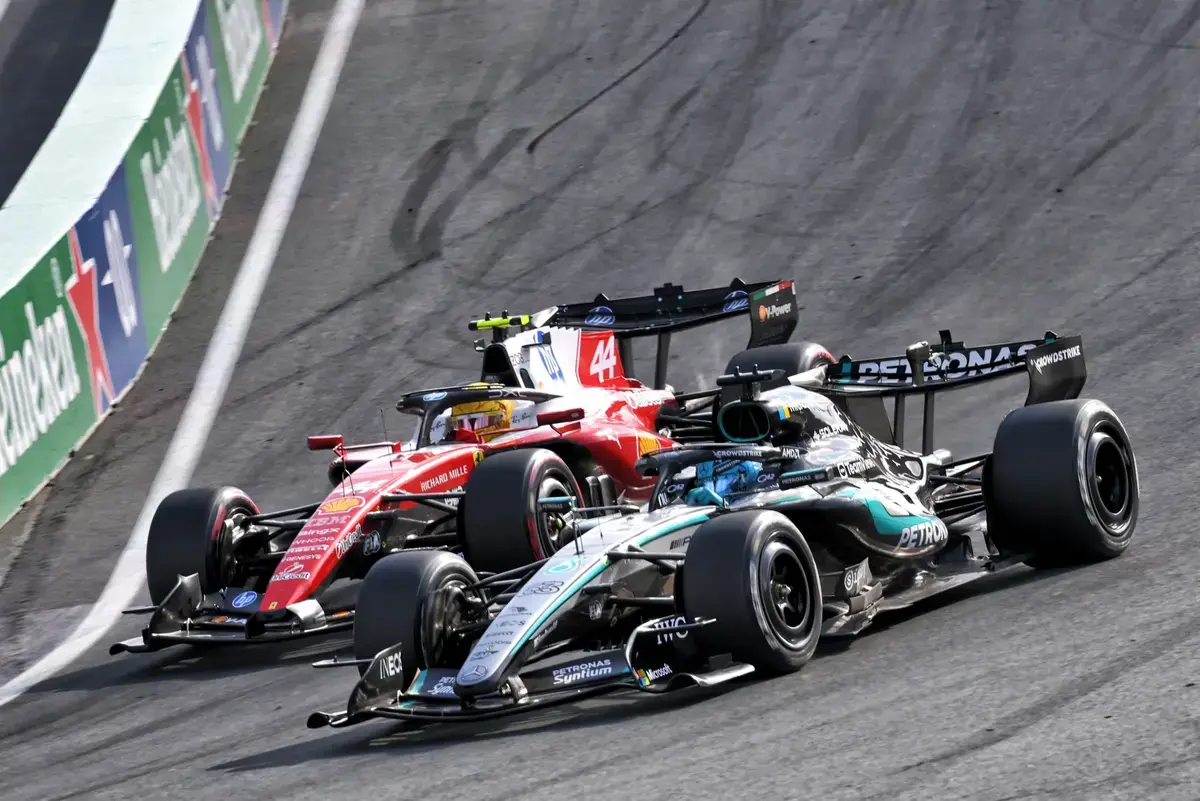
Speaking ahead of the Dutch Grand Prix, where Ferrari’s hesitant use of team orders put the spotlight firmly back on its operational shortcomings, Hamilton insisted morale inside the team remains high.
“I think everyone’s really buoyed up, everyone’s really focused within the team. There’s a lot of belief in the team, which is really amazing to see, and we’re continuously adding performance and pushing the car forward, so there’s not really much more that I can ask from [the team].” – Lewis Hamilton
Nice sentiment. But belief doesn’t win championships, and neither does bolting more downforce onto a car that then gets undone by a scruffy pit stop or a strategy call made two laps too late. Hamilton knows this, which is why the compliment came with a caveat attached.
“I don’t think I can ask for any more from the team, except we’ve just got to into the second half of the season and try to execute better.” – Lewis Hamilton
Translated from driver-speak into plain English: the car’s fine, now stop dropping the ball on Sundays.
Zandvoort Was the Evidence, Not the Exception
Ferrari’s struggles in this exact area came home to roost at Zandvoort, where Hamilton slipped to third in the standings, level on points with former Mercedes team-mate George Russell but behind him on countback of wins. Both now sit 59 points adrift of championship leader Kimi Antonelli, who has quietly turned Mercedes’ 2026 into a procession while the rest of the grid argues among itself over scraps.
Zandvoort wasn’t an isolated bad day either. Team principal Fred Vasseur admitted as much in comments to Motorsport.com, pointing to Hungary and the Netherlands as back-to-back weekends where Ferrari’s pace simply didn’t translate into results. In Budapest, Hamilton nearly took pole on a circuit that should have suited the SF-26, only for a poor start, a speeding penalty and sluggish pit stops to wipe out the podium chances for both him and Leclerc. In Zandvoort, Ferrari admitted it fell out of its tyres’ operating window in qualifying and then compounded it with more wasted opportunities in the race itself.
Vasseur’s own framing was blunt enough.
“If you want to be the champion, you can’t leave points on the table. We have to score the maximum number of points that we can.” – Fred Vasseur
It’s hard to argue with that logic when Ferrari sits 87 points behind Mercedes with 11 races still to run. A gap that size doesn’t get closed by hope and home-race enthusiasm alone.
Monza Won’t Forgive More Mistakes
The timing of all this self-reflection matters. Ferrari heads into its home race this weekend at Monza with an engine upgrade reportedly on the way, alongside the usual aerodynamic tweaks that have characterised its relentless development programme this year. New parts are the easy part. Turning them into clean weekends is where Ferrari keeps tripping over its own feet.
Vasseur was refreshingly candid about why 2026 has been such a minefield for every team on the grid, not just his own.
“It’s challenging this season because everything is new. Regulations, energy, tyres are different compared to last year, so it means that we have many more new questions on the table than we had last year, and it’s why we are all making more mistakes. But my job is also to minimise this number of mistakes.” – Fred Vasseur
Fair point, up to a point. Every team is wrestling with the new regulations, the energy management headaches and the tyre characteristics that have made 2026 such an unpredictable season. But Ferrari doesn’t have the luxury of blaming the regulations when McLaren is busy proving it’s possible to get this right. Lando Norris has taken back-to-back wins in Hungary and at Zandvoort, and McLaren’s own quiet development gains have turned it into a genuine threat rather than a plucky also-ran chasing the front two teams.
Vasseur even conceded the power unit itself remains a live variable, swinging performance by a lap-on-lap margin that can cost positions on the grid.
“The power unit is the key. From one lap to the other you can still have a swing of performance. It’s much less than what we had in China or Australia, where we were sometimes losing four, five tenths. Now we are losing one or two. But that’s four positions on the grid in Zandvoort.” – Fred Vasseur
Belief Won’t Close an 87-Point Gap
Hamilton’s diagnosis and Vasseur’s admission point at the same uncomfortable truth: Ferrari’s car is not the problem anymore, its inability to string together a clean weekend is. That’s arguably worse news for the Scuderia, because a car deficit can be engineered away with enough wind tunnel time and enough upgrades. A pattern of self-inflicted errors, repeated across multiple grands prix, points at something closer to a cultural issue, and those take longer than one home race to fix.
Monza offers Ferrari a stage, a passionate crowd, and reportedly fresh power unit parts to play with. What it won’t offer is any forgiveness if the pit wall fumbles another strategy call or the mechanics fluff another stop. With Norris breathing down Ferrari’s neck in the standings and Mercedes refusing to slow down, this is the weekend where “executing better” needs to stop being a soundbite and start showing up on the timing screens.