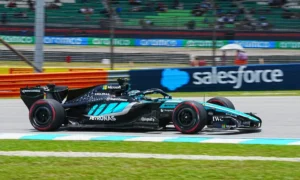
Lewis Hamilton didn’t claw his way from 17th to third in the Bahrain Grand Prix in Malaysia by sitting tight and hoping. The telemetry says otherwise: this was a calculated, brutally effective recovery drive built on tyre management that left the rest of the grid looking ordinary.
Ferrari’s decision to start Hamilton on slicks on a soaking track has already been picked apart elsewhere, including in our earlier piece on how he dropped to P18 after the slick tyre gamble failed. What matters now is what happened next, because the data from Sepang tells a story that has very little to do with fortune and everything to do with Hamilton simply driving better than everyone around him once the track turned in his favour.
The Numbers Behind the Collapse
Start the story where the data starts: at the green lights, roughly half the grid gambled on intermediates while the other half, Hamilton included, rolled the dice on slicks. The track surface was still visibly wet, but soaring ambient temperatures convinced several teams the racing line would dry out fast enough to justify the risk.
It didn’t. By the end of lap two the field had split cleanly in two, with the intermediate runners banking a commanding advantage while the slick-tyre gamblers, Hamilton among them, bled time at an average of around 15 seconds a lap. While Charles Leclerc cut his losses and pitted immediately, Hamilton stayed out, betting the track would dry before the damage became terminal. It didn’t dry anywhere near fast enough, and a Safety Car on lap nine let every driver still on intermediates swap to slicks at a fraction of the usual time cost. Hamilton restarted 15th, having given up ground he would then have to find all over again.
The Numbers Behind the Recovery
This is where the telemetry gets interesting. Once the track genuinely dried, Hamilton was running tyres far older than anyone around him and still carved through the field. By lap 22 he had gained ten positions to sit fifth behind Isack Hadjar, and once he hit clear air his pace only sharpened further.
Over the following laps Hamilton was matching the lap times of Kimi Antonelli, who was running medium tyres nine laps fresher, and trailing race leader Max Verstappen by only fractions of a second per lap. For a driver who had been 80 seconds off the lead at one stage, that is not a lucky break. That is a driver extracting everything a tyre has to give while everyone else is still working theirs in.
The track conditions help explain why those ageing softs held up so well. Track temperature during the race hovered around 34°C, roughly half what it had been in qualifying, which meant the long-run simulations every team had run in practice were effectively worthless. Teams repeatedly chose to keep drivers on worn soft tyres rather than fit fresher mediums or hards simply because the softs were faster in the conditions that actually turned up on Sunday.
Where the Recovery Stalled
Having avoided the pits entirely up to that point, Hamilton was forced to make a stop and ducked in on lap 32, rejoining on the medium compound. Hadjar pitted for fresh softs on the same lap, and the gap between the pair dropped below a second.
Across that medium stint Hamilton was losing roughly half a second a lap to Verstappen on average. Had he found a way past Hadjar sooner and kept his early pace, he would have been in position to have a proper go at George Russell, who was himself struggling to live with Verstappen and Antonelli up front.
The Second Safety Car Changes Everything
A second Safety Car gave the field another cut-price pit stop, and Hamilton used it to switch back to softs. His pace shot up immediately, and he dealt with Hadjar without much of a fight. Russell’s retirement then removed any prospect of a straight fight for the final podium spot, handing Hamilton third without having to throw a single late lunge.
Hamilton explained the thinking behind the strategy call that put him in this position. Speaking afterwards, as reported by Crash.net, he discussed the gamble on slicks.
“I went into the pit lane, I looked at the ground, I was like, ‘It’s still wet.’ I went to the pit wall and I was like, ‘It’s still wet.’ And they’re like, ‘Yeah, but because it’s been so long, it’s definitely going to dry up real quick and maybe we’re already in the crossover.'” – Lewis Hamilton
He was characteristically blunt about what he would tell the team in the debrief.
“Yeah… not going to the casino with the guys.” – Lewis Hamilton
Team principal Fred Vasseur did not try to dress up the call as anything other than a mistake, telling Sky Sports F1 that the split grid made the right answer genuinely hard to see from the pit wall but conceding Ferrari had landed on the wrong side of it.
“The choice of the tyres, you can discuss at length. But I think 50 per cent of the cars went for slick, 50 for inters, from the pit lane you don’t have the global picture of the track, and it’s not easy to understand what is the exact situation, but, for sure, we were on the wrong side.” – Fred Vasseur
Why This Kind of Race Suits Hamilton
None of this happens without chaos, and chaos tends to flatter exactly the kind of driver Hamilton still is. Strip out the tyre strategy and variable grip that defined Sunday and what is left is raw pace management under pressure, and that is precisely the terrain where a seven-time champion still has an edge over most of the grid. Conditions like Sepang’s reward feel and racecraft over pure car performance, which is why Verstappen and Fernando Alonso also had strong afternoons while others floundered.
Malaysia marked Hamilton’s seventh podium of the season, a result nobody would have predicted when he was 80 seconds off the lead and sliding backwards through the order. The recovery that followed was all his own doing.