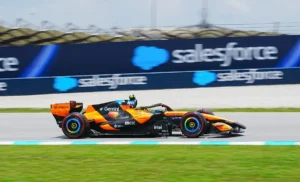
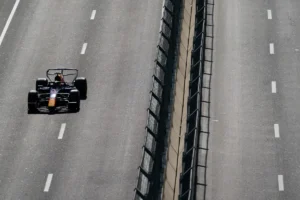
Lewis Hamilton started the Bahrain Grand Prix in Malaysia from the front row, alongside Max Verstappen. Within a handful of laps he was running 18th. That is what happens when you guess wrong on tyres at Sepang, and Hamilton guessed about as wrong as it gets.
A delayed start, then a worse one
The Sepang International Circuit already had one farcical delay behind it before a wheel had properly turned in anger. The race started an hour and 40 minutes behind its original slot after a thunderstorm rolled through, and then the formation lap itself had to be suspended after several cars, Hamilton included, ran into problems before the lights even went out. The formation lap chaos delayed the start.
Once the race finally did get going, the track was drying but still greasy enough that the correct tyre choice mattered more than anything that had happened in qualifying. Most of the field read that correctly. Hamilton did not.
The slick tyre gamble that blew up
Hamilton started on soft slicks, a call he shared with his Ferrari teammate Charles Leclerc, the Alpine pair of Pierre Gasly and Franco Colapinto, Haas’s Oliver Bearman and Cadillac’s Valtteri Bottas. Fourteen other drivers took intermediates. Lando Norris and Fernando Alonso split the difference on mediums.
It took about two laps for the gamble to look terminal. Every driver who had started on slicks was swallowed up by the intermediate runners, who scythed past with the kind of grip advantage that makes a mockery of raw pace. By lap eight Hamilton had been shuffled back to 18th, a brutal fall for a driver who had lined up second on the grid only hours earlier.
Leclerc at least had the sense, or the luck, to cut his losses. He pitted for intermediates and was quick enough on them to claw his way back past Hamilton despite the time lost in the pit lane, a small but pointed detail given the two started the race on identical rubber.
Verstappen profits while Mercedes leads
While Ferrari’s tyre call unravelled, Red Bull‘s Verstappen made the best of a scrappy opening himself. He was swamped off the line by the Mercedes pair of Kimi Antonelli and George Russell, but recovered to run second behind Antonelli once he had picked off Russell on track.
That sequencing matters because Hamilton did not simply lose ground to the cars that read the conditions correctly.
The plan Hamilton had going in
Before any of this unfolded, Hamilton had been refreshingly candid about what Sunday was actually going to take. Sharing the front row with Verstappen for the first time since the 2023 Hungarian Grand Prix sounds romantic until you remember that qualifying pace means almost nothing once the tyres start cooking on Sepang’s abrasive surface.
“I’m much happier with where the car is now, but tomorrow is a completely different story. It’s about keeping these tyres alive on this circuit.” – Lewis Hamilton
He went further on the thermal demands of the place, pointing out that the smallest mistake off the line gets punished instantly in these conditions.
“They’re overheating from the start. Every time you have wheelspin, every time the car steps out slightly, depending on the wind, it all makes a difference to how far you’re going to get.” – Lewis Hamilton
He also flagged, accurately as it turned out, that Verstappen’s long runs in practice looked ominous.
“I think we have a good balance. But Max was really fast on his long runs, so I’m going to do my best to try and hang on to him tomorrow.” – Lewis Hamilton
None of that preparation accounted for starting the race on the wrong compound entirely. You can manage tyre degradation all you like, but it is difficult to out-think a decision that puts you two tyre generations behind half the grid before the first corner.
Who else paid the price
Hamilton was far from alone in the fallout, which is some small comfort if none at all competitively. The full list of slick starters reads like a cross-section of the grid’s tyre gamblers: Leclerc, Gasly, Colapinto, Bearman and Bottas all made the same call and suffered broadly the same fate, dropping to the back as the intermediate runners carved through. Norris and Alonso were on mediums.
The sheer scale of the tyre split, with 14 drivers choosing intermediates against six on slicks and two on mediums, tells its own story about how marginal the decision really was. Reading a drying but still damp track correctly is one of the oldest tests in the sport, and on this occasion the majority of the field passed it while a chunk of front-runners, Hamilton chief among them given where he started, failed it spectacularly.
A front row squandered before the real race even began
Hamilton’s whole pre-race plan hinged on using his grid slot to apply pressure on Verstappen from lap one, backed by a tyre allocation that Ferrari believed gave him a genuine strategic card to play through the middle stints. Instead, he spent the opening phase of the race recovering from a decision made before the lights even went out, chasing back through traffic rather than hassling the man on pole. Slipping to 18th inside eight laps is the kind of result that undercuts the narrative before it has a chance to begin.