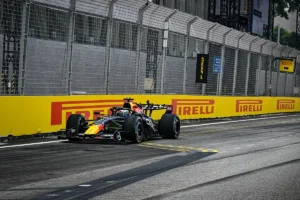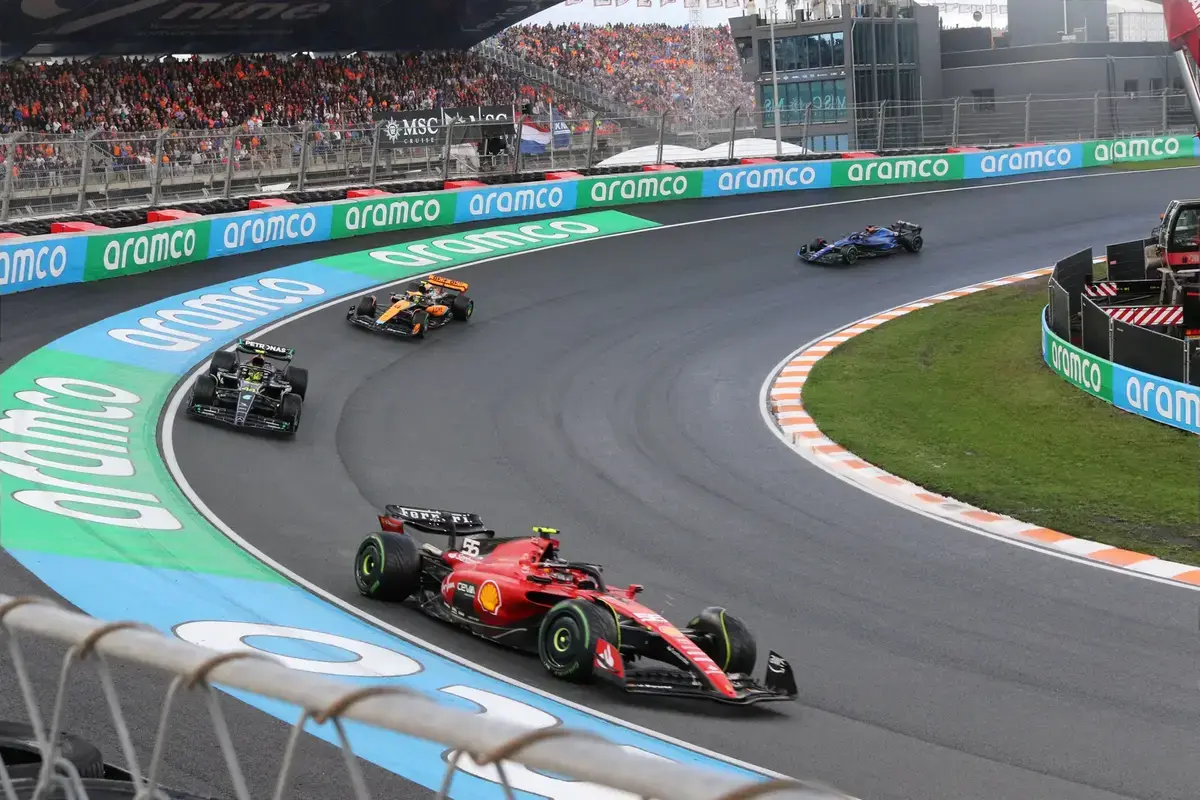

Zandvoort is already living on borrowed time in the Formula 1 calendar. The Dutch Grand Prix has no hosting contract beyond 2026, which makes this weekend’s race a farewell of sorts. And as if the occasion needed extra drama, the FIA has handed the circuit one of the most restricted active aero configurations of the entire season. Two Straight Mode zones. That is all.
What the FIA Has Actually Decided
The governing body has confirmed the layout for Max Verstappen‘s home race, and it is straightforward enough. Two Straight Mode (SM) zones will be in operation at Zandvoort this weekend. The first runs along the pit straight; the second sits on the straight between Turn 10 and the Turns 11/12 chicane. That is your lot.
The more notable detail, however, is what will not be permitted. In the old DRS era, drivers could open their rear wings through Zandvoort’s famous banked final corner, giving them a slipstream advantage heading onto the main straight. Under the 2026 active aero regulations, that is no longer allowed. Straight Mode will be deactivated through the banking entirely.
Drivers within one second of the car ahead will still be able to activate Overtake Mode on the banking itself, using a battery boost as they approach the pit straight. So the pursuit tool is still there; it has simply changed shape. Whether that produces the same effect as the old rear-wing deployment is a question that will be answered in qualifying and, more importantly, on race day.
Context: Fewer SM Zones Than Almost Anywhere Else
Two zones is not a lot. To put it in perspective, as reported by PlanetF1, this matches the Japanese Grand Prix at Suzuka as the joint-lowest SM count of the 2026 season, excluding Monaco where active aero was effectively banned altogether. Australia and Belgium led the way with five zones apiece; Britain, Hungary and Barcelona all had four. Zandvoort sits at the other end of the spectrum.
The reasoning, as always with SM zone allocation, comes down to safety. The FIA assesses each circuit individually and identifies the stretches where drivers can safely deploy active aero without creating unpredictable situations at high speed. Zandvoort’s layout, with its swooping high-speed corners and limited straight-line sections, simply does not offer many safe windows. The banked final corner is the obvious example of a section where speeds and lateral loads make open aerodynamic configurations a safety concern rather than a racing tool.
What It Means for Teams and Drivers
From a strategic standpoint, a circuit with only two SM zones places a greater premium on mechanical grip, downforce balance and tyre management rather than raw straight-line speed. Teams will not be chasing drag reduction at the same aggressive rate as they would at, say, Spa or Silverstone. Setup choices will tilt towards cornering performance, which historically favours cars with well-balanced aerodynamic platforms.
Overtaking, always a challenge at Zandvoort, is not going to become significantly easier under this configuration. The pit straight SM zone offers an opportunity, but one pass attempt per lap is a narrow margin. The Turn 10 straight gives a secondary option, but it feeds into a chicane that tends to neutralise any speed advantage fairly quickly.
For drivers already on the limit at a circuit that offers very little room for error, the removal of active aero through the banking is arguably a sensible call. But it does mean that the spectacle of watching a driver throw their car through the bankings with the rear wing open is now, like Zandvoort itself on the calendar, a thing of the past.
A Farewell Weekend With Added Significance
The timing of all this carries some weight. This is Verstappen’s final Dutch Grand Prix at his home circuit, a venue where he has won three times between 2021 and 2023 and has never finished lower than second in five attempts. He arrives this weekend without a victory in 2026, sitting sixth in the drivers’ championship with Red Bull fighting to recapture the form that once made them untouchable.
The sprint format adds another layer of complexity. Zandvoort hosts the fifth sprint event of the 2026 season this weekend, meaning teams face a compressed schedule with limited practice time to dial in their setups. Getting the active aero calibration right across both SM zones in a short window is a challenge, and mistakes in setup philosophy tend to be punished more harshly in sprint weekends where there is no time to recover.
McLaren have brought new rear upgrades to Zandvoort, which could prove particularly relevant given how cornering-oriented the circuit’s demands are under this year’s active aero rules. Lando Norris won here in 2024; his teammate Oscar Piastri took the victory in 2025. McLaren, it is fair to say, know this place.
The Bigger Picture
Strip back the sentiment about farewell races and home heroes, and the FIA’s decision on SM zones is a technical administrative call that will shape the tactical approach of every team in the paddock this weekend. Fewer overtaking opportunities generally mean track position matters more, strategy windows become more critical, and the safety car or virtual safety car can swing a race result dramatically.
It also serves as a reminder that the active aero era, for all its promise of more natural racing, is still a work in progress. Circuit-by-circuit zone allocation feels clinical and occasionally arbitrary to fans who simply want to see cars racing. Two zones at one of the most exciting layouts on the calendar, and none through the most visually dramatic corner, is a configuration that will produce its own kind of race. Whether it is a better race than the DRS era offered here remains to be seen.
Zandvoort deserves a proper send-off. Whether the regulations allow for one is the real question hanging over this weekend.