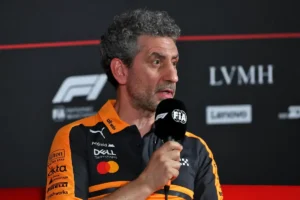
A year ago Audi’s pit crew could not be trusted to bolt a wheel on straight. Now they’re the quickest in the field, and the man responsible used to run Max Verstappen’s pit box at Red Bull. Funny how these things work out.
Audi racing director Allan McNish has confirmed what plenty had already suspected: the team’s remarkable pit-stop turnaround owes a great deal to Lee Stevenson, the former Red Bull chief mechanic who joined the Sauber/Stake operation in 2024 as it prepared for Audi’s works arrival this season. Stevenson has since been promoted into a team manager role that mirrors the one Jonathan Wheatley held at Red Bull, back when Red Bull’s pit crew was the benchmark everyone else was chasing, and briefly the outright world record holder before McLaren snatched it away with a 1.8-second stop for Lando Norris at the 2023 Qatar Grand Prix.
From Wheel-Nut Farce to Fastest in the Pit Lane
Context matters here, and it is not flattering to Audi’s recent past. Back in 2024, the Sauber operation that would become Audi was wrestling with a costly and embarrassing technical issue involving wheel nuts, the kind of problem that turns a routine pit-stop into a highlights-reel blooper. Fast forward to this season, and Audi set the fastest pit-stop at both the Dutch and Italian Grands Prix. That is not a minor stat. That is a team going from a laughing stock in the pit lane to the class of the field in roughly two seasons.
McNish did not dress this up as some mysterious alchemy. Asked about the Zandvoort and Monza performances, he went straight to the source, telling media including RacingNews365 that the wheel-nut saga was very much a 2024 problem, and one the team has since worked hard to eliminate.
“It was a technical issue; it was in 2024, actually, and it was the technical issue at that point. And this has been an area that’s been worked on really through the end of last year, beginning of this year. In terms of the team, so Lee, who came to us last year, middle of 2025, he’s got a good feel for what we needed to do.” – Allan McNish
Same People, Different Results
What makes this story more interesting than a straightforward personnel swap is McNish’s insistence that the personnel barely changed at all. The mechanics doing the stops now are largely the same ones who were fumbling wheel nuts not so long ago. The difference, in his telling, is process, feel, and leadership, not a wholesale roster clearout.
“At the end of the day, the team there is the same people pretty much, and they’re delivering it very, very well and consistently now. Because in Zandvoort, it was always the quickest as well, and also the other thing from my point of view, it’s not just necessarily one stop, but when we have multiple stops, all the stops are good, and so the team there are working very well.” – Allan McNish
That consistency point is worth dwelling on. Any team can land one blistering stop under perfect conditions. Landing the fastest stop every time, across multiple stops in the same race, is a different discipline entirely, and it’s the kind of repeatable excellence that used to be Red Bull’s calling card during the Wheatley years. Audi is essentially importing that culture wholesale, mechanic by mechanic, habit by habit.
Why It Actually Matters in the Midfield
It would be easy to file pit-stop times under trivia, but McNish was blunt about why this actually counts for something in the current midfield scrap. With Audi sitting on 16 points in the constructors’ standings and fighting it out with the likes of Williams and Haas rather than the frontrunners, every fraction of a second in the pits is a fraction of a second not spent defending against a chasing car with fresher tyres.
“That’s important for us as well because we’ve got to take every advantage out of the race that we can. It’s not as if there’s much of a delta in this midfield, and so they’ve definitely delivered the opportunity for the drivers to take more out of the race.” – Allan McNish
That is about as close as a racing director gets to admitting his cars aren’t fast enough to win on pace alone, so the team needs to find its margins elsewhere. Pit-stop time is one of the few genuinely controllable variables left once car performance is fixed for the weekend, and Audi appears to have worked that out before most of its rivals bothered to.
Building Rather Than Inheriting
McNish was careful, and probably rightly so, to push back on the idea that Audi simply inherited a slice of Red Bull’s old magic by hiring one man. The framing he offered was closer to a slow rebuild than an instant fix, which tracks with Stevenson having joined in the middle of 2025 and the improvement only becoming visible at Zandvoort and Monza this season.
“I wouldn’t say we inherited [Stevenson’s strengths], but I think we have developed it. But at the end of the day, that was one of the reasons that Lee came on board was to build the team within the garage.” – Allan McNish
“I think he and the team that’s in there have done a very good job. You just see them now, the way that they conduct not just the pit stops but also all of the work on the cars. It’s very good to see.” – Allan McNish
There is something almost quaint about a modern F1 team crediting a specific individual for a specific cultural shift, in an era when everything gets wrapped in phrases like “process” and “methodology”. McNish just says a bloke came in, knew what needed fixing, and fixed it.
A Small Win, but a Real One
None of this changes Audi’s position on the grid. They are still eighth in the constructors’ championship, still building, still years from troubling the teams that actually win races. But pit-stop excellence is not nothing. It’s the kind of marginal gain that turns an eleventh-place finish into a ninth, and eventually turns a rebuilding project into a team that other paddocks quietly respect. Red Bull spent years building a reputation as the gold standard in the pit lane. It’s a little rich, and more than a little satisfying for Audi, that the way they got there was by hiring the man who helped build it.