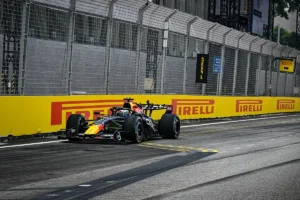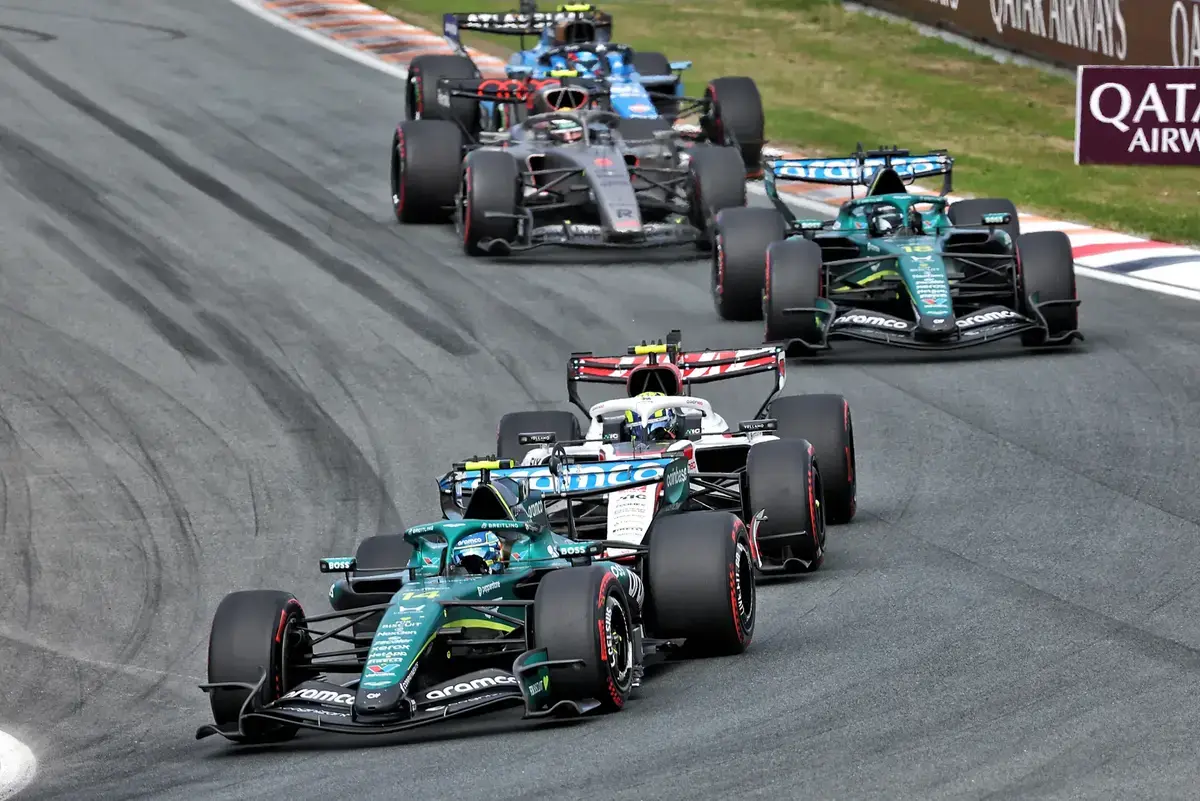

Aston Martin wants you to believe it has turned a corner. Fernando Alonso scored points, Honda’s new engine hit its internal targets, and everyone from Zandvoort onwards has been talking up three seconds of lap time found in the space of two race weekends. Sounds like a team on the up. Except Lance Stroll still thinks the car is a lottery, Honda itself admits it is nowhere near the top manufacturers, and the exact same problem kept coming up when drivers, engineers and the team principal were asked what needs fixing next.
That problem is driveability, and it is not some minor footnote. It is the difference between Honda’s engine doing what the driver actually asks for and the driver fighting the power unit corner after corner. Until that gets sorted, nobody, not Alonso, not Newey, not Honda’s own engineers, actually knows how good this engine really is.
The Numbers Look Good, Until They Don’t
Start with the positives, because there genuinely are some. Honda’s chief engineer Shintaro Orihara told The Race that the revised power unit ran reliably all weekend in the Netherlands, with cooling and lubrication behaving exactly as expected. Extra power is likely somewhere between 10 and 30bhp, though Honda is characteristically tight-lipped on specifics.
“We achieved our internal target from the dyno and then we have confirmed the same improvement trackside.” – Shintaro Orihara
Fine words, but Orihara didn’t stop there. He also admitted Honda is “still far away” from the sport’s leading manufacturers, and that there’s one glaring issue everyone in the paddock, including Honda itself, has now flagged as urgent.
“We know that there is room to improve our driveability and this remains paramount for us looking ahead to the next races.” – Shintaro Orihara
Translation: the engine can produce the numbers on a dyno, but getting that power to behave predictably on track, especially under braking, is another matter entirely.
What Driveability Actually Means (and Why It’s a Nightmare)
It would be easy to assume driveability is just about smooth throttle response. It isn’t. Under the 2026 rules, the engine has to seamlessly hand over from powering the rear wheels to acting as a generator for the MGU-K the moment a driver lifts off. Get that transition wrong and you get instability, unwanted understeer, or a gearbox that simply refuses to engage a downshift because the synchronisation isn’t there.
Orihara’s own explanation, relayed by The Race, gives a sense of just how fiddly this is: the MGU-K can be harvesting 350kW while engine torque and driver demand are heading towards zero at completely different rates, and all of it has to be synchronised in real time between the combustion engine, the battery and the brake-by-wire system. When the battery hits its charge limit mid-corner, the harvesting has to stop instantly, removing a chunk of deceleration force the driver was relying on. If that sounds like a recipe for cars behaving unpredictably at exactly the moments drivers need predictability most, that’s because it is.
The regulations have made this worse, not better. Batteries now account for roughly half the available power, so getting the harvesting phase right matters more than ever, and the loss of the MGU-H has taken away a tool manufacturers used to lean on to shuffle energy between systems without going through the battery at all. Add in Honda working with new fuel and lubricant partners in Aramco and Valvoline, and you have a manufacturer relearning combustion characteristics from close to scratch. Orihara’s blunt admission that “sometimes our combustion is not stable” says everything about where Honda currently sits.
Aston Martin’s Progress Is Real, Just Don’t Get Carried Away
None of this erases the genuine progress. Aston Martin started 2026 roughly 3.1% off the pace benchmark in qualifying, then got worse before it got better, slipping to more than 4% adrift at Barcelona, the Red Bull Ring and Silverstone as rivals developed faster than they did. Hungary brought the first real sign of life, with the upgraded chassis reaching Q2. Zandvoort was better still, Alonso within 1.4% of the benchmark in Q1 despite getting stuck behind Esteban Ocon on his outlap.
Alonso’s own verdict, delivered with the sort of dry satisfaction only a driver who has spent a season and a half near the back of the grid can muster, was blunt.
“We improved three seconds in two races. This is amazing.” – Fernando Alonso
It is a fair point, and a useful reminder of how far Aston Martin had fallen before this uptick. But let’s not pretend ninth place in the Netherlands was some statement of intent. It owed plenty to an opportunistic one-stop strategy as much as raw pace, and Alonso himself struggled to say how much of the gain was down to Honda’s new engine versus circumstance, precisely because the driveability issues are masking the engine’s true potential.
Honda’s Homework, and Monza Looming
There’s no quick fix here. Honda used Friday data at Zandvoort to rework calibration overnight at its Sakura base, producing a genuine step forward for qualifying on Saturday. Orihara admitted it still wasn’t “enough for the drivers”, but progress is progress, and further calibration work is planned before the Italian Grand Prix, which arrives next week rather than this one, with practice getting under way on Friday 4 September at 10:30 UTC, check the calendar for your local time.
Monza is not an obvious friend here. It is one of the most power-sensitive circuits on the calendar, exactly the kind of track where driveability shortcomings under hard braking and traction zones get punished rather than hidden. Alonso reckons there are “a couple of tenths” still to find if Honda optimises everything, which would be enough to put Aston Martin into the regular points fight rather than relying on strategy gambles. Whether Monza is the place that happens remains to be seen.
Wheatley’s Return and Newey’s Exit Door
While Honda works through its combustion headaches, Aston Martin’s off-track soap opera rumbles on. Jonathan Wheatley, who quit Audi within 48 hours of being outed as Aston Martin’s prime team boss target, resurfaced in the paddock at Zandvoort for the first time since walking away from his previous job. He was spotted heading into the Alpine hospitality unit, reportedly just to catch up with his old colleague Steve Nielsen, as detailed by PlanetF1.com, though nobody in the paddock believes his reappearance is entirely coincidental.
Wheatley remains the strong favourite to eventually take over from Adrian Newey, who never actually wanted the team boss job in the first place and has been open about the toll it has taken. Newey, who turns 68 in December, admitted earlier this year that the management workload had eaten into the time he’d rather spend on car design, and that a difficult period with his health meant he had to “balance health and work much more carefully.”
Zandvoort marked Newey’s fifth trackside appearance of the season, having missed four races after Australia before returning in Monaco. Read between the lines and it’s not hard to see where this is heading: a designer who wants to design, a candidate lurking suspiciously close to the paddock, and a team that would very much like to sort its leadership structure at the same time it is trying to sort its engine.
The Verdict
Aston Martin has found three seconds, Honda has hit its dyno targets, and everyone is talking a good game. But “still far away from the top manufacturers” is not a phrase any team wants attached to its engine partner two thirds of the way into the season, and a car both drivers describe as unpredictable is not the platform on which title challenges are built. Progress is progress, but let’s not confuse a good weekend at Zandvoort with a problem actually solved. Ask again after Monza.