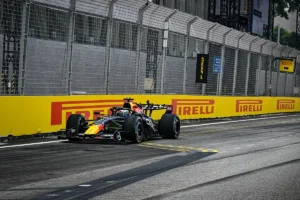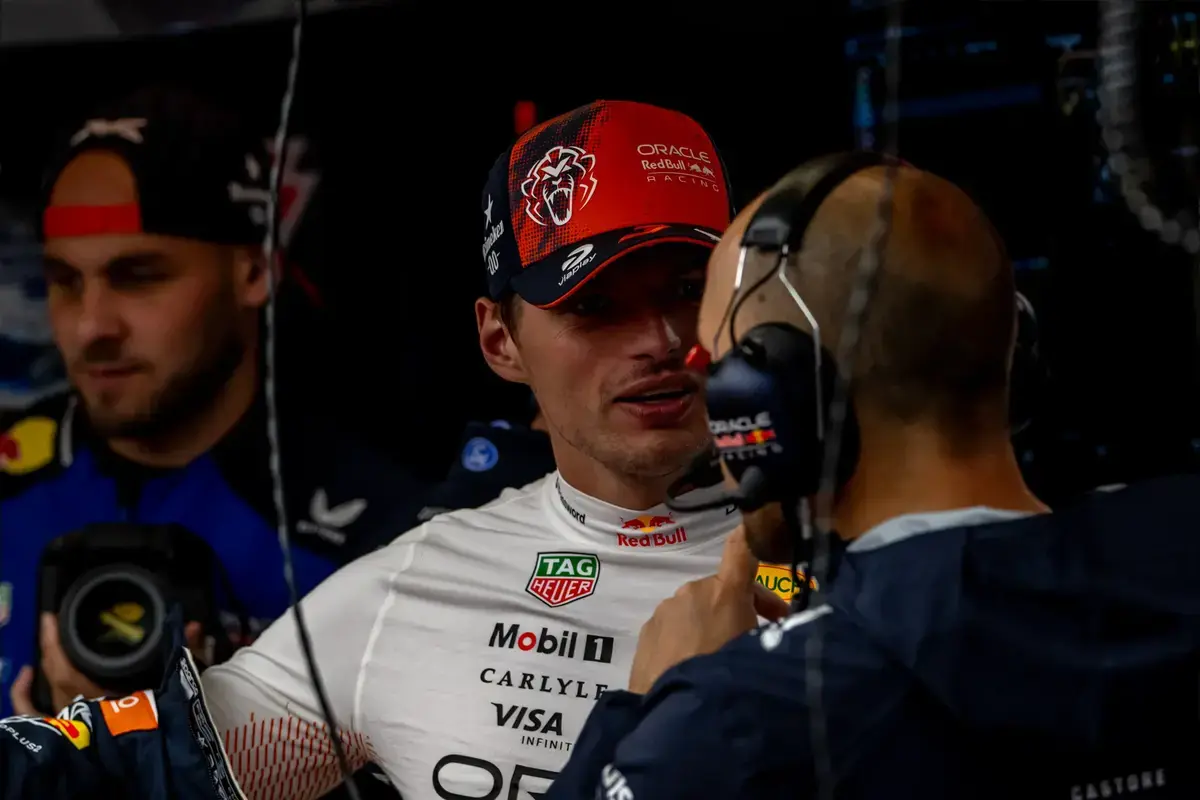

The FIA has confirmed what everyone already suspected: Red Bull has the best internal combustion engine on the 2026 grid. What it has not confirmed is almost everything else, and that silence is now Red Bull’s biggest problem heading into the run of races that will decide its season.
Red Bull’s power unit was rated the benchmark after the first ADUO assessment window, a verdict that leaked out of Monaco within minutes and left Red Bull fuming behind closed doors. The second review period has now come and gone with zero change to the token allocations, which on paper sounds like reassuring stability. In practice, it means Red Bull remains the only manufacturer banned from touching its engine for the rest of the year, while its rivals keep collecting development tokens and free cost cap money simply for being slower.
What the FIA actually confirmed, and what it didn’t
Here is the entire substance of this week’s announcement: Mercedes stays in the 2-4% deficit bracket, earning one upgrade token this year and another for 2027. Ferrari, Audi and Honda remain more than 4% adrift, netting two tokens apiece in each period. That’s it. No percentages, no rankings between the chasers, no explanation of methodology beyond a single line insisting the findings are “incredibly robust”.
The FIA’s justification is that the performance index data is commercially sensitive, which is a reasonable position right up until you remember this data determines who gets free money and who doesn’t. As Autosport reports, sources close to the process believe the underlying order has barely shifted since Monaco, but that is an educated guess stitched together from token allocations and engine introductions, not anything the FIA has actually stated. Nobody outside the manufacturers themselves knows the real gaps. That is either admirably discreet or a governance black hole, depending on how charitable you’re feeling.
The maths nobody can check
Because tokens aren’t cumulative and cap out at two, a manufacturer can shift several percentage points within a bracket without anyone on the outside noticing. Mercedes could theoretically now sit anywhere between 1.99% ahead of Red Bull and 3.99% behind it, and the token count would look identical either way. Ferrari’s Austria upgrade could, in theory, have vaulted it ahead of Red Bull on outright ICE power without triggering any change in its homologation allowance, provided Mercedes stayed inside its own bracket too.
Nobody, Red Bull included, can prove which of these scenarios is true. That’s the uncomfortable bit. The FIA is asking the paddock to trust a measurement system it won’t show its working for, on a metric that decides who gets to develop their engine and who gets to watch from the sidelines.
Red Bull’s problem isn’t the engine, it’s the electronics
Here’s the part that should really irritate Red Bull: ADUO only measures the internal combustion engine, yet the upgrade tokens it hands out cover the entire power unit, hybrid systems included. Toto Wolff has happily admitted Mercedes has the strongest overall power unit in F1, largely thanks to its electrical deployment. Red Bull’s ICE might be the best in the business, but its energy recovery and deployment are reportedly lagging, and because the FIA’s benchmark says its combustion engine is untouchable, Red Bull is banned from fixing the bit that’s actually costing it.
Team boss Laurent Mekies has argued there is “not a single data point” proving Red Bull’s engine is genuinely the best, pointing to real-world deficits at power-sensitive circuits. The FIA’s response, delivered by single-seater director Nikolas Tombazis, was essentially: the numbers are the numbers, and energy management issues are a separate problem the ranking was never designed to capture. Both things can be true simultaneously, which is precisely why this system generates more heat than light.
How Red Bull talked itself into this trap
The delicious irony is that Red Bull helped build the cage it’s now rattling. When the rules were drawn up last year, manufacturers reportedly resisted folding championship position into the ranking, and Red Bull was among those pushing to keep it simple and ICE-only. At the time that made sense: a newcomer with an unproven chassis didn’t want to be punished for early points if the car turned out ordinary. Instead the car has been patchy while the engine has been strong, so the metric that seemed like a safety net a year ago is now the rope around Red Bull’s neck.
Tombazis has conceded the system needs “evolving” and admitted to reviewing whether turbo size and other design choices should be factored in, something Ferrari in particular would rather avoid given its smaller turbo was a deliberate strategic call that ADUO now lets it fix for free. But changing the rules requires manufacturer consensus, and right now Mercedes, Ferrari, Audi and Honda are all quietly benefiting from Red Bull’s benchmark status. Turkeys, meet Christmas.
What happens next, and what still doesn’t add up
The third ADUO window runs until the United States Grand Prix, with Ferrari’s next engine step expected around the Italian Grand Prix at Monza, a circuit that will properly stress-test any hybrid gains given how little braking and energy harvesting there is around Monza’s flat-out layout. If Ferrari’s new spec, or Honda’s Spec 2, closes the gap meaningfully, Red Bull could finally earn a token. If not, it stays frozen out until the winter, unable to develop an engine that on paper is the best in F1 but in practice can’t be turned into consistent race results.
What lingers after all this is not confidence in the system but a pile of unanswered questions. How close is Mercedes really? Has Ferrari’s upgrade already closed more ground than the token count suggests? Is Red Bull’s advantage shrinking silently within its own bracket while everyone assumes nothing has changed? The FIA insists its measurements are robust, but robust and transparent are not the same thing, and right now Red Bull is being asked to accept a verdict it can neither verify nor appeal, based on data it will never see, judged by a metric it agreed to when the incentives pointed the other way.
A system built to help the strugglers, hurting the wrong team
ADUO was conceived to stop Honda-style disasters from dragging on for years. Instead it has become a mechanism where the sport’s dominant chassis manufacturers, currently Mercedes and Ferrari up front in the standings, keep collecting free upgrade tokens and cost cap relief while the team with the best combustion engine sits on its hands. Red Bull’s championship position, currently fourth with Max Verstappen a distant sixth in the drivers’ standings, only reinforces how little correlation there is between “best engine on paper” and actually winning races.
Nobody in the paddock seriously believes the FIA fabricated its numbers. But refusing to publish methodology while handing out financial and developmental advantages worth millions is not a footnote, it’s the whole story. Red Bull agreed to a system that has quietly turned its greatest strength into a liability, and until a rival stumbles or the rules get rewritten, that is exactly where it will stay: officially the best, and completely unable to prove or improve it.