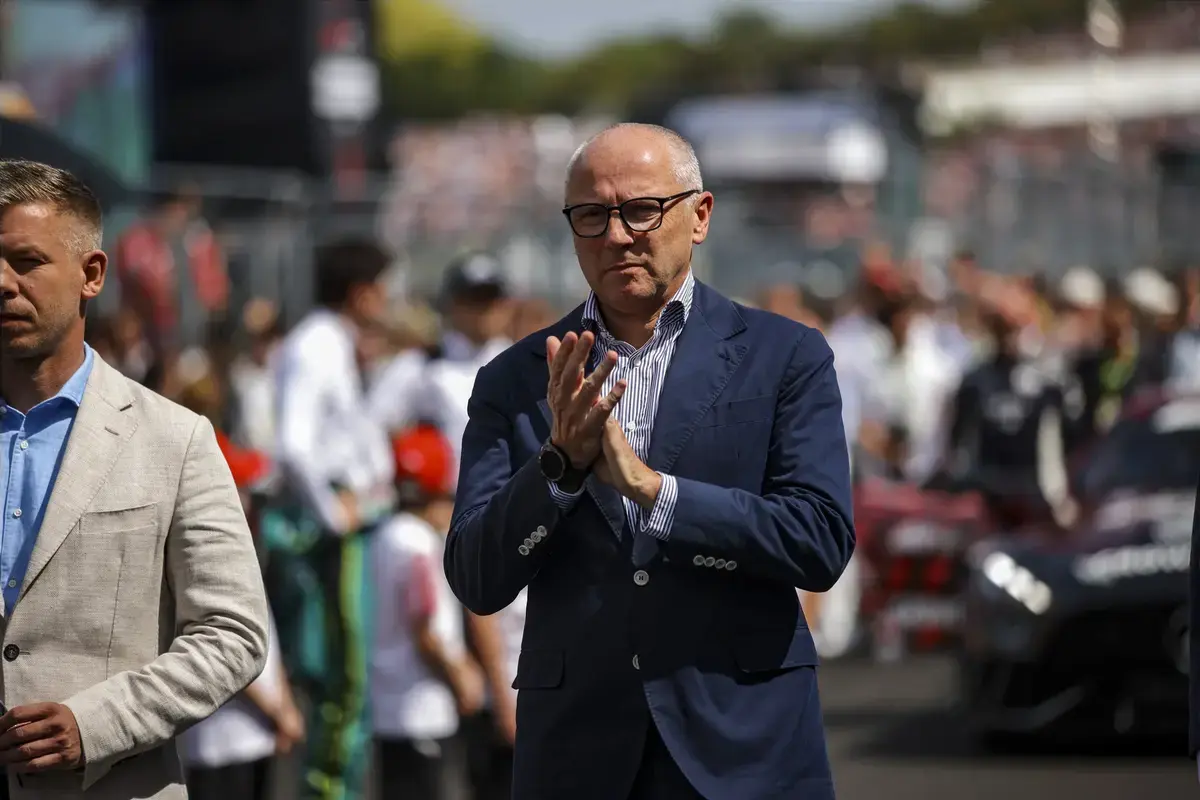

Stefano Domenicali has a message for the F1 fans who want to understand why overtakes actually happen: stop asking. The Formula 1 CEO has come out swinging against demands for battery state-of-charge graphics on broadcasts, insisting that nobody really cares how a driver operates their car. Quite the take, given the 2026 regulations have made energy management the single biggest performance differentiator on the grid.
The Star Wars Defence
To be fair to Domenicali, he did not just wing this position. He consulted a Hollywood director. Specifically, Star Wars creator George Lucas, who was present in Hungary and apparently provided the F1 boss with a revelation about what modern fans actually want.
“I had an incredibly interesting discussion with George Lucas on Saturday. He gave me an incredible view on how new fans are watching Formula 1. They are fascinated by the fact that there is a lot of action.” – Stefano Domenicali
With all due respect, George Lucas also made the prequel trilogy. His read on what audiences want is not always infallible.
Calling Your Core Fans a Niche
Domenicali’s argument boils down to this: the majority just want to see overtakes. The fans who want to know why an overtake happened are a “niche”. He cited the Max Verstappen move on Lewis Hamilton at Turn 1 in Hungary as a piece of art that viewers should simply appreciate without context. But how much of that move was Verstappen’s late braking, and how much was Hamilton conserving battery on the run to the corner? We are apparently not meant to ask.
“No one is interested in how you drive your car. The people are interested in whether you are overtaking or not.” – Stefano Domenicali
The problem is that with 47% of power coming from electrical motors in 2026, “whether you are overtaking” is directly and visibly tied to battery deployment. Removing that information does not simplify the product; it obscures it. As Ferrari’s own drivers have admitted the SF-26 makes no sense to even them at times, expecting fans to follow the action blind feels a touch optimistic.
The Drivers Are Not Exactly Thrilled Either
It is worth noting that this dismissal of technical complexity comes at the same time as Verstappen and others continue to voice frustration with the regulations themselves. Domenicali says drivers are free to criticise, but adds pointedly that “the more you are vocal on certain things, the more the negativity becomes personal”. Make of that what you will.
Following the Money, Not the Fans
Domenicali points to F1’s own Fan Voice data showing 66% of respondents rated 2026 races as good or excellent, up from 60% in 2025. Fine numbers. But a panel of 60,000 self-selecting fans is not the same as a transparent audit of what your most engaged audience actually wants. Removing data that helps people understand a fundamentally complex product is not simplification; it is dumbing down by design. If the regulations are going to remain this reliant on energy strategy, hiding the battery graphic is not protecting casual fans; it is protecting the narrative that the racing is straightforward when it clearly is not.
Domenicali’s instinct to chase new audiences is commercially sound. But treating your knowledgeable fanbase as an inconvenient minority to be managed rather than served is a strategy with a long and ugly track record in sport. Ask any rugby union administrator how that went.