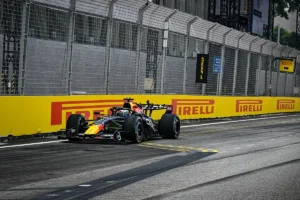

Mercedes wins seven of the first nine grands prix, and the reward for everyone else? Mercedes gets engine upgrade tokens. You genuinely could not script this. The ADUO scheme, Formula 1’s supposedly clever catch-up mechanism for power unit manufacturers, has produced a result so absurd that even Mattia Binotto, a man who chooses his words carefully, is calling it out publicly.
What ADUO Was Supposed to Do
The logic behind ADUO was simple enough. With 2026 power unit regulations effectively frozen for years, any manufacturer that fell badly behind at the start of the cycle risked dragging that deficit all the way to 2030. The system would give laggards additional development tokens to close the gap, mirroring the wind tunnel time allocation that already exists for chassis performance. A sensible safety net, in theory.
In practice, the FIA measures only V6 internal combustion output to determine who qualifies. The hybrid component, which contributes roughly half of total power, is ignored entirely. Red Bull‘s Ford V6 was declared the benchmark, locking it out of further improvements. Mercedes, whose overall power unit is widely regarded as the strongest on the grid, was handed upgrade room anyway. Honda, the manufacturer that arguably needs help most, is left scrambling.
Binotto Names the Problem Directly
Audi’s team principal did not mince words on where the flaw lies.
“In my opinion, the limit has been that it has exclusively measured performance on the track. A car with an overall advantage can afford not to fully exploit the potential of its power unit. It’s possible, for example, that Mercedes had an engine with superior potential, but had no need to push it to the limit because it already had an advantage thanks to the car. If that were the case, it could have also gained additional development margin.” – Mattia Binotto
It is a pointed accusation wrapped in diplomatic language. If a team leads every race by a comfortable margin, there is zero incentive to run the engine flat out. Lower measured output equals upgrade tokens. The system practically rewards restraint from the dominant team.
The Manufacturers Wrote This Rule Themselves
Here is the part that deserves more attention. The FIA actually wanted a more comprehensive measurement system, incorporating factors like turbo pressures and operating temperatures. The power unit manufacturers collectively vetoed it, insisting on simplicity. As FIA Single-Seater Director Nikolas Tombazis confirmed, the V6-only metric was the manufacturers’ choice, not the FIA’s preference.
So the teams most likely to benefit from a flawed system were involved in designing that very flaw. Convenient.
A Sliding Scale Built on Sand
The ADUO sliding scale grants upgrade tokens for every two percent a V6 falls short of the benchmark, which is a vanishingly small margin. Worse still, once a manufacturer qualifies, they can overhaul virtually the entire power unit, including hybrid components, not just the V6 that triggered eligibility. The scope for whole-unit improvement under the guise of V6 catch-up is considerable. Red Bull has contested the FIA’s findings, but the team’s year has already been defined by frustration, and the governing body has not shifted its position.
Meanwhile, Mercedes has signalled no urgent need to deploy its upgrade allocation, which, if Binotto’s reading is correct, rather proves his point.
A System That Needs Fixing Before 2027
Binotto is not questioning the FIA’s data. His concern is more fundamental: the original intent has been lost. A safety net for genuine backmarkers has morphed into something that can benefit a team already standing comfortably at the front.
The manufacturers who demanded simplicity in 2025 should perhaps reflect on how that simplicity is playing out. The FIA wanted complexity for a reason. Nobody listened. Now the sport is left with an upgrade system that appears to punish success on one metric while rewarding a very different kind of cleverness entirely.