
Toto Wolff had his finger hovering over the panic button at Monza, and he is not shy about admitting it. Mercedes let Andrea Kimi Antonelli and George Russell race each other for the lead with no team orders in sight, and it very nearly blew up in spectacular fashion at the Rettifilo chicane.
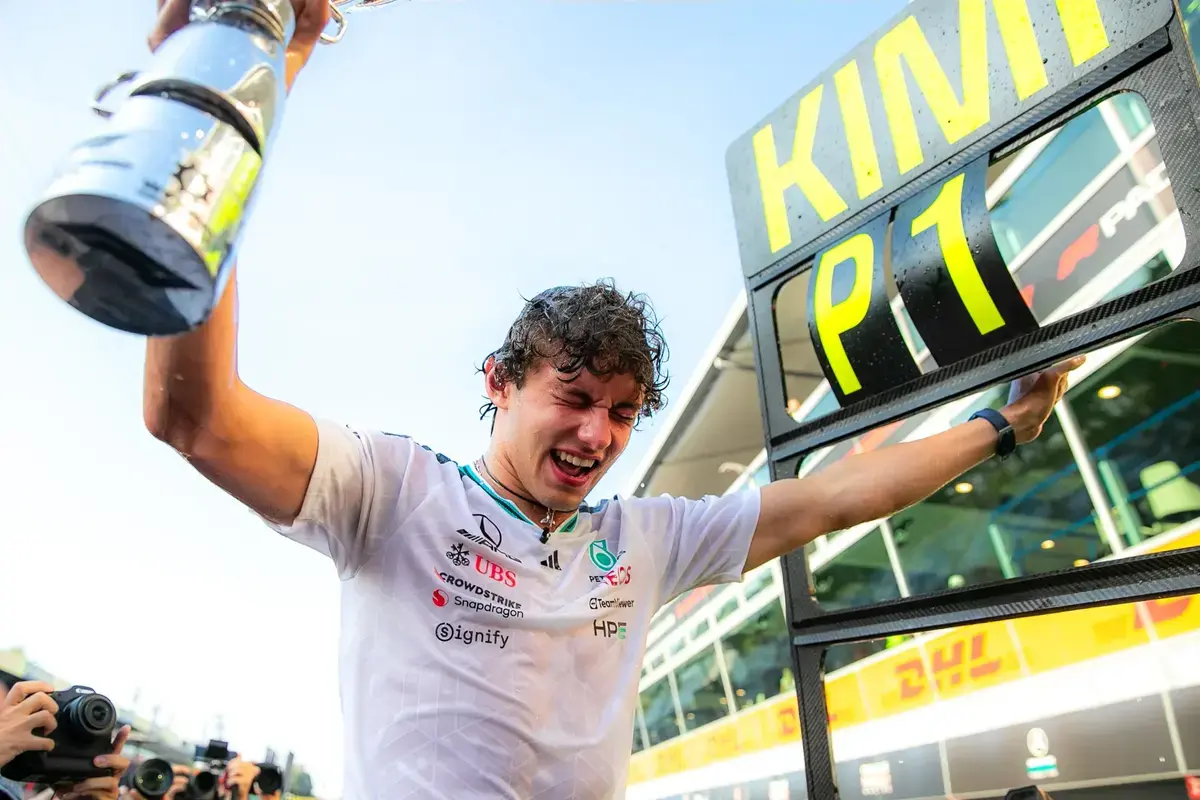
Kimi Antonelli won that race from 19th on the grid, a story already told in full elsewhere. What has not been told is quite how close Mercedes came to turning a famous victory into a punchline, and how close Wolff came to stepping in and killing the fight altogether.
The Moment That Nearly Ended It All
With a handful of laps to go, Antonelli caught his team-mate again after an earlier pit stop under the virtual safety car had briefly separated them. What followed was not a clean, textbook pass. Russell tried to hold his line through the corner without cutting it, Antonelli found himself on the dirty side of the track, ran onto the marbles, and speared straight on into the gravel trap.
It could have gone horribly wrong. It did not. Antonelli somehow extracted the car and completed what turned into, by comparison, a far simpler overtake soon after. Wolff was not applauding the escape act so much as wincing at what might have been.
“The last incident was unfortunate. George tried not to cut the corner, and Kimi then, obviously, on the marbles went straight, and that could have ended up in a disaster when it comes to the race result, and we would have been like idiots.” – Toto Wolff
That is about as close as a team principal gets to admitting his drivers gambled with the result and got away with it. Had Antonelli beached the car rather than powered out of it, Mercedes would have handed away a home win, a 1-2, and a chunk of championship credibility, all because nobody upstairs pulled the trigger on team orders. Wolff knows it, and to his credit he is not pretending otherwise, as first reported by Crash.net.
The Button Wolff Never Pressed
Mercedes insists it runs two number ones rather than a clear hierarchy, and generally lets its drivers race. Fine in theory. Rather more nerve-shredding in practice when both cars are trading the lead of an Italian Grand Prix multiple times a lap, with Max Verstappen sat right behind waiting for either of them to make a mess of it.
Wolff revealed he was seconds from intervening, ready to radio both race engineers and tell his drivers to back off.
“We were thinking it’s clean, but it’s a bit close, and I had my finger on the button, to Marcus, to Bono, to Kimi, to George, but didn’t push it.” – Toto Wolff
That admission is more revealing than anything said in victory lane. This was not a team calmly trusting its drivers to sort it out between themselves. This was a boss watching two cars go at each other on identical strategy, at the team’s own home race, and talking himself out of intervening in real time. The line between “letting them race” and “hoping for the best” is thinner than Mercedes would like to admit.
Why the Stakes Were Never Equal
Wolff was careful to point out that this was not a straightforward fight between equals with nothing to lose. Antonelli was chasing a home win in front of his own crowd. George Russell was fighting to keep any realistic championship hope alive, a hope that, after failing to win for a fifth grand prix in a row, according to Motorsport.com, now sits 66 points behind his team-mate. Those are two very different sets of incentives sitting in identical cars, and Wolff knows exactly how quickly that dynamic can curdle.
“The team component, which is difficult for a race driver that wins, that is that tries to win a Grand Prix, especially for Kimi in Monza, especially for George, who needs to keep scoring points in order to stay in the race, they’ve always been clean.” – Toto Wolff
Clean, yes, mostly. But “mostly clean” is doing a lot of heavy lifting in a sentence about two team-mates nearly wiping each other out of their own home grand prix.
A Building Block, or a Warning Sign
Wolff has framed the whole episode as a learning experience rather than a crisis, calling it “another building block of how to go and race in the future” and insisting it showed genuine racing spirit within the team. That is the sunny version. The less flattering version is that Mercedes let a title-relevant race lead hinge on a coin flip at a gravel trap, and got bailed out by a very good driver rather than a very good decision.
Given that Russell is not the only one with reason to feel slightly aggrieved about how Monza strategy played out, and with Red Bull’s Max Verstappen lurking just 15 seconds back at the flag, the margin for error next time might not be so forgiving. Mercedes got its fairytale finish at Monza. It should not mistake a near miss for a system that works.