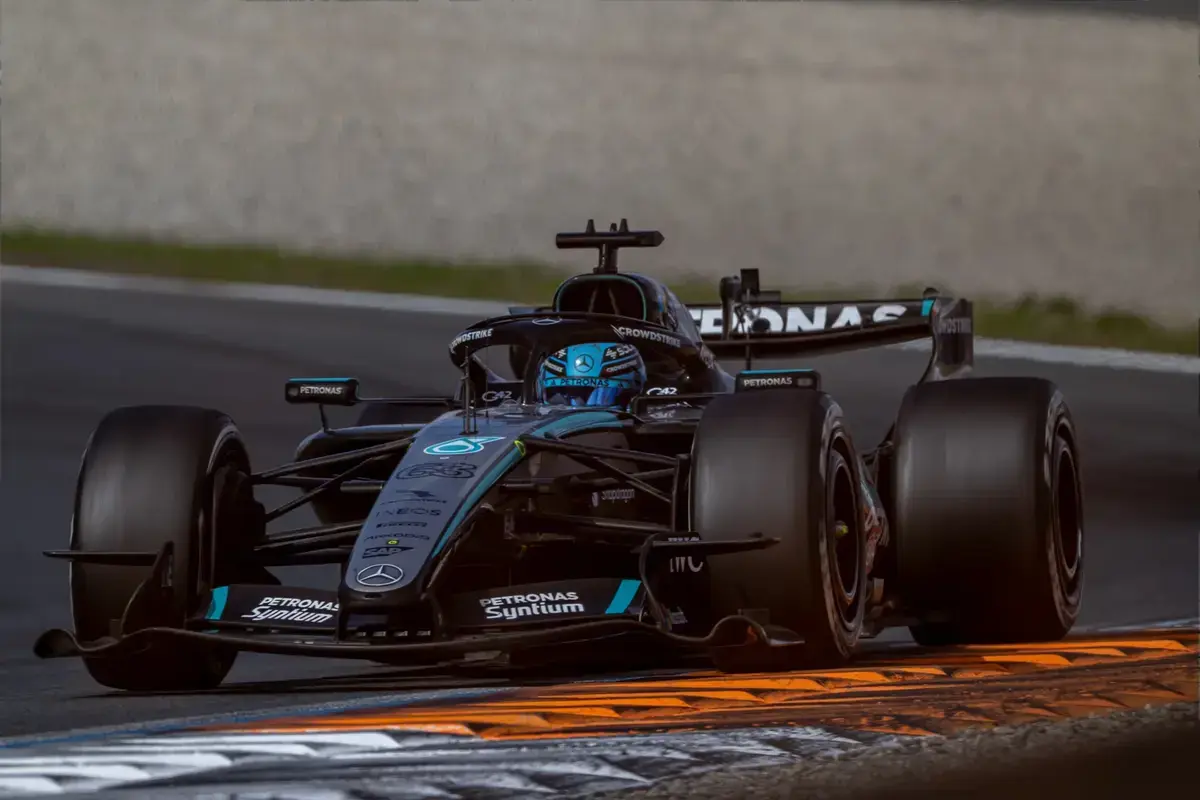

Kimi Antonelli knows exactly when his punishment is coming. George Russell doesn’t, and Mercedes seems in no hurry to tell him. That gap between certainty and vagueness tells you plenty about where Russell currently sits in the team’s pecking order.
Antonelli’s grid drop at Monza is confirmed, a consequence of burning through his engine allocation after a terminal power unit failure in Barcelona back in June. Russell’s own penalty is coming too, after failures in Canada and a stoppage at the end of his Hungary qualifying lap, but unlike his teammate he has no fixed date. Mercedes is still working it out, and that uncertainty arrives at the worst possible moment for a driver who has just endured a miserable stretch that saw him compared unfavourably to Valtteri Bottas.
Two Failures, One Firm Answer
Mercedes deputy team principal Bradley Lord did not sugarcoat the situation when explaining the dilemma facing the team. Both Russell and Antonelli have suffered power unit failures this season, and both will need fresh hardware before the year is out. Antonelli’s case was straightforward: his allocation ran out, so Monza it is, timed to coincide with his home race and a circuit where the team reckons the sporting damage will be minimal.
“We’ve not yet quite nailed down where George will take his, but it’s there for both of them because both of them have suffered engine failures.” – Bradley Lord
Russell’s situation is murkier because his components have not yet failed outright, they’ve simply raised enough concern to warrant a plan. That distinction matters. Antonelli’s penalty was forced by hard failure. Russell’s is preventative, which gives Mercedes room to gamble on delaying it, but also means the team could get the timing wrong and hand him a race-ending problem before it ever pulls the trigger.
Why Monza Isn’t the Answer for Both
Mercedes trackside engineering director Andrew Shovlin was refreshingly candid about how much the team’s thinking on Monza penalties has shifted, telling the team’s Nu Silver Arrows Radio Show that the low-drag, low-degradation Monza of old made grid penalties there painful. The current car and circuit combination, he argued, is a different proposition entirely.
“Now you’ve got a real energy-starved circuit and it becomes one where there are four overtaking zones. You definitely can’t defend at all of them. And if you are a faster car, we expect it to be relatively straightforward to make progress.” – Andrew Shovlin
That confidence explains why Antonelli gets to take his medicine at Monza. It does not explain why Mercedes wouldn’t simply do the same for Russell in the same race and be done with it. The answer, according to Shovlin, is that the team is wary of stacking both penalties in one weekend and doesn’t want two cars fighting forward from the back simultaneously while defending a lead in both championships.
Baku Looks Like the Frontrunner
With Monza effectively ruled out for a double penalty, attention has shifted to races immediately afterwards where overtaking is similarly straightforward. Baku’s long straights and heavy braking zones make it look like the obvious candidate, sharing enough characteristics with Monza that Mercedes believes a grid drop there would be survivable. That would mean Russell gets through the Italian and Spanish rounds before serving his penalty at the Azerbaijan Grand Prix.
The newly built Madrid circuit is, for now, too unpredictable to gamble on. Nobody has raced there yet, and Mercedes isn’t about to make a strategic call based on a venue it knows nothing about. If Baku doesn’t work out, Sepang has been mentioned as a fallback, hosting the Bahrain Grand Prix in Malaysia the week after Baku and offering, in theory, another circuit where cars can pass relatively freely.
The Numbers Game Behind the Delay
None of this is simply about circuit layout. Shovlin was clear that the bigger question is risk management, weighing the chance of another failure against the cost of a grid penalty and the points lost in fighting back through the field.
“It’s never an absolutely known thing and that’s evolving race on race… It could be that our optimism for taking a PU to the sixth or seventh race might be higher in a few races time than it is right now.” – Andrew Shovlin
That’s a fairly blunt admission that Mercedes is essentially running probability calculations on its own engine, race by race, hoping the components hold long enough to avoid a costly early swap without waiting so long that Russell suffers a race-ending failure in a spot where it actually costs championship points. Given that Russell sits 59 points off the title lead having taken points hits of his own with a DNF in the mix, a badly timed grid penalty is the last thing his season needs right now.
A Decision Mercedes Can’t Keep Postponing
There’s a reason the team can afford to stall on this while leading both championships comfortably, as Shovlin more or less admitted when he said Mercedes wants to “do the painful stuff” while ahead. It’s a sound strategy in theory, but it also means Russell is the one left carrying the uncertainty while his teammate already knows his fate. If Mercedes waits too long chasing the perfect statistical outcome and the engine fails somewhere inconvenient, that calculated gamble becomes an unforced error, and Russell will be the one paying for it on track.