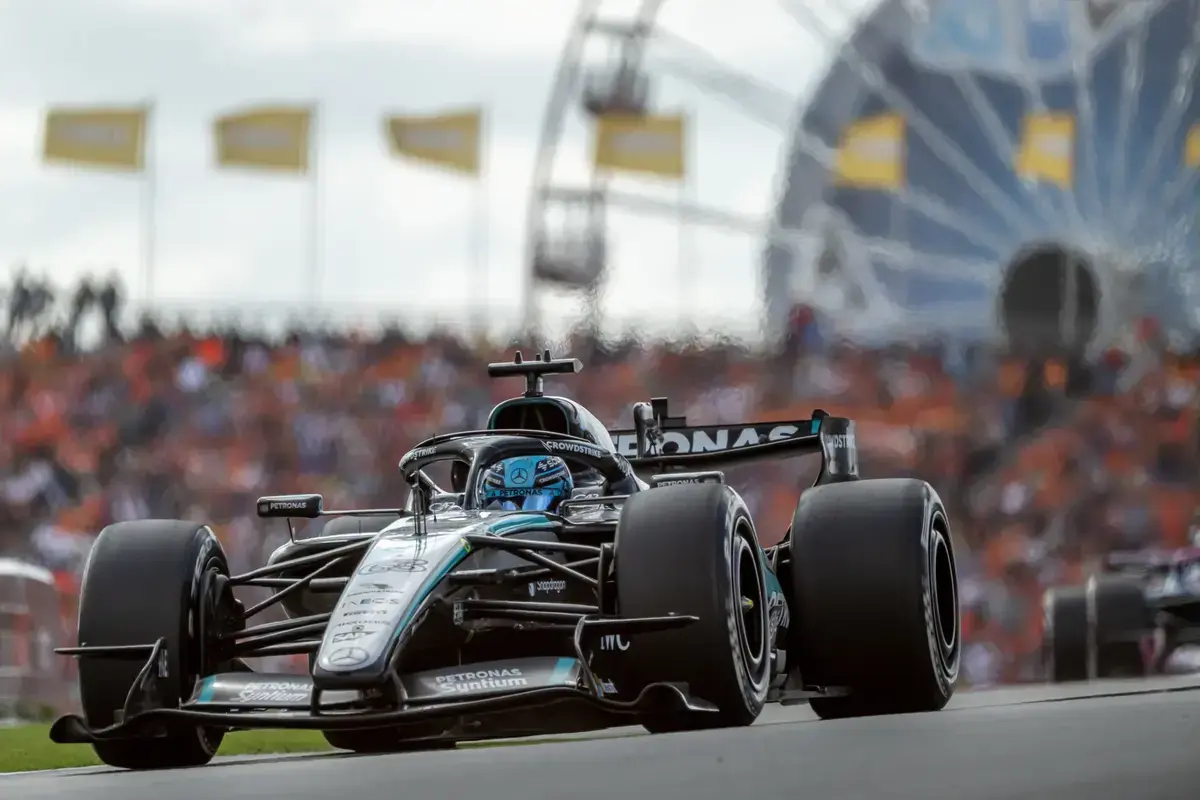

Mercedes wants you to think the team order that cost George Russell a podium position and six championship points at Zandvoort was the product of careful, dispassionate process. The truth, according to the team’s own explanation, is that it had already decided who mattered more before the race even started.
George Russell is now facing a separate grid penalty for an engine change, still to be scheduled, on top of everything else that went wrong for him at his own team’s hands during the Dutch Grand Prix weekend. But the story that deserves scrutiny is not the penalty. It is how deputy team principal Bradley Lord has now revealed that Mercedes discussed exactly this kind of scenario in a pre-race meeting, meaning the team order that cost Russell dearly was not some panicked, reactive call. It was a plan sitting in a drawer, waiting to be used.
The Meeting That Decided Russell’s Fate Before Zandvoort Even Started
Under a virtual safety car triggered by Esteban Ocon‘s stricken Haas, Mercedes pulled Kimi Antonelli in from second for a free tyre change. Russell stayed out, inherited second, and found Antonelli tucked in behind him on fresher rubber moments later. Shortly after the restart, Russell was told to let his team-mate through so Antonelli could chase down race leader Lando Norris.
Speaking about the call, as reported by RacingNews365, Lord confirmed the full debrief did not happen straight after the chequered flag but was pushed to the Monday because of an early red flag and a delayed schedule. That detail matters, because it means the explanation being offered now has had days to be polished into something that sounds calm and inevitable, rather than the messy, contentious call it clearly was in the moment.
“George naturally questioned the instruction when he first received it, but he understood the wider picture.” – Bradley Lord
Lord’s account is that the Sunday morning strategy meeting had already flagged the risk: the field was too tightly bunched for Mercedes’ own cars to be allowed to fight each other for position. That sounds sensible in isolation. It also conveniently means that whichever Mercedes driver found himself ahead through strategy alone, rather than through actually racing for it, was always going to be waved through by whoever was behind.
Why Antonelli’s Free Pit Stop Made the Call Simple for Mercedes
The mechanical justification is straightforward enough. Antonelli had used the virtual safety car for what Lord called a free stop. Had Russell tried to do the same, he would have rejoined behind a Ferrari and lost the podium outright. So swapping the two Mercedes drivers back to their “natural” order preserved the podium for the team while giving Antonelli a run at Norris for the win.
Lord insists the logic was not personal. “Had the circumstances been reversed, we would have acted in exactly the same way,” he said. “The priority was to give the car in second the best chance of attacking, while giving the car in third clear air and the best opportunity to defend its position.” Fine words, and probably even true in the abstract. But abstractions do not pay championship points, and it was Russell’s tally that took the hit while Antonelli’s swelled.
The Overtake Mode Question Mercedes Chose Not to Answer With Action
Here is the genuinely new wrinkle in this story. Once it became obvious Antonelli was not going to catch Norris for the win, Mercedes actually discussed swapping the order back, this time to hand Russell the overtake mode power boost he needed to fend off the chasing Ferraris of Lewis Hamilton and Charles Leclerc.
Trackside engineering director Andrew Shovlin explained why Mercedes talked itself out of it. “We discussed it. The gain was around two tenths of a second, principally on the straight, which was also where George was most vulnerable,” Shovlin said. “There was a concern that trying something we had not rehearsed could cause the cars to become entangled.” In other words, the team considered rescuing Russell’s podium fight with a second reversal, decided the reward was not worth the risk of two of its own cars crashing into each other, and let Antonelli cruise ahead cleanly instead.
“You might not have given him even a 50 per cent chance of keeping both Ferraris behind.” – Andrew Shovlin
Russell then held off both Ferraris anyway, a defence Shovlin rated as thoroughly impressive given the circumstances, helped along by a late virtual safety car that briefly cooled the fight. It is a performance that deserves credit on its own terms. It also happens to let Mercedes off the hook: because Russell defended so well, nobody has to ask too hard whether the team actually gave him the tools to do it, rather than simply hoping he would manage without them.
The Numbers Still Tell the Real Story
Strip away the process talk and the arithmetic is brutal. Russell’s podium finish left him 59 points behind Antonelli in the championship, which is precisely where he stood before the Dutch Grand Prix weekend began. His Sprint win earlier in the weekend effectively counted for nothing once the main race order was settled. Mercedes can call this a priority decision all it likes. From where Russell is sitting, with a season now down to 11 races remaining and a gap that refuses to shrink, it looks a lot more like a team that has already picked its favourite, and is simply better than most at explaining why that is fine.