
Twenty-one kilometres per hour. That is how much slower Lewis Hamilton‘s Ferrari was arriving at the braking zone compared to the Mercedes at the Austrian GP. Not in theory. Not in someone’s simulation. In telemetry, lap after lap, race after race. The ADUO system was supposed to level the power unit playing field. Instead, it has handed out free passes to manufacturers who lobbied the rules into existence, and left everyone else staring at the back of a Silver Arrow disappearing into the distance.
The Telemetry Does Not Lie
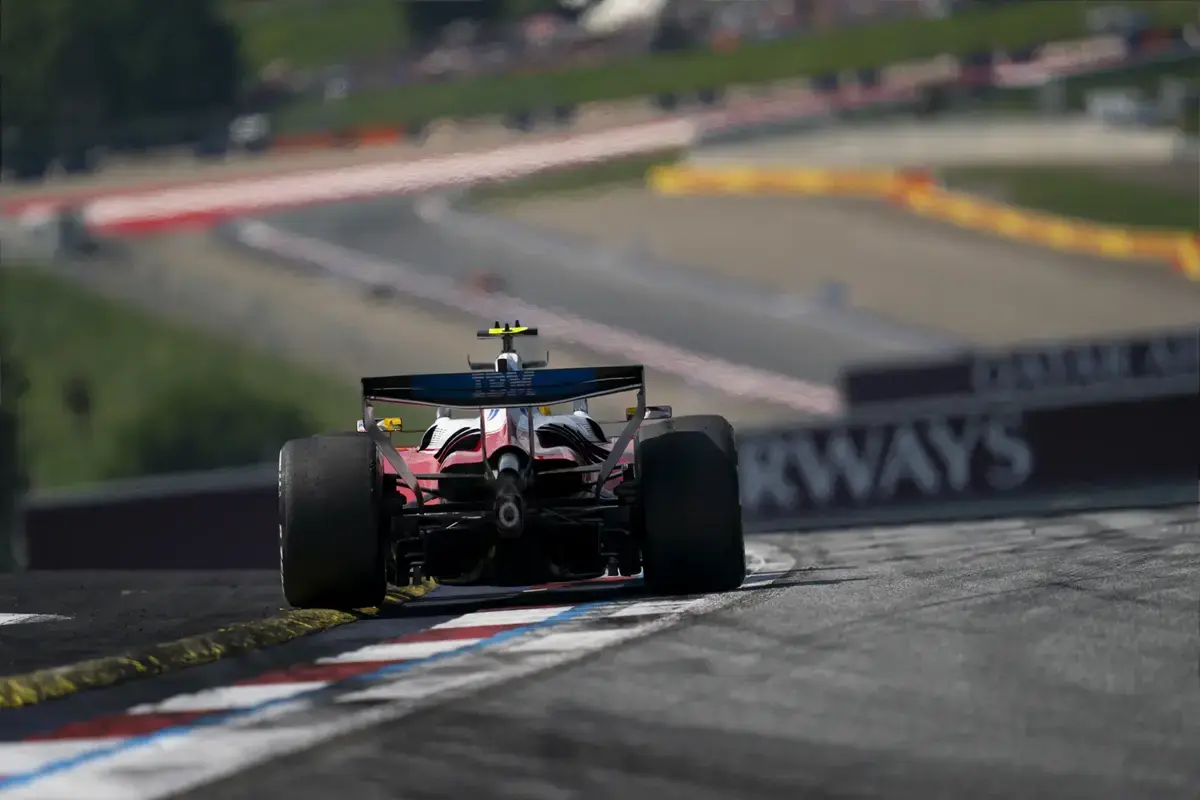
The gap between Ferrari and Mercedes on the run between Turn 3 and Turn 4 at the Red Bull Ring tells the story bluntly. Both cars exit the corner with similar traction. By mid-straight, the lines diverge. By the braking zone, Ferrari is already 12 km/h down on Mercedes. Then comes the clipping phase, where Ferrari’s electric power cuts out severely while Mercedes barely flinches. Hamilton, who was last to lift off the throttle, still arrived at the braking point 21 km/h slower. He loses over a tenth and a half to Kimi Antonelli in that single sector alone. As Hamilton put it himself:
“They have tremendous power at the end of the straight. I was dropping back and they just kept going.” – Lewis Hamilton
That is not a power unit in the same postcode as his Ferrari. Ferrari’s Austrian GP weekend was already a disaster before the telemetry made it look even worse.
The ADUO Absurdity in Full Bloom
Here is where it gets truly farcical. Ferrari’s internal combustion engine is reportedly 6 to 8 percent behind Red Bull’s benchmark ICE, which is the unit the FIA decided was the best on the grid. Red Bull, meanwhile, is furious about being crowned top dog because it means rivals can develop freely while they sit frozen at the front. Red Bull’s own car has clear limitations, yet its engine is the reference point. The team lobbied hard to keep ADUO measurements restricted to the ICE only, confident their chassis was the weakness, not their power unit. That gamble has backfired spectacularly.
Mercedes Holds All the Cards
Toto Wolff confirmed the new units in Austria carried zero performance upgrades, just fresh mileage and reliability fixes. No upgrade is currently planned. Why would it be? McLaren boss Andrea Stella noted that even two Mercedes-powered cars show noticeably different top speeds, suggesting Mercedes itself may not be fully exploiting its own power unit. Ferrari, meanwhile, is waiting on a larger turbocharger expected at Zandvoort or Monza for its second ADUO allocation. George Russell won the Austrian GP with a unit that was not even upgraded. That is the situation everyone else is dealing with.
A System Already Broken
The FIA is already revising the 2026 power unit regulations for 2027 and 2028, shifting the ICE-to-electric ratio back toward combustion power to cure the superclipping problem that makes straight-line speed so unpredictable. The sport spent years designing this formula. It has lasted half a season before requiring emergency surgery.
Mercedes sits 302 points clear at the top of the constructors’ standings. Wolff has no reason to rush an upgrade, no reason to panic, and every reason to smile. The rest of the paddock can argue about ADUO classifications all the way to Budapest. The stopwatch has already delivered its verdict.