
All the ingredients, none of the result. Aston Martin arrived in 2026 with Adrian Newey, Fernando Alonso, Aramco’s money, and a shiny new Honda works partnership. What they actually got was vibrations, battery failures, and a gap to Cadillac that measured around a full second. And now Honda’s chief engineer has admitted they didn’t even grasp the true scale of the mess until January.
A Very Painful Confession
Honda trackside manager and chief engineer Shintaro Orihara has been refreshingly candid about the partnership’s struggles. His verdict? Everything looked manageable at the end of 2025. Then January happened.
“At the end of last year, our position was not so bad. Performance and drivability were in the development stage, but it looked okay. But in January, we realised that performance was always up, down, up, down. We found some performance, but then we also found some reliability issues.” – Shintaro Orihara
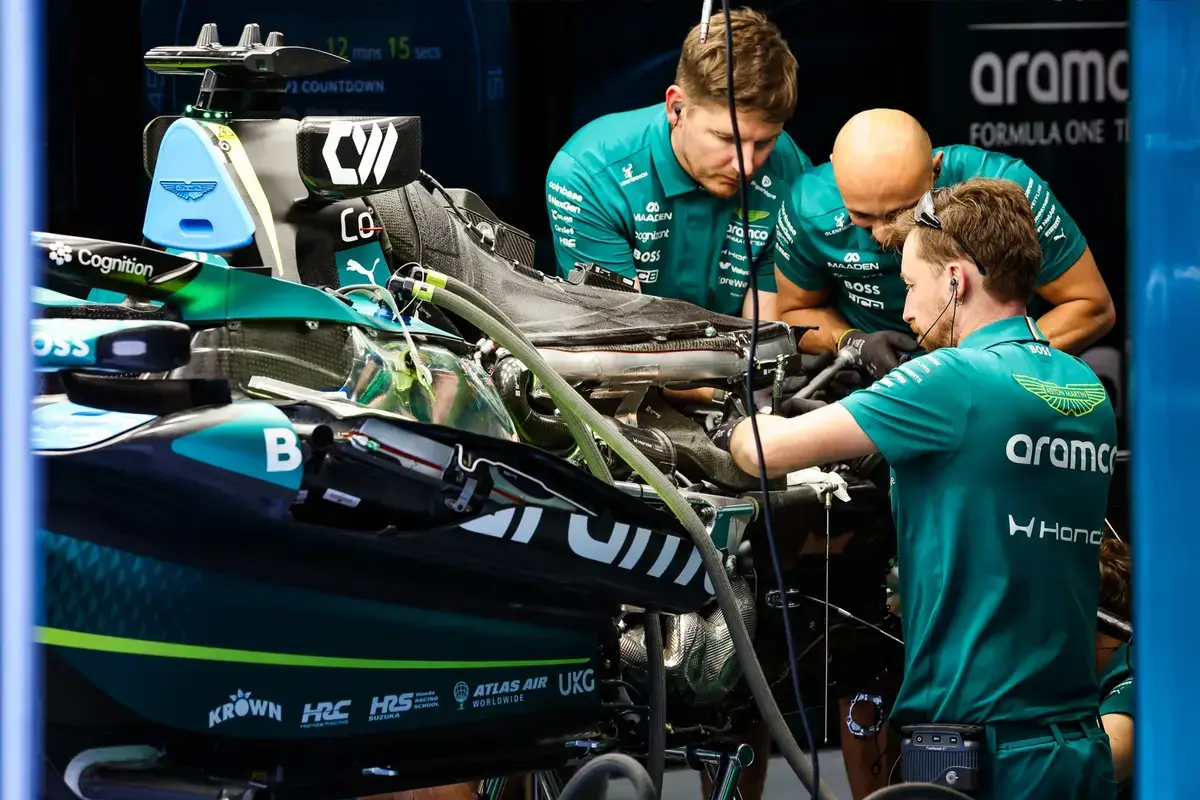
Reliability concerns forced Honda to sacrifice performance gains just to keep the engine in one piece. That set the entire development programme back, and by the time pre-season testing in Barcelona rolled around, the situation was clearly dire.
“When we started running in Barcelona, we realised that our performance was definitely poor compared to the other manufacturers. And also, we found some issues on the battery side.” – Shintaro Orihara
Battery Woes Made Everything Worse
Battery problems are particularly brutal in this context. They don’t just hurt performance; they eat into track time. For a partnership desperately needing data to close a widening gap, losing laps in winter testing was catastrophic. As Orihara put it, they knew by end of 2025 things weren’t great. They simply hadn’t expected it to be this bad.
The Regulation Change Nobody Fully Solved
To Honda’s credit, this wasn’t simple incompetence. The 2026 technical regulations changed virtually everything simultaneously. The MGU-K output jumped from around 120kW to 350kW. Fuel flow rates shifted. And crucially, the MGU-H was scrapped entirely, creating turbo boost management headaches that directly caused the drivability misery Alonso endured all season.
As Orihara explained, the challenge wasn’t any single component. It was the brutal combination of every change landing at once, with no margin for error.
Zandvoort Is Step One, Not the Answer
A new engine upgrade, already tested at the Hungaroring during a filming day, is expected to debut at Zandvoort. Honda is framing it as a first step towards reducing their still significant power deficit. Read that carefully: first step. There is clearly a long road ahead. Newey and Alonso have backed Aston Martin to turn it around, but optimism alone won’t close a second-a-lap gap.
For a manufacturer that dominated F1 with Red Bull not long ago, this is a humbling reset. The question now is whether Honda can recover fast enough to make the Aston Martin project meaningful before the 2026 season becomes a write-off nobody wants to remember.