
Lewis Hamilton has stopped pretending. After trundling home sixth at Monza, the seven-time champion looked into the cameras and told anyone who’d listen that Ferrari’s backing for his title bid arrived weeks too late to matter. Not days. Weeks. That’s not a driver venting after a bad afternoon, that’s a man doing the maths in public and not liking the answer.
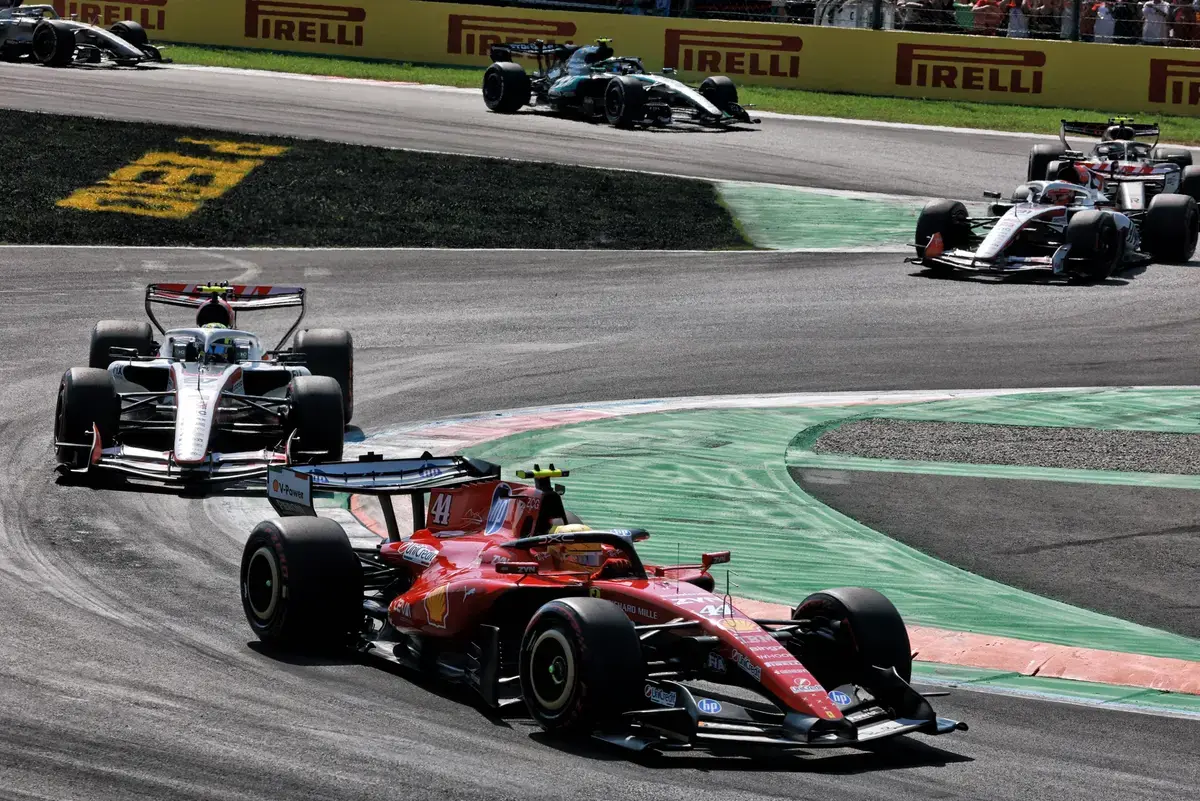
The Italian Grand Prix went wrong for Ferrari before it had really begun. Charles Leclerc squeezed his own team-mate into the gravel at the first chicane, then binned his own car into the Parabolica barrier two laps later, dragging a red flag into what was supposed to be a home celebration. That saga has been picked apart elsewhere. This is about what Hamilton said once the dust, and the gravel, had settled.
Weeks, Not Days
Hamilton’s language was blunt and it wasn’t a slip of the tongue. Speaking to media including Autosport at Monza, he didn’t hedge.
“I think from today, we’ve just lost so much ground to them on points. It’s far too late for those decisions to come. It’s many, many weeks too late.” – Lewis Hamilton
Read that again. This isn’t a complaint about one bad Sunday. It’s Hamilton saying, on the record, that whatever conversations Ferrari should have had about prioritising his championship push should have happened a long time ago, and now the moment has gone. The team, in his telling, has essentially run out of road.
The Numbers Do the Arguing For Him
Here’s the thing about Hamilton’s frustration: it isn’t paranoia, it’s arithmetic. He now sits 76 points behind championship leader Kimi Antonelli, with team-mate Leclerc a further 36 points back in fifth. Ferrari itself has slipped 122 points adrift of Mercedes in the constructors’ table. With ten rounds left this season, that’s not a gap you close by hoping the car comes good. It’s a gap you close by not throwing points away on your own team-mate at your home race, and Ferrari did precisely that.
Hamilton was refreshingly honest about what that means for his own prospects, telling the written press: “All I can do is just try and turn up. I’ll get up tomorrow morning and I’ll give it my best. Ultimately today, I feel massively gutted for the tifosi, who showed up for us today.” That’s the sound of a driver managing expectations downward in real time, in front of the people who paid to watch him do the opposite.
No Rules of Engagement
The Turn 1 clash with Leclerc is the flashpoint that gives Hamilton’s broader complaint its teeth. Leclerc’s post-race line, that “we went too far”, got a swift correction. “I was ahead in Turn 2. By the apex, I was ahead. There was no ‘we’ in it,” Hamilton said. He was equally clear that he isn’t the problem: “I don’t race dirty. I’ve always raced clean and fairly and always left space. I’ve come into the team and tried to be respectful of space and definitely not put the team in jeopardy.”
What he wants, and what he says Ferrari doesn’t have, is a proper framework for exactly this scenario. “When I was at Mercedes, we had a written rule of engagement. We never really had it too bad. Maybe moments with me and Nico [Rosberg] a couple of times. But more often than not it was good,” he said. “Here, there are no rules.”
That’s a genuinely damning thing for a seven-time champion to say about the team he joined with a title bid in mind. Not that the strategy is slow, not that the car lacks pace on a given weekend, but that the sport’s most decorated active driver and his team-mate are essentially racing each other with no agreed boundaries at all.
Pointing Up, Carefully
Hamilton stopped short of torching the garage. Asked whether there’s a deeper cultural problem at Ferrari, he pushed back on the framing while still making his point. “It comes from the top. It trickles down, decisions. It starts with Fred,” he said, referring to team principal Fred Vasseur. “There’s only so much you can say, so much you can push and shout from the mountain top. Yesterday, I said we’ve got to look at how we communicate. If we continue to travel the same path, we get the same result.”
He was careful, too, not to throw the mechanics and engineers under the bus. “I think the guys in the factory are doing a really great job. We’re not executing as cleanly as well as we can,” he said, adding that any procedural fix will wait: “probably not next week, but particularly after the next race.” Given the season has 10 races left after Monza, that’s still a lot of championship left to lose ground in while Ferrari has its internal chat.
A Complication Ferrari Built Itself
None of this happens in a vacuum. Leclerc’s position at Ferrari isn’t just about lap times, it’s understood his camp had a hand in Vasseur’s own appointment, which makes team orders a genuinely awkward conversation rather than a simple sporting call. Vasseur, for his part, said after the race he’d only had a brief word with Hamilton and hadn’t yet spoken to Leclerc about the incident, and pointed out that pitting under the virtual safety car would have dropped Hamilton behind Yuki Tsunoda and Pierre Gasly, a claim that looks shakier than Ferrari might like given Hamilton’s pace that weekend.
Vasseur also drew a comparison to last year’s McLaren situation, arguing it was “too early” to formalise team orders before Monza. Hamilton’s whole point is that it’s now too late as well. That’s not a comfortable window for Ferrari to have missed entirely.
What This Costs Ferrari Beyond the Title
It’s worth remembering the constructors’ championship isn’t just pride, it’s the money that funds next year’s car. Every point Ferrari’s drivers take off each other in incidents like Monza is a point that could decide where the team sits in the commercial pecking order. A team that lets its two drivers scrap for position while a triple-digit points gap opens up to Mercedes is a team making an expensive habit of it.
Hamilton has effectively told Ferrari, in public, that the clock on his 2026 title challenge has run out and that the decisions needed to keep him in it should have been made long before a home Grand Prix went up in gravel and barrier debris. Whether Ferrari treats that as a wake-up call or just another uncomfortable press conference to survive will say a great deal about what kind of team he actually signed up for.