
Cadillac Fined as FIA Puts the Whole Grid on Notice
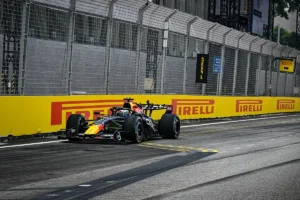
Cadillac has been fined after Colton Herta’s car ground to a halt at Monza with a failed Car Deployment System, the third such failure the FIA has logged this season. The stewards let the team off with money this time, but the accompanying warning reads like the last polite email before the sporting penalties start landing.
That is the real story here. Not the stranded car, not the red flag, but the FIA effectively telling every outfit on the grid that patience with faulty CDS units has run out.
What Actually Went Wrong
Cadillac did not exactly cover itself in shame during the hearing. The stewards heard from the team’s Sporting Director and Head of Reliability, alongside the FIA Technical Delegate and an FIA F1 Electronics Engineer, and by all accounts Cadillac turned up with genuine answers rather than excuses. The team presented detailed schematics showing the CDS was designed to operate independently of the car’s other systems, exactly as the regulations demand, and demonstrated the system had been checked and tested the day before the car turned a wheel in competition.
The problem sat somewhere nobody had flagged before: the CDS still needs power when the car’s main electronics are switched off, in what is known as “P0 mode”, and that power comes from a lithium battery supplied by a third party. One of the four cells in that battery failed. The CDS went dark. When Herta’s car stopped, marshals could not simply push it clear, and out came the red flag.
Nobody in that hearing room seemed to be arguing in bad faith, which is more than can be said for a lot of stewards’ sessions this year. Cadillac’s promised fixes sound sensible enough on paper: get the battery supplier to specify an expected maximum life, introduce daily or pre-session checks, and run a replacement programme so cells do not quietly die mid-weekend.
The Regulation That Cadillac Broke
The FIA rulebook is not vague on this point. It states plainly that the CDS “must be in working order throughout the Competition even if the main hydraulic, pneumatic or electrical systems on the car have failed.” That is the whole point of the system: it exists for the moment everything else on the car has already given up. A battery cell dying and taking the backup system down with it is precisely the scenario the rule was written to prevent.
The stewards accepted Cadillac’s transparency and judged the remedial plan reasonable. They still landed on the only conclusion the regulation allows: a breach occurred, and responsibility for a third-party part failing sits with the team regardless of who manufactured the battery. Comforting intentions do not rewrite a rulebook.
Third Time Is Apparently Still Just a Fine
Here is the number that should worry every team on the grid rather than just Cadillac: this is the third reported CDS failure of the season, and each one has produced a red flag with genuine sporting consequences. Three strikes, and the stewards have still reached only for a financial penalty. That restraint will not last much longer if the pattern continues.
The stewards’ own language leaves little room for a generous reading. They stated explicitly that although a monetary penalty applies in this instance, competitors should understand that future failures may bring sporting penalties on top of the fine. That is about as close to a written threat as a stewards’ document gets, and it is aimed at the whole paddock, not just at Cadillac’s garage.
The CDS exists for one job: getting a stranded car off the circuit quickly and safely, which matters rather a lot when marshals are working trackside and other cars are still circulating. A system that only works when everything else on the car is functioning normally is not a backup system at all, it is decoration. The FIA seems to have finally run out of patience with treating it as an afterthought.
Why This Lands Hardest on Cadillac
There is a certain grim symmetry in the newest team on the grid being the one to trigger the warning shot for everyone else. Cadillac sits bottom of the constructors’ standings without a point to its name, and now carries the extra distinction of being the outfit that finally tipped the FIA into threatening sporting penalties across the board. Sergio Pérez and Valtteri Bottas have enough on their plates fighting for relevance in a struggling car without their team also becoming the poster child for a reliability crackdown.
The wider context does not help Cadillac’s case for sympathy either. This story follows directly from Herta’s car grinding to a halt in FP1 at Monza, a weekend that has otherwise been dominated by Ferrari’s home upgrade worries and grid penalty dramas for the championship contenders. Cadillac has managed to make headlines at its own home turf for entirely the wrong reasons.
A Fine Now, a Problem Later
Nobody should mistake this for Cadillac getting away with anything. A monetary penalty at this stage is the stewards giving the whole grid a chance to fix a systemic weak point before someone gets hurt for real. The next team whose CDS battery quietly dies mid-session should not expect the same leniency, and neither should Cadillac if it happens again. The FIA has drawn its line in writing. Ignoring it now would be an act of remarkable self-sabotage from a team that can least afford another headline like this one.