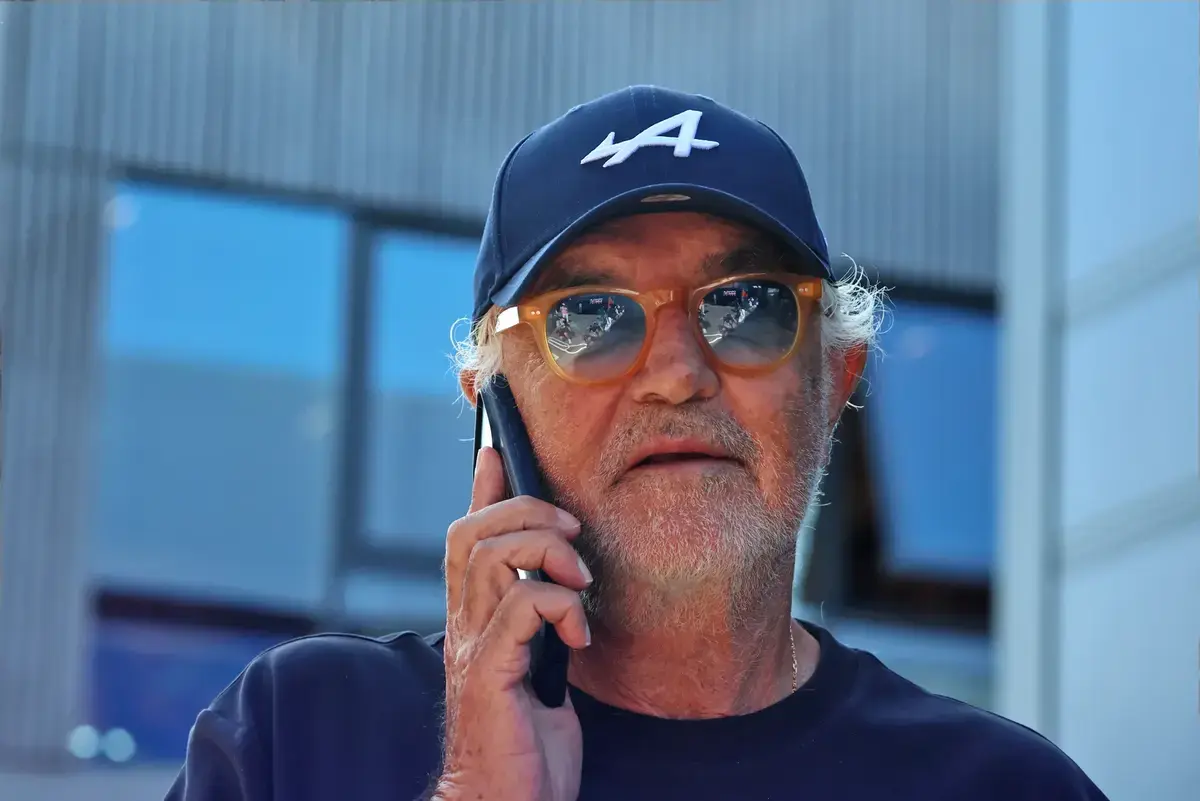

Losing an appeal is one thing. Standing in front of the media afterwards and accusing one of the judges who ruled against you of secretly working for the rival team that brought the case is quite another. That is exactly what Alpine boss Flavio Briatore did on Friday, and it turned what should have been a routine FIA verdict into one of the messier moments of the season.
The background, briefly: the FIA’s International Court of Appeal reinstated two five-second penalties against Pierre Gasly for a pit-lane speeding offence, dropping him from third to seventh in the final classification, with Isack Hadjar restored to the podium. That story, and the timekeeping error that triggered Alpine’s original review, is covered in detail in our report on Hadjar’s reinstatement. What matters here is what happened next.
An Extraordinary Accusation, Live on Camera
Briatore did not wait long to vent. Minutes after the ruling landed, he was in the FIA’s Team Principals’ Press Conference launching an attack on one of the four panel members, telling media including RacingNews365 that the judge in question had undisclosed ties to McLaren, the team that lodged the appeal alongside Red Bull.
“Sorry, this is very unfair. First, we accept the decision, but what is very strange is of the four judges on the panel, one of the judges acts like a prosecutor. For us, that’s not a big problem. The problem is that he’s very linked with McLaren, because we have a nice picture of this guy at the speech for McLaren in 2018 at McLaren Special Operations (MSO) in Beverly Hills.” – Flavio Briatore
Briatore went further, pointing to a charitable link he says ties the judge to McLaren directly.
“He has a foundation called One Drop Foundation, and McLaren gave a car. This is quite unfair. One of the judges was linked with a team protesting us.” – Flavio Briatore
This is not a mild gripe about a decision going the wrong way. This is a public claim, made on the record, that a judicial panel inside the FIA’s own court contained someone with personal and professional connections to one of the parties in the case. If true, that is a genuine problem for the credibility of the sport’s judicial process. If not true, it is a reckless allegation to throw around in a press conference with cameras rolling.
Stella’s Attempted Defence Gets Nowhere
McLaren boss Andrea Stella tried to steer the conversation back to the merits of the case, framing the appeal as a matter of sporting principle rather than points, arguing the hearing was about clarifying how the rules on pit-lane measurement are applied consistently across the grid, and noting that Red Bull was not the only team represented at the hearing. Briatore was having none of it.
“What is unfair is that the judge was linked with McLaren; this is unfair. The judge normally needs to be completely independent, and this judge was very nasty during the hearing. He was acting as a prosecutor, and after, we found out why the reason was he so nasty. The guy is very linked with McLaren.” – Flavio Briatore
It is worth noting Briatore did name the judge directly in comments reported by the Dutch edition of RacingNews365: Filippo Marchino, an American with Italian heritage. Briatore’s issue is not with the substance of the ruling on the pit-lane measurement error, which he says Alpine accepts, but with who was sitting in judgement. That is a distinction he repeated several times, almost as if daring anyone to accuse him of being a sore loser.
“We had no idea this guy was linked with McLaren. We went to the hearing with McLaren, and we see it was very funny because this judge was not a judge; he was a prosecutor. After, we found out this guy was linked with the McLaren team; this is what I think.” – Flavio Briatore
Why This Matters Beyond One Bad-Tempered Press Conference
It would be easy to write this off as Briatore being Briatore, the same operator who has spent decades needling rivals and stewards alike. But the substance of the claim, if it holds up, is not trivial. The International Court of Appeal is meant to be the final word on disputes exactly like this one, and its authority rests entirely on the assumption that its panel members have no skin in the game. A judge with a documented appearance at a McLaren corporate event and a charity that has received a McLaren car is, at minimum, an awkward look, regardless of whether it actually influenced the verdict.
Briatore was careful, repeatedly, to separate the outcome from the process. He is not disputing that Alpine’s own timekeeping review triggered this mess in the first place, nor is he pretending Gasly’s penalties were wrongly reinstated on technical grounds.
“The decision in Monaco was from the same people, because the stewards talking about are the same. Everything was done the same, and I accept everything. What I do not accept is when you have the judge, the panel. We need somebody independent.” – Flavio Briatore
That framing matters. Briatore is not launching a conspiracy theory about the result, he is questioning the composition of the court itself, and doing so by name. That is a considerably harder thing for the FIA to simply wave away than a team boss complaining about a decision he did not like.
What Happens Now
Briatore closed his remarks with a line that sounded less like a tantrum and more like a threat of follow-through.
“The panel should be completely independent, and you don’t need somebody linked with some team, especially the team involved with us in this situation. Only that. Nothing. Now we see. We think about what we can do next.” – Flavio Briatore
Quite what “next” means is unclear, but an accusation this specific, aimed at a named individual on the FIA’s own judicial body, is not the sort of thing that quietly disappears after one press conference. Either the FIA addresses the conflict-of-interest question head on, or it lets the suspicion fester heading into a run of eleven races still to come this season, with the Pierre Gasly penalty dispute serving as the spark rather than the story. One suspects Briatore knew exactly what he was doing when he chose to name names in front of the cameras rather than in a quiet letter to Paris.