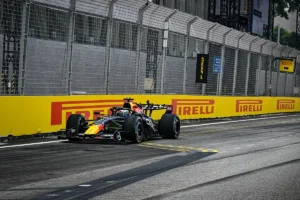

Honda spent months promising an improved power unit for Zandvoort. What Fernando Alonso got instead was an engine that refused to stop pushing under braking and a rear wing that wouldn’t open. The result: last on the grid for Saturday’s Sprint, and a Spaniard doing his best not to sound too furious about it.
Aston Martin arrived in the Netherlands with Honda’s freshly upgraded spec fitted to both cars, hoping for a step forward after a promising Hungary weekend. Instead, both Alonso and Lance Stroll crashed out in SQ1, leaving the team stranded at the wrong end of the timesheets before the Sprint had even started.
An engine that wouldn’t let go
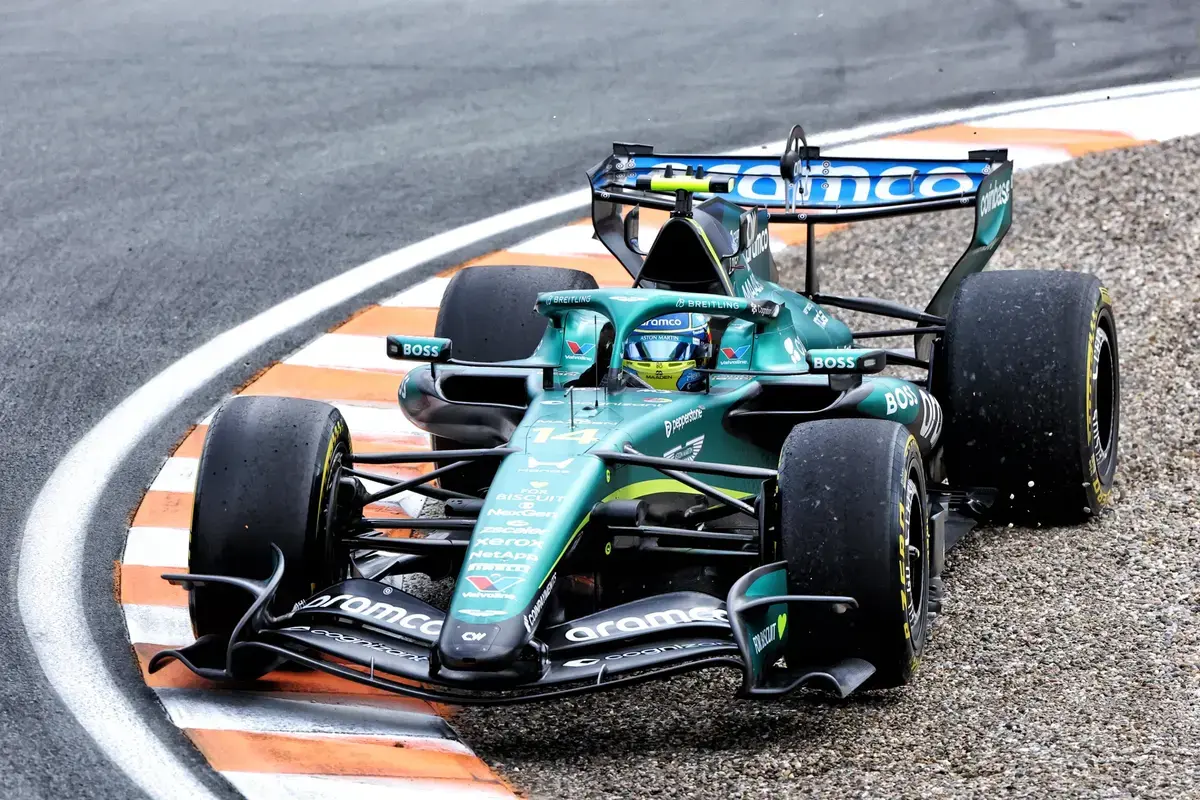
Alonso’s problems weren’t subtle. On his first flying lap in Sprint qualifying he locked the front brakes and speared straight into the gravel, a symptom, he explained, of an engine that simply wouldn’t back off when he lifted. Told to accredited media at Zandvoort including PlanetF1.com, Alonso didn’t hold back on the diagnosis.
“Free practice was more or less okay, but in qualifying, we had problems on the engine drivability. It was pushing under braking, so it was difficult to stop the car sometimes because the engine was over-delivering.” – Fernando Alonso
Translation for anyone who hasn’t driven an F1 car at 300 km/h into a braking zone: the power unit kept sending power to the rear axle exactly when Alonso needed it gone. That is not a minor calibration quirk. That is the sort of fault that puts a two-time world champion into the gravel trap in front of his home comforts, if you can call Zandvoort that for a Spaniard.
The rear wing that stayed shut
As if an engine with a mind of its own wasn’t enough, Alonso’s straight-line mode, the system that flattens the rear wing on the pit straight to cut drag, refused to activate. Telemetry reportedly showed a top-speed deficit of around 24 km/h compared to a working system, which on a low-downforce, high-speed lap like Zandvoort’s is the difference between a competitive time and an embarrassment.
“And then apparently, the SLM didn’t work for me, so I could not open the rear wing. A combination of both made the laps very tricky. When you brake, and the throttle is open, it’s difficult to stop the car.” – Fernando Alonso
Two separate faults, one car, one qualifying session. Alonso’s final lap in SQ1 was more than three seconds off pace-setter Charles Leclerc and still half a second slower than Sergio Perez, who occupied the next spot up. That is not a rounding error. That is a power unit and an aero system both quietly conspiring against their driver on the same afternoon.
Diplomatic Alonso, furious subtext
To his credit, Alonso didn’t set fire to Honda’s PR department on the spot. He pointed out that Friday practice, where he ran 12th, just two-tenths off the top ten, had actually felt like progress. But the framing of his comments told its own story: this is an engine that is, in his words, still “immature,” arriving on a Sprint weekend where there is precisely one practice session to sort out problems that would normally take three.
“It’s still very early days and the power unit is probably a bit immature with all of the controls. It’s a Sprint weekend, on a normal weekend we have three practice sessions to nail the package. We will try to understand a few things.” – Fernando Alonso
That’s Alonso being generous. Strip away the diplomacy and what he’s really saying is that Honda rolled the dice on a Sprint weekend with an unfinished product, and Aston Martin paid for it with a driver stuck at the back of the grid for Saturday’s race.
Timing that could not be worse
Aston Martin currently sit rock bottom of the constructors’ table, a single point to their name all season, with Stroll yet to register anything at all. A power unit upgrade was supposed to be the turning point, the moment the Honda partnership started paying dividends after years of promises. Instead it delivered a driver who couldn’t brake properly and a rear wing that stayed glued shut on the straight.
None of this happened in isolation, either. Elsewhere in the paddock this weekend, Mercedes and Ferrari have been trading blows at the front, George Russell claimed Sprint pole ahead of Lando Norris, and Lewis Hamilton found himself stunned by a transformed Ferrari. Aston Martin, by contrast, is still trying to work out why its new engine tried to put its lead driver into the gravel trap.
The verdict
Honda will point to Friday’s promising pace as proof the upgrade has genuine potential, and maybe it does. But an engine that overpowers its own brakes and a wing system that forgets how to open are not teething problems you can wave away with talk of being “early days.” Alonso is 45 years old and has seen every kind of unreliability F1 has thrown at a driver over two decades. If even he sounds this measured while describing a car that wouldn’t stop, Honda has considerably more than fine-tuning to do before Monza.