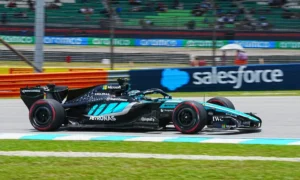
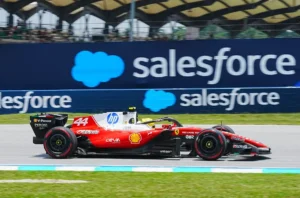
Four Formula 1 cars did not stop on the formation lap in Malaysia because of bad luck, bad driving or bad weather alone. They stopped because of a software bug the FIA never got round to testing properly, buried inside the very system that governs how much electrical power a car is allowed in the wet. Nikolas Tombazis, the FIA’s single-seater director, has now explained exactly how a governing body with years of development time managed to miss it.
A Bug Hiding in Plain Sight
The Bahrain Grand Prix in Malaysia was Formula 1’s first genuinely wet race of the season, and that single fact turned out to be the whole problem. The energy management software involved, built by the FIA in collaboration with the teams over several years, caps electrical deployment at 250kW in wet conditions. Fine in theory. Except nobody had ever run that software at the kind of crawling, near-standstill speeds a safety car-led formation lap produces in a downpour.
Tombazis did not dress it up. Speaking to media including Motorsport.com in an additional post-race session, he laid out what went wrong on the formation lap.
“We didn’t manage to test the software as extensively as we would have liked because there’s been very little wet running this year. There was a bit of a combination of circumstances which caused this bug to kick in.” – Nikolas Tombazis
“Basically, on the formation lap, some cars went very slowly and almost came to a standstill. There was a bit of a concertina effect between cars and some cars almost stopped completely. That bug prevented then the power to be redeployed and for the cars to start again.” – Nikolas Tombazis
Max Verstappen, leading the pack at the front, slowed heavily and triggered the concertina effect that rippled back through the field. Some cars behind him braked harder in reaction, hit the same ultra-low speed threshold in certain minisectors of Sepang, and got trapped in whatever loop the bug created. Others further back never reached those speeds at all and sailed through untouched. There was, according to Tombazis, no technical reason Mercedes-powered cars appeared less affected. It simply came down to who braked hardest and when.
Why the Throttle Pedal Felt Dead
Oliver Bearman described the sensation in terms that should worry anyone who assumed F1 cars still answer directly to a driver’s right foot.
“I’ve never seen or felt anything like that. I was shocked that… I didn’t even know that the FIA could control our throttle pedal. That was quite scary, actually. My throttle pedal just stopped working. It was like it was not connected and the engine was just idling. It was so weird, I mean, shocking.” – Oliver Bearman
That raises the obvious question nobody at the FIA has fully answered yet: why would an internal combustion engine be affected at all by a bug supposedly limited to electrical deployment? The initial suggestion is that the bug diverted all throttle input into recharging the MGU-K instead of sending it to the engine, which would explain why drivers felt precisely nothing when they pressed the pedal. It is not a confirmed diagnosis. It is a plausible one, offered by a governing body that is still working through its own homework.
How the FIA Patched It in Minutes, Not Days
Whatever criticism the FIA deserves for not catching this sooner, the emergency fix itself was handled with some competence. Engineers identified the specific minisectors where the extreme low speeds had triggered the fault and simply lifted the 250kW energy constraint in those zones, overriding the very restriction that caused the chaos in the first place.
“Fortunately, our guys understood the issue very, very quickly. I think the update was done very competently. It was obviously a rush job. The priority was to get running as quickly as possible again, so I think the reaction time was quite fast. It wasn’t a perfect job and, clearly, we didn’t test the updates, but I think it was the way to handle such a case.” – Nikolas Tombazis
Every team then had to receive and install the revised software on their cars before the race could restart, which explains the bulk of the delay fans sat through. The start had already been delayed by rain before any of this started.
A Mistake the FIA Says Was Avoidable
Here is where Tombazis stopped being quite so forgiving of his own organisation. Asked directly whether the FIA should have anticipated that wet races carry a high probability of a safety car, and therefore of exactly these low speeds, he did not dodge it.
“Well, any bug is a product of a mistake. I mean, I don’t know of any software that doesn’t have bugs and updates. Your computer probably gets updated every three days and those are all bugs. Of course, anticipating these things is what one hopes to do, but sometimes some very combination of events isn’t properly anticipated and causes the problem. I think if we had had a bit more testing, we probably would have managed to catch it in time and not to have such a situation.” – Nikolas Tombazis
That is a remarkably direct admission for a governing body usually allergic to saying it got something wrong. A safety-critical system, tied to energy deployment in the wet, went through years of development without ever being tested at the speeds a wet safety car period actually produces. Sixteen rounds into the season, in the sport’s first proper wet race, that gap finally bit.
What Happens Before the Next Wet Race
Tombazis was careful not to overpromise. The specific bug has been identified and patched, but he stopped short of guaranteeing nothing like it will ever resurface.
“We would all like it to be simpler, but the fact is when you have as much electrical energy, it does make it more complicated. I think you appreciate that the race has now finished about one hour ago and we haven’t done a full debrief of the situation to see how we can avoid such an issue. Every race, we have a long debrief afterwards where we identify criticalities. Obviously, that was a major criticality and we need to make sure we avoid it. But can I guarantee it will never happen again? This specific problem, yes. A problem, no. But we will do our best to avoid it, of course.” – Nikolas Tombazis
It is a candid answer, and candour counts for something. But it also leaves one uncomfortable fact sitting on the table: Formula 1’s 2026 cars run on machinery that is 47% electrical, built on software stacks complex enough that a single untested edge case can stall four cars on a formation lap. The FIA has fixed this specific bug. Whether it has fixed the testing process that let it through in the first place is, by Tombazis’s own admission, still an open question.