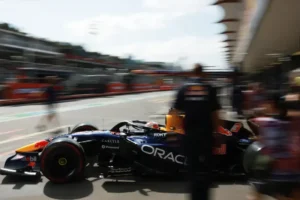
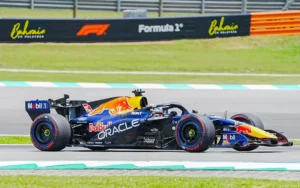
Sepang has done what Sepang does best. With the grid formed and engines warm, the heavens opened over Malaysia and the start of the Bahrain Grand Prix has been delayed, because nothing says Formula 1’s 2026 rebrand quite like a race named after one country being held up by rain in another.
A sudden deluge swept over the Sepang International Circuit roughly 40 minutes before lights out, and rather than easing off it got worse, complete with lightning strikes that left officials with little choice. The FIA confirmed the start would be pushed back, with a minimum 10-minute notice period now required before the race can begin. For a sport that loves nothing more than a tidy broadcast schedule, this is the sort of unscripted chaos television executives quietly dread and committed fans secretly enjoy.
A Season Without a Single Wet Session
Here is the genuinely interesting part buried under the puddles: 2026 has not produced a single collective wet session so far. That means an entire grid, and arguably an entire generation of current cars, is about to get its first proper taste of these machines on a soaked circuit in a live, points-paying Grand Prix.
That is not a small thing. It is the difference between drivers confidently trusting a car’s limits and drivers tiptoeing around them, hoping the simulator translated properly. Teams have spent the season fine-tuning setups for dry, grippy conditions, and now they are being asked to guess their way through a wet one. Expect mistakes. Expect at least one driver to find the limit the hard way.
Verstappen Already Sounding the Alarm
Speaking to Sky Sports F1 on the grid, Max Verstappen did not sugarcoat it. “There are new cells popping up, so it is a big deal for everyone,” he said. Coming from a driver who has built a reputation on treating treacherous conditions as a personal advantage, that is not a throwaway line. If Verstappen is flagging the unpredictability, everyone else on the grid should be nervous too.
The forecast, for what little comfort it offers, suggests the rain cell should clear, and given Malaysia’s climate the track ought to dry out quickly once it does. But “should” and “ought to” are not words anyone wants hanging over a race weekend that already has enough politically awkward baggage attached to it.
Malaysia’s History of Punishing This Sport
Sepang has previous, and not the flattering kind. The 2009 Malaysian Grand Prix was abandoned outright due to thunderstorms, and the 2012 edition was suspended for a spell when the heavens did something similar. Malaysia’s weather does not politely wait for a gap in the schedule. It arrives when it wants, and Formula 1 has a long enough history here to know that no forecast is worth fully trusting.
The circuit itself is throwing up separate challenges regardless of the rain. The Sepang surface is notoriously abrasive, and drivers had already been mulling two- or three-stop strategies for the race before the sky intervened. Throw standing water and fluctuating grip into that equation and strategy calls go from tricky to borderline impossible to plan more than a few laps ahead.
The Race Everyone Agreed to Hold Somewhere Else
It is worth remembering why any of this is happening at Sepang rather than Bahrain in the first place. This Grand Prix is being staged in Malaysia because of the ongoing war in the Middle East, following an agreement struck between Formula 1, the FIA, and the Malaysian and Bahraini governments. It was already an unusual compromise before a drop of rain fell. Now it risks becoming a race remembered less for its grid and more for the storm that delayed it, which feels about right for a Grand Prix that was improvised into existence to begin with.
This weekend’s drama follows a build-up that was eventful enough without the weather’s involvement. Qualifying produced its own headlines once the stewards got involved, reshaping the starting grid after three separate grid penalties were applied, while Friday practice had already shown Verstappen setting the early pace on F1’s return to Malaysia after a nine-year absence. Mercedes, meanwhile, had spent the weekend quietly nervous about whether their updates were actually working, a question Kimi Antonelli answered in FP3 before any of this rain showed up to complicate matters further.
No Margin for Error
With Antonelli sitting on a commanding championship lead and Mercedes dominating the constructors’ table, a chaotic wet race is precisely the kind of leveller that could scramble the order further down the grid, where points are tighter and the margin for a costly mistake is almost nonexistent. Teams like Red Bull and McLaren, still fighting to close gaps in the standings, will treat any delay and any resulting change in conditions as an opportunity rather than an inconvenience. Nobody plans for a storm, but the smart ones will be the first to adapt once the lights eventually do go out.
For now, the grid sits and waits, lightning flashing over Sepang, a minimum ten-minute window ticking before officials can even think about going again. Malaysia has reminded Formula 1 exactly why it has a reputation for turning race weekends upside down, storm clouds included.