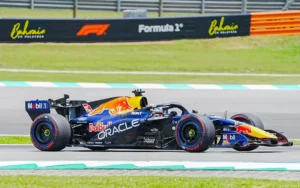
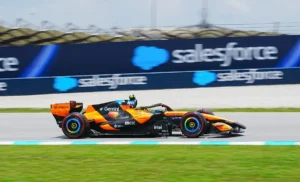
Formula 1 cars stopping dead on a formation lap is not supposed to happen. It happened to four of them in Malaysia, and now the FIA has promised a ‘full review’ into exactly how its own software let it happen in the first place.
The governing body confirmed it will investigate the chaos that unfolded before the Bahrain Grand Prix got going at Sepang, after a software issue brought several cars to a near standstill or a complete stop during the formation laps. This was not a case of drivers misjudging tyre warming in the wet. It was a systems failure that the FIA has openly admitted it never saw coming.
Four Cars, Two Laps, One Very Public Problem
With the race start already delayed, the field was sent out for two formation laps to assess the standing water left behind by the rain. Pole-sitter Max Verstappen was among the cars that slowed dramatically. Second-placed Lewis Hamilton fared worse, grinding to a halt on the back straight and holding up the cars behind him before tumbling down the order before the race had even begun. Esteban Ocon and Valtteri Bottas also stopped on track, at which point the FIA pulled the plug on the start sequence entirely and threw out the red flags.
RacingNews.Today has already covered how heavy rain and lightning delayed the Bahrain GP start at Sepang. What happened once the field finally did get moving is a separate mess entirely, and one the FIA cannot blame on the weather alone.
A Patch, Not an Apology
The red flag period lasted just under an hour while a software patch was worked on and immediately transferred to the teams. Whatever they did worked. The race resumed without a repeat of the formation lap farce, which is the only mercy in this entire saga. But the fact that a fix could be found and distributed in under sixty minutes raises an obvious question: why wasn’t this tested properly before four cars nearly became stationary roadblocks in the wet?
FIA single-seater technical director Nikolas Tombazis offered the closest thing to an explanation, pointing to the simple reality that the 2026-spec cars had never run a formation lap in genuinely wet conditions before. All previous wet running had come in Pirelli tyre testing or pre-season shakedowns, neither of which replicates the pressure of a live grid sitting on a grid slot with cameras rolling.
“[The issue was] not being tested in those specific conditions.” – Nikolas Tombazis
That is a tidy way of saying the software had a blind spot nobody thought to check until it was exposed in front of a global television audience. Pre-season testing exists precisely to catch this sort of thing, and wet-weather formation laps are not some exotic edge case. Rain at a grand prix is not hypothetical, it is inevitable.
The FIA’s Own Admission
To its credit, the FIA did not try to dress this up. The governing body issued a formal statement confirming the issue “had not been detected by the FIA or teams” until the cars were already out on track and struggling. That is a remarkably blunt admission for a regulatory body that spends most of its time managing message discipline as carefully as it manages track limits.
It also means every team on the grid was flying blind alongside the FIA. Nobody noticed until Verstappen, Hamilton, Ocon and Bottas were stranded in real time. For a sport that prides itself on reliability data down to the millisecond, that is not a great look.
What a Review Actually Needs to Find
Promising a “full review” is the easy part. Every governing body says this after an embarrassing incident, and most of the time it produces a quiet technical directive nobody outside the paddock ever reads. The real test here is whether the FIA can explain why wet formation lap running was never stress-tested against the new 2026 software before a points-paying grand prix, and whether that gap gets closed before the next time rain threatens a start.
Verstappen eventually recovered to win a chaotic affair, as detailed in our Bahrain GP race result report, so the on-track story has a tidy ending. The off-track one does not, not yet. A software bug that stops Formula 1 cars dead on a formation lap is not a minor glitch to be patched and forgotten. It is the kind of failure that belongs in a proper, published review, not a formal statement.
For now, the FIA’s position is on record: the fault went undetected by everyone involved, a patch was found within the hour, and a review has been promised. Whether that review produces anything more substantial than reassurance is the only thing worth watching for.