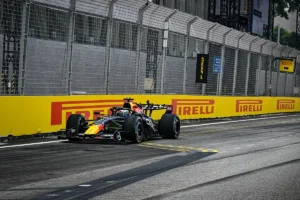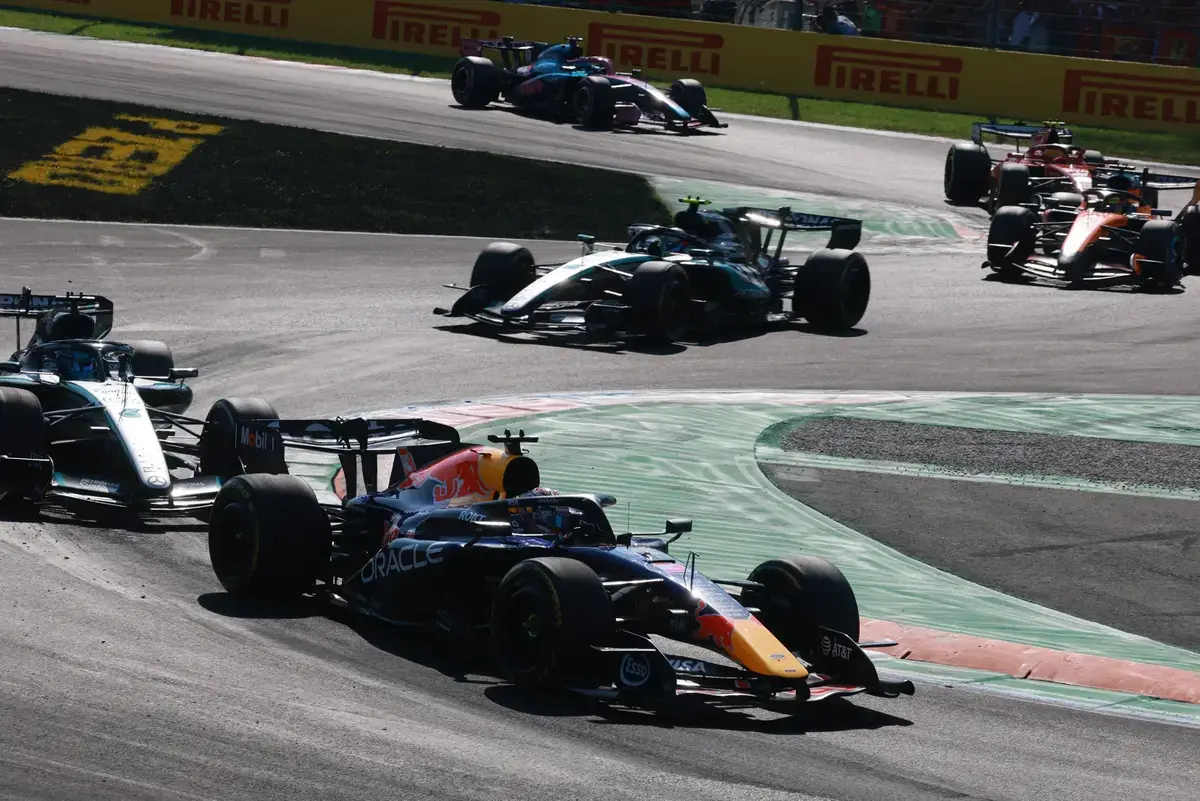

Max Verstappen has stopped dressing up Red Bull’s 2026 season as anything other than what it is: a rebuilding job with no title fight attached. In a strikingly candid interview with BBC Sport, the four-time champion confirmed his flirtations with McLaren and Mercedes were genuine, admitted Red Bull’s car has a problem nobody has fixed in more than a year, and delivered his bluntest verdict yet on the hybrid engines he clearly cannot stand.
This is not new territory for Verstappen, who has never been one for corporate soft-soap. But the tone here is different. There is no hedging, no diplomatic nod to “the process”. Just a driver sitting sixth in the standings on 127 points, 140 adrift of championship leader Andrea Kimi Antonelli, telling it straight: this year is about learning, not winning.
No Title Fight, No Pretending Otherwise
Asked directly where his head is at, Verstappen didn’t reach for the usual platitudes about fighting to the end.
“Of course it’s not where I want to be, but as a team we’re trying to just learn and understand a lot of things for next year. We are not in a title fight. We are just trying to find more performance.” – Max Verstappen
That’s a remarkable admission from a man who has spent most of his career refusing to accept anything less than a car capable of winning. The standings back him up: Red Bull sit fourth in the constructors’ table on 204 points, comfortably behind Mercedes, Ferrari and McLaren, and Verstappen’s five podiums this season have yet to be converted into a single win. Recent form offers little comfort either. His last three results read P3, DNF, P2, respectable enough, but nowhere near the front-running consistency of Antonelli or Lando Norris, who has won the last two races.
What’s Actually Wrong
Verstappen’s diagnosis of the car itself is refreshingly specific for a sport addicted to vague corporate language about “correlation” and “windows”.
“Overall we’re just lacking a bit of performance. The car is not where I want it to be feeling-wise, and the through-corner balance is too hit and miss between entry, mid and exit. It’s just fundamentally something in the car that we need to try and work on for the next year.” – Max Verstappen
He goes further, acknowledging this isn’t a one-season blip but a theme that has persisted across a change of regulations, which is the sort of admission that should worry Red Bull far more than a single bad Sunday. Personnel have shifted too. “Some people have left, new people have come in,” he said, without naming names, leaving open the question of whether the new arrivals are the fix or just fresh faces asking the same unanswered questions.
Why He Signed, and Why McLaren and Mercedes Were Real
Verstappen’s new deal with Red Bull runs to the end of 2030 on paper, but as he freely admits, it still carries performance clauses, meaning the contract changes far less than the length suggests. He was equally frank about why he put pen to paper despite the team’s struggles.
“It comes down to also feeling well within a team. This is like a second family to me. The belief that you can turn things around, you can build towards hopefully a better future with other people, new people.” – Max Verstappen
He also confirmed, without any attempt to spin it as media speculation, that talks with rival teams had taken place and were taken seriously.
“You talked to Mercedes last year, McLaren this year. Of course, any kind of chat you take seriously. They’re all very respectful chats. There’s nothing wrong with that. I felt that staying was, for me, the right choice.” – Max Verstappen
It’s a rare moment of transparency in a paddock where such conversations are usually buried under layers of denial until years later, if ever. Verstappen’s framing is that patience wins in the end, pointing to his own history of waiting out lean years at Red Bull rather than jumping to a faster car. Whether that patience survives another season like this one is the question nobody, including Verstappen, can honestly answer yet.
The Nurburgring Highlight and a Le Mans Dream
Away from the grind of a season without wins, Verstappen lit up discussing his Nurburgring 24 Hours appearance in May, where he and his GT3 team-mates were leading by around 30 seconds with three hours and 20 minutes remaining before a broken driveshaft ended the run.
“It was an incredible experience. And pure. Pure motorsport. Once I was in the race, you switch to another level. I was just in a zone. It’s really enjoyable.” – Max Verstappen
He also confirmed talks with Fernando Alonso about a possible Le Mans entry together, though he was careful to attach conditions: it needs to fit both schedules, and there needs to be a genuine shot at winning.
The Engine Rant
If there’s one section of this interview that will be quoted back at Verstappen for years, it’s his takedown of the current hybrid engine formula. He didn’t hold back on how the batteries and energy deployment have hollowed out the skill of driving on the limit.
“In the history of the sport, normally the driver that is the most committed, the latest on the brakes, earlier on throttle, committing in the high speed, they get rewarded. But now you’re constantly thinking about holding in a bit, going later on throttle, braking earlier. It’s so unnatural.” – Max Verstappen
He then reached for an example that will not please everyone in the paddock, pointing to how quickly Yuki Tsunoda and Liam Lawson adapted to unfamiliar machinery this season as proof the cars themselves are numbing driver input.
“No disrespect, and I hope no-one picks up on this. But look at Yuki. He jumps in the car, never driven it before, immediately competitive. Liam jumps from Racing Bulls to Red Bull, immediately competitive. It’s because these cars are numb to your driver inputs.” – Max Verstappen
His prescription for F1’s next engine era, expected around 2030 or 2031, is blunt: ditch the turbo hybrids entirely and go back to a lightweight V8, with batteries reduced to little more than a push-to-pass gimmick rather than a core part of performance. It’s a vision entirely at odds with F1’s current direction, and it puts Verstappen firmly in the camp of drivers who think the sport’s electrification push has gone too far, too fast. Given that Red Bull’s own engine credentials have become something of a running joke this season, a driver openly longing for the V8 era while sitting winless in P6 is not exactly a subtle message to send.
A Driver Rebuilding, Not Retreating
What comes through most clearly is that Verstappen has made peace with a season of learning rather than winning, without pretending it doesn’t sting. He rejects the idea of chasing a faster seat elsewhere purely to pad the résumé, framing his stay at Red Bull as a deliberate choice to rebuild rather than abandon ship. Whether that patience is rewarded next year, or whether Red Bull’s engine and chassis problems prove as stubborn in 2027 as they have been this year, will determine whether this interview reads as loyalty vindicated or a warning nobody at Red Bull heeded in time.