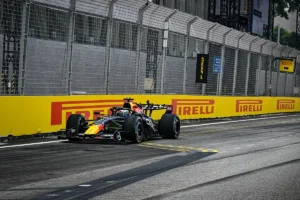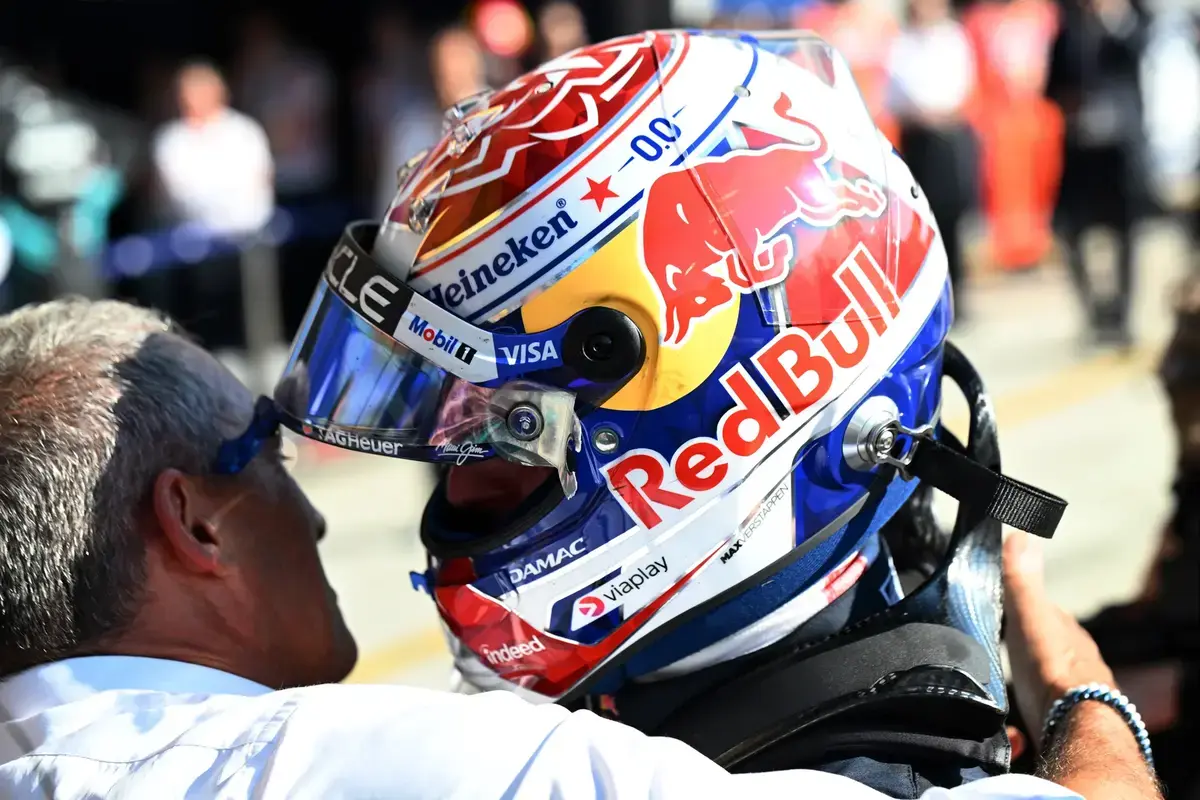

Max Verstappen stood on the Monza podium with a smile, a hug for the race winner, and a fairly blunt explanation for why he wasn’t the one popping the champagne up top. A straight-line deployment problem, in his own words, “cost us a lot”, and once the Mercedes pair got in front there was nothing to be done about it.
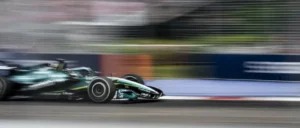
Kimi Antonelli won the Italian Grand Prix from nineteenth on the grid, with George Russell completing the Mercedes one-two, Verstappen’s race was a different beast entirely: a car that briefly led, then got walked past on the straights by cars it simply could not match, then had to fight its way back onto the podium through late braking and no small amount of bravado.
A Lead He Could Never Keep
Starting fifth, Verstappen wasted no time working through the field, dispatching Lewis Hamilton, Charles Leclerc and Pierre Gasly in the opening laps. When the race restarted following Leclerc’s heavy crash, a moment covered here, Verstappen briefly found himself at the front after getting past Russell. It didn’t last. Russell was back through almost immediately, and moments later Antonelli, who had spent the afternoon carving through the field from the back, sailed past too.
“I tried to battle but we were just too slow on the straight,” Verstappen said after the race. “We just lacked the same deployment, and that basically cost us a lot because at one point it’s not defendable anymore.”
That’s the sentence that matters here. Verstappen isn’t complaining about a car that was slow everywhere, he’s pointing at one specific, glaring weakness that turned a genuine shot at victory into damage limitation. Red Bull had the pace to lead a lap at Monza. It didn’t have the pace to stay there.
The Turtle Problem
Verstappen was characteristically colourful when asked how much he’d enjoyed the wheel-to-wheel scraps that followed, telling reporters, as Crash.net reported, that there wasn’t much to enjoy about being driven past “like you’re a turtle”. It’s a good line, and also a fairly damning one. When a four-time world champion starts describing his own car in reptilian terms, something in the deployment map needs fixing sharpish.
The technical issue, as Verstappen explained it, was specific to the zone between Turns 2 and 4, where Red Bull’s hybrid deployment simply couldn’t match the Mercedes-powered runners. That’s not a vague complaint about horsepower, it’s a precise diagnosis of exactly where the seconds were vanishing. On a circuit built almost entirely around straight-line speed, that’s about the worst possible place to be found wanting.
Pitting Under the VSC and Fighting Back
Verstappen’s response to losing the lead wasn’t to sulk, it was to pit for fresh hard tyres during a mid-race Virtual Safety Car and go again. He rejoined down in seventh and had to carve his way back past a queue of cars including the McLarens, eventually reclaiming third by the flag.
“I had to send it many times around the outside because we were just struggling a lot with deployment from turns two to four compared to our competitors,” he said, adding that “top speed wasn’t our friend today”, a phrase that will do just fine as the epitaph for Red Bull’s Monza weekend.
He was candid too about the limits of even his overtake mode. “As soon as they can hang in that overtake mode, it’s just too powerful for us to actually really defend that, even on better tyres,” Verstappen explained, noting it took him a while just to clear the McLarens despite the tyre advantage. When your fresher rubber isn’t enough to guarantee a quick pass, the problem clearly isn’t the tyres.
Podium as Consolation, Not Vindication
Context matters here. Verstappen arrived at Monza off the back of a difficult weekend at Zandvoort, where he’d been openly unhappy with the car, and Red Bull clearly found something between Friday and Saturday to turn that around. “For us to be on the podium after a very difficult weekend in Zandvoort, where the car was not really to my liking, we managed to have a strong turnaround from Friday to Saturday,” he said, while also flagging that “a few bits and areas” still need work, on top of the obvious straight-line shortfall.
That’s a fair summary of where Red Bull sits right now: capable of a podium on a track that should theoretically expose every one of its weaknesses, but only by relying on Verstappen’s braking and racecraft to paper over a deployment gap the engineers haven’t solved. The result flatters the car. The driver did the heavy lifting.
Where This Leaves the Season
Verstappen’s third place moves him to 127 points, still a distant sixth in the standings and nowhere near the title picture given Antonelli’s commanding lead at the top. Ten races remain, and Monza was never going to be the venue where Red Bull closed that gap regardless of how the deployment issue played out. But the underlying point stands on its own merits: a car that gets outrun on the straights at the fastest track on the calendar has a problem that won’t magically disappear at slower, twistier venues either, it’ll just be less visible.
Verstappen took the positives and ran with them in his post-race comments, calling it a “very good result” and admitting he was simply happy to be up there. Fair enough as a reaction in the moment. But a podium built on late-braking heroics rather than raw pace is a warning sign dressed up as a good news story, and Red Bull would do well to treat it as exactly that.