
Lewis Hamilton went looking for a gap that wasn’t really there, found gravel instead, and the FIA has just told him that’s entirely his own problem. The stewards looked at his first-lap coming together with Charles Leclerc at Monza, noted it, and closed the file without so much as a reprimand. No investigation. No penalty. Nothing.
For a governing body that loves nothing more than dragging drivers in front of the stewards for the mildest of track limits infringements, the silence here is notable. Two Ferraris banging wheels at the start of their home grand prix, one of them launched into the gravel trap, and the FIA’s verdict amounts to a shrug.
What Actually Happened at the Chicane
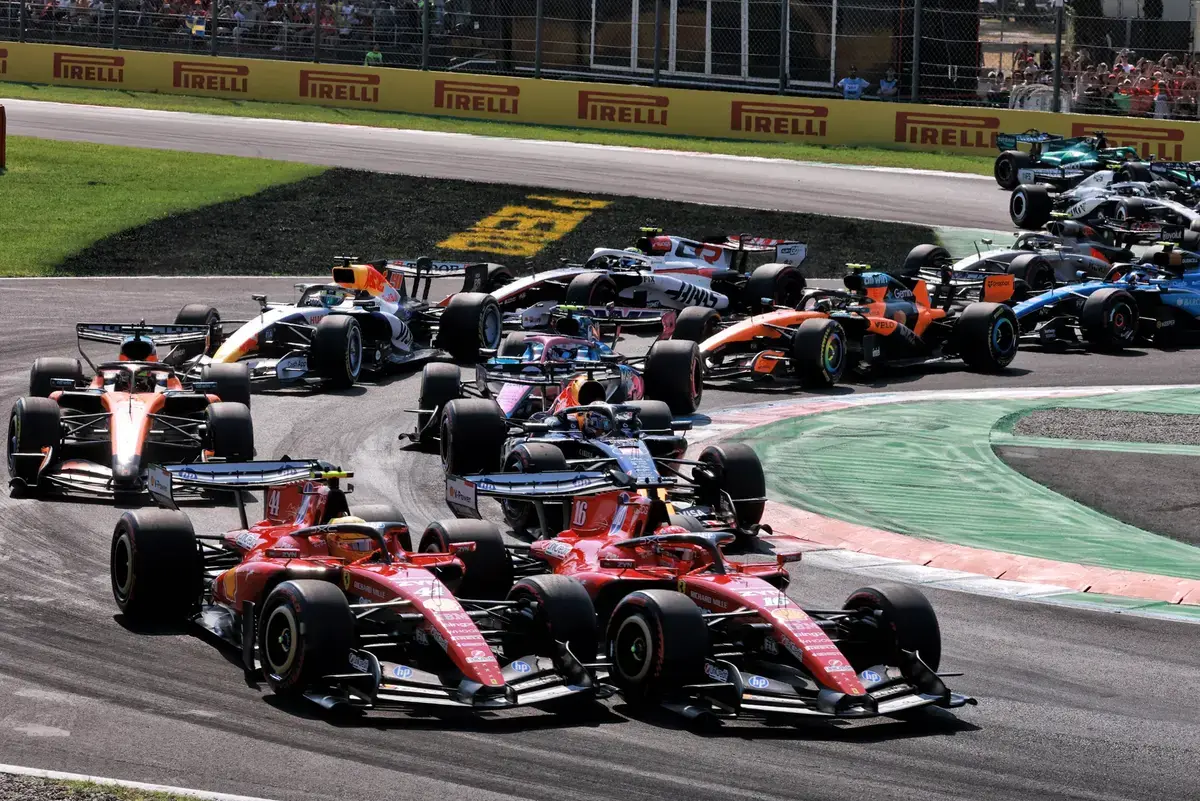
Hamilton and Leclerc lined up on Monza’s second row and both got reasonable starts, but it was Hamilton who had the tow and used it to dive down the inside of his teammate into Turn 1. Leclerc held his ground, took the inside line for Turn 2, and simply didn’t leave Hamilton anywhere to go. Two wheels found the gravel, Hamilton lost momentum, and he tumbled all the way down to tenth.
Over the radio, Hamilton didn’t hide his frustration, telling Ferrari that “Charles pushed me off.” It’s the sort of complaint that sounds compelling in the heat of the moment and rather less compelling once you rewatch the footage.
Sky’s Pundits Had Already Made Up Their Minds
Sky F1’s Martin Brundle wasn’t buying Hamilton’s version of events even before the stewards weighed in. “I’m sorry, Lewis, but Charles was always going to do that,” he said. “You bundle him into the first apex, he’ll bundle you straight back, and it has cost Hamilton dearly.”
Karun Chandhok went further, breaking down the geometry of the move corner by corner. He noted Leclerc got the slightly better launch, Hamilton had the tow, and by the braking zone there was just about enough room for Hamilton to be alongside, but only just. His conclusion was blunt: going around the outside of your teammate at the first chicane is a gamble that rarely pays off. “You put yourself on the outside in a position of risk by trying to go around the outside of another car,” he said. “That’s always a risky move and a gap that is always going to close.”
The Stewards Agreed With the Pundits, Not the Driver
Having reviewed the incident, the stewards decided no further action was required, effectively backing Brundle and Chandhok’s reading over Hamilton’s radio complaint. It’s a decision that lines up with the wider racing guidelines: a car overtaking around the outside needs to be ahead at the apex to be entitled to space, and by the FIA’s own footage, Hamilton wasn’t.
Whether that’s the correct application of the rules or simply the standard the stewards apply whenever two cars from the same team clatter into each other is a fair question. Plenty of similar incidents between rival teams have drawn far harsher scrutiny this season. When it’s an in-house squabble at Ferrari’s home race, apparently a note in the file is punishment enough.
Leclerc Already Admitted as Much Himself
Ferrari’s own driver didn’t need the stewards to tell him what happened. Leclerc later admitted the clash went too far for a home race, even as he pushed back on suggestions of a wider rivalry with his teammate, as reported by Motorsport.com. As Leclerc himself admitted, the clash went too far for a home race. What matters today is that the governing body looked at the same footage and decided there was nothing to see.
A Race That Got Away From Both of Them Anyway
The irony is that neither Ferrari driver ended up benefiting from the incident regardless of what the stewards decided. Leclerc’s afternoon unravelled a lap later when he spun out at Parabolica, an accident serious enough to trigger a red flag while the barriers were patched up, as covered in our report on the red-flagged Italian GP. Hamilton, having clawed his way back from tenth, salvaged a P6 in front of the tifosi, a result that barely registers against the chaos of a home weekend where the headline was Kimi Antonelli’s stunning win from P19.
Team Orders Talk Now Looks Even More Hollow
Before the race, Hamilton had openly called for Ferrari to prioritise the team, arguing that unity was the only way to beat Mercedes and win at Monza. He pointed to a chaotic qualifying session, where he squeaked into Q3 by just 0.001 seconds over Gabriel Bortoleto, as proof that individual agendas were costing the team dearly. “It’s obviously positive to make progress on the grid,” he said of the improved starting positions handed to both Ferraris after Oscar Piastri’s grid penalty, adding that with a single Mercedes ahead of them, “hopefully that gives us the chance to work together as a team and beat them.”
Within a handful of corners of the race actually starting, that plea for cooperation was in the gravel trap alongside Hamilton’s front-left tyre. If this is what team unity looks like under braking, Ferrari’s title credentials, however slim they remain given Antonelli’s commanding lead, deserve every bit of the scepticism they’re getting.
Nothing Changes if Nothing Gets Punished
The FIA’s decision not to act sends a fairly clear message to both Ferrari drivers: sort out your own squabbles, because the stewards aren’t interested in refereeing intra-team scraps unless someone ends up in the barriers. Given how this season has gone for Ferrari, with Hamilton and Leclerc far behind championship leader Antonelli, that’s an invitation for this exact scenario to repeat itself. Ferrari can talk about team unity as much as it likes. Until the stewards start treating these clashes as something worth punishing, the drivers have no real incentive to change how they race each other.