
Formula 2 rolled out its next car at Monza, and the headline news is not what it looks like. It’s what happens when it stalls.
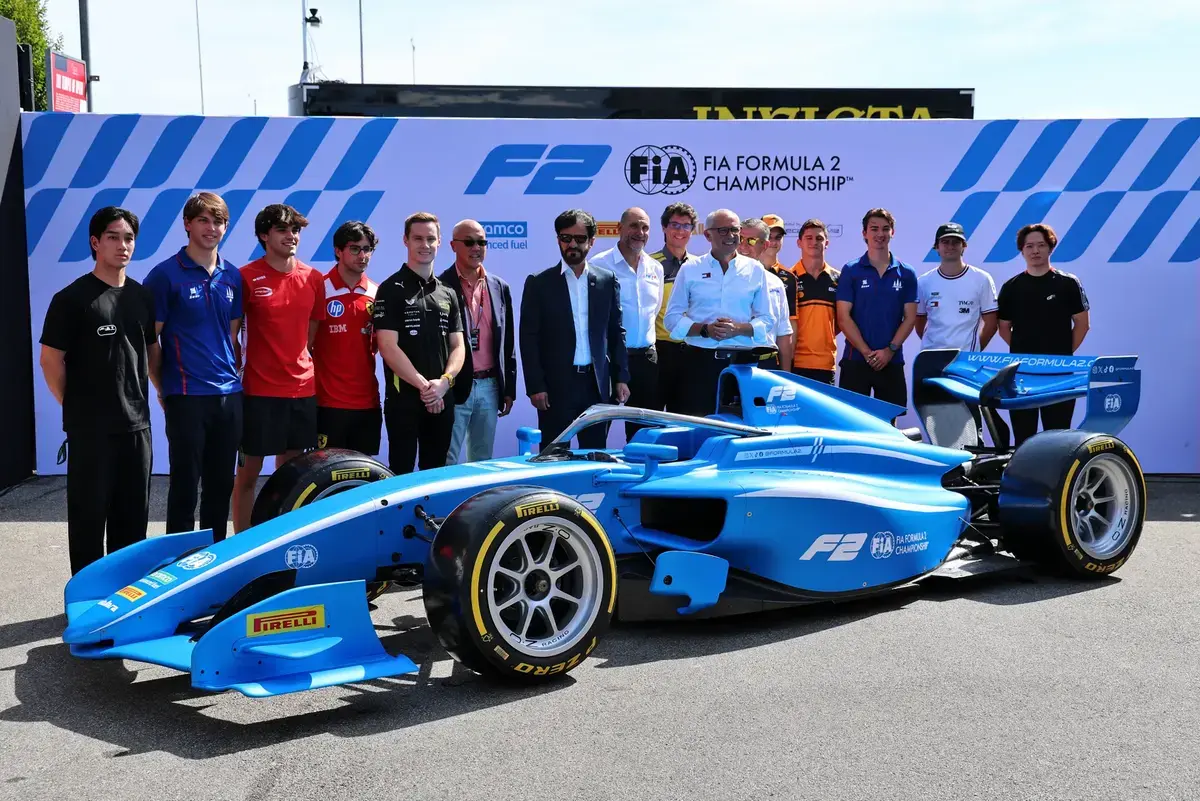
The support series unveiled its 2027-2029 challenger in a bespoke paddock event at the Autodromo Nazionale Monza, timed neatly to coincide with the Italian Grand Prix weekend. The car keeps the existing Dallara chassis to keep a lid on costs, but comes with redesigned front and rear wings, a fresh aerodynamic package aimed at closer racing, and, for the first time, an on-board starter so drivers who spin or stall no longer sit there stranded waiting for a marshal. It is a sensible update rather than a revolution, and that is precisely the point.
Evolution, Not Revolution, and That’s Deliberate
F2 has form here. The current car arrived in 2024 to echo the ground-effect look F1 ran from 2022 to 2025. This new one nudges the aesthetic closer to F1’s 2026 generation without tearing up the underlying package, according to The Race. Same 3.4-litre turbocharged V6 Mecachrome engine as the 2024-26 cars. Same 18-inch wheelrims that F2 was running years before F1 caught up. Same Dallara tub underneath the new bodywork. The bits that matter for a team’s budget stay untouched: braking performance, steering effort and cockpit ergonomics are all unchanged, which means the car remains accessible to a wide range of drivers rather than becoming another arms race only the richest can afford.
That’s the trade-off F2 has always had to manage. It wants to look and feel like the pinnacle it’s feeding drivers into, but it can’t price out the very drivers it exists to develop. Redesigning wings and adding a starter motor is the compromise: enough change to matter, not enough to blow the budget up.
The Starter Motor Is the Real Upgrade
Ignore the aero talk for a second, because the on-board starter is the change that will actually be felt every single race weekend. Anyone who has watched F2 knows the drill: a car spins, stalls, and its driver sits helplessly in the gravel or on the grass waiting for a marshal to arrive and give it a shove, often costing them the rest of the session or the race. F2 says this has been solved through what it calls an evolution of the current gearbox, supplied by Hewland. No more sitting in a stricken car hoping for track marshals to save your afternoon. It sounds like a minor mechanical tweak. In practice, it removes one of the most infuriatingly random ways a junior driver’s championship weekend could be wrecked through no fault of their own.
The Suits Line Up to Take Credit
Naturally, nobody launches a car like this without half the paddock’s senior figures queuing up for a soundbite. F1 president and CEO Stefano Domenicali called F2 the ultimate proving ground for the next generation of Formula 1 drivers, adding that the new car is another important step forward, combining innovation, safety and closer racing while maintaining the level playing field that allows drivers to showcase their ability.
“I want to thank His Excellency Mohammed Ben Sulayem and the FIA, Bruno Michel and his team, plus all the technical partners and teams whose collaboration has made this possible. We look forward to seeing the car on the grid, and watching this talented generation create their own stories as they fight for the opportunity to make their mark in Formula 1.” – Stefano Domenicali
FIA Formula 2 Championship CEO Bruno Michel framed the redesign as being led by a single priority: keeping the car as the right tool to get drivers ready for F1.
“Together with the FIA, we have opted for the current chassis and focused on redesigning the front and the rear wings. This enables us to keep the costs managed, while bringing the design closer to the look of an F1 car while enhancing the F2 car’s ability to deliver close racing.” – Bruno Michel
Michel also pointed to the starter motor as a genuine operational fix rather than a gimmick, noting it will allow drivers to restart their car after spinning or stalling on track, and reiterated the continued work with Aramco and Pirelli on driver preparation and sustainability. Whether fans notice any of the wing geometry is another matter. What they will notice is fewer sessions ruined by a car sat dead on the circuit.
Why This Matters Beyond the Paddock Photo Op
F2 isn’t just any support series, it’s the last rung before the top step, and its recent graduate list does the talking. Current championship leader Kimi Antonelli came through it before landing at Mercedes, as did Isack Hadjar at Red Bull and Arvid Lindblad at Racing Bulls. Every car change in this series is, in effect, a change to the tool used to shape the next batch of F1 talent. Get it wrong and drivers arrive underprepared. Get it too radical and only the wealthiest junior outfits survive to run it.
The current F2 title picture, incidentally, is being led by Red Bull junior Nikola Tsolov, a reminder that this series still has business to finish before any of this new metal turns a wheel in anger. The 2027 car won’t affect this year’s finale, but it will shape the grid that follows it, potentially including a team not yet on it. The Race reports the new car is expected to be the one used by Lando Norris‘s newly created LN4 Fusion outfit, which recently emerged under former Prema figure Rene Rosin. That entry has not been officially confirmed yet, though it is understood to be a formality, meaning the reigning grand prix winner’s junior project could be running this very chassis before long, a neat footnote given Norris’s own ambitions to reshape the junior ladder.
A Cautious Bet That Makes Sense
There’s a version of this story where F2 goes all in on a radical new car every cycle just to generate headlines. It hasn’t done that, and it shouldn’t. Keeping the Dallara chassis while sharpening the aero and finally sorting the stalling problem is the boring, sensible choice, and boring and sensible is exactly what a feeder series needs to be. Flashy full rebuilds are how you price talented drivers out of the sport before they’ve had a chance to prove themselves. F2’s 2027 car won’t dominate any highlight reels for its silhouette alone, but if it means fewer wrecked sessions and fields that can actually race each other wheel to wheel, that’s a far better legacy than a car that merely looks the part.