
Flavio Briatore accused an FIA judge of being in McLaren’s pocket. The FIA’s own appeal court has just told him, without ever using his name, that he is talking nonsense.
The International Court of Appeal released a statement on Saturday morning, hours before Italian Grand Prix qualifying, defending the independence of the panel that stripped Pierre Gasly of his restored Monaco podium. It is a rare thing for a judicial body inside motorsport to issue a public rebuttal like this, and the tone leaves no doubt about how seriously the ICA has taken Briatore’s outburst.
What Briatore actually said
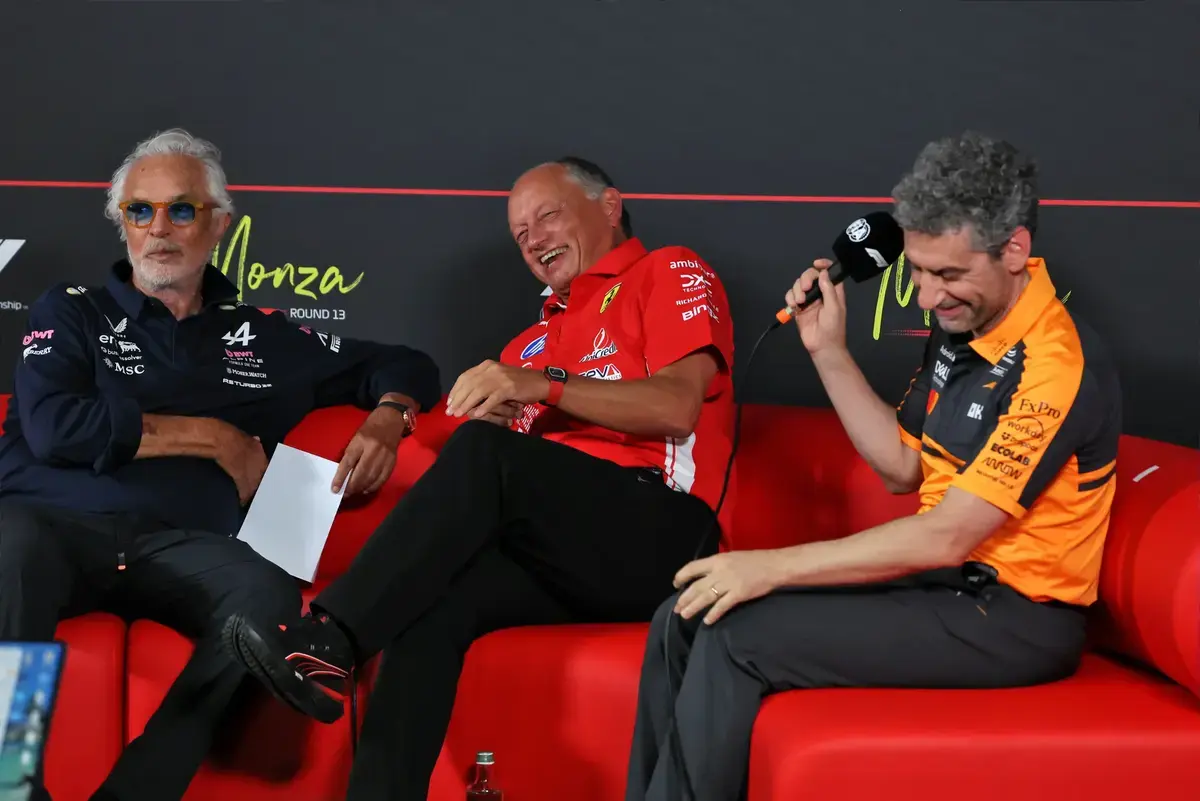
On Friday, in a press conference alongside Andrea Stella and Fred Vasseur, the Alpine executive advisor claimed judge Filippo Marchino acted like a “prosecutor” during the hearing and was “very nasty”, a description Briatore said he could live with. What he could not accept, he said, was Marchino’s supposed link to McLaren, citing a 2018 Beverly Hills event where McLaren Special Operations, the road car customisation arm with no connection to the F1 team, had provided vehicles. Stella called the insinuation “insulting” and warned that such claims need to be backed up. Marchino has not yet had his say; RacingNews365 reports he has been approached for a right of response.
The FIA Courts respond, sort of
The ICA never mentions Briatore by name. It does not need to. The statement opens by acknowledging it is “aware of public comments questioning the independence and impartiality of the judges of the panel that decided Case ICA-2026-06-07-08-09”, which is about as close as a judicial body gets to saying “we saw what you did on Friday and we are not having it”.
“The FIA Courts wish to make clear that the appointment and participation of the judges in that case, like for any other case, were conducted in accordance with the applicable FIA judicial procedures and usual practice, which are inspired by the highest standards like the IBA Guidelines on Conflicts of Interest in International Arbitration.” – FIA International Court of Appeal
The statement then walks through the mechanics nobody outside the paddock’s legal departments usually bothers to explain. Judges are elected by the FIA General Assembly, some nominated by a group of at least five F1 teams. Every judge discloses interests annually to the FIA Compliance Officer and signs a fresh declaration of independence for each case, a document that gets served to the parties involved. It is dry stuff, but it is precisely the sort of dry stuff designed to make Briatore’s photo-and-a-hunch approach look flimsy by comparison.
The line that actually stings
The killer detail sits halfway through the statement, and it is the part Briatore will struggle to explain away. Both at the start and the end of the hearing, all parties, Alpine included, were invited to raise objections about the composition of the court or the conduct of the proceedings.
“None did so. No objection was raised during the hearing concerning the manner in which the Court questioned the witness or conducted the proceedings.” – FIA International Court of Appeal
Read that again. Alpine had two separate opportunities, on the record, to flag concerns about Marchino sitting on that panel. It said nothing. Only after losing did the alarm bells about bias start ringing, which rather undercuts the idea that this was a genuine, pre-existing concern rather than a reaction to an unfavourable verdict.
Diversity of the bench as a defence
The ICA also leans on its practice of building panels from judges with different cultural and geographical backgrounds, arguing this diversity of legal traditions strengthens the fairness and credibility of the whole process rather than undermining it. It is a reasonable point, if a slightly defensive one: an institution explaining its own safeguards after someone has just publicly questioned whether those safeguards work.
Crucially, the ICA draws a hard line between criticising a verdict and criticising the people who reached it. Disagreeing with the legal reasoning behind a decision is fine, the statement says, and accepted by the judges themselves. Attacking the integrity of the judges is a different matter entirely.
“The Court is confident in the soundness of the proceedings and the integrity of the judges. The FIA Courts remain committed to the independence and impartiality of their judges and to the integrity of the judicial process.” – FIA International Court of Appeal
Context nobody should forget
The case itself, briefly: McLaren and Red Bull had appealed the stewards’ decision to rescind Gasly’s two five-second penalties for pit-lane speeding, penalties originally handed down at Monaco, then overturned after Alpine’s successful right of review, then reinstated by the ICA. The upshot was Gasly dropping to seventh and Isack Hadjar reclaiming third. Alpine initially said it disagreed with the ruling but would respect it. That respect lasted about a day before Briatore went scorched earth in front of the assembled media.
An unforced error with no obvious upside
It is hard to see what Briatore gains from this beyond a headline. The ICA’s rebuttal is measured, procedural and, crucially, backed by the simple fact that Alpine raised no objection when it had the chance. Unless Briatore can produce something more substantial than a photograph from an unrelated road car event eight years ago, this looks less like an integrity scandal and more like a team principal venting after a decision went against him. Marchino still has not spoken publicly. Given how thoroughly the ICA has just done it for him, he may not need to.