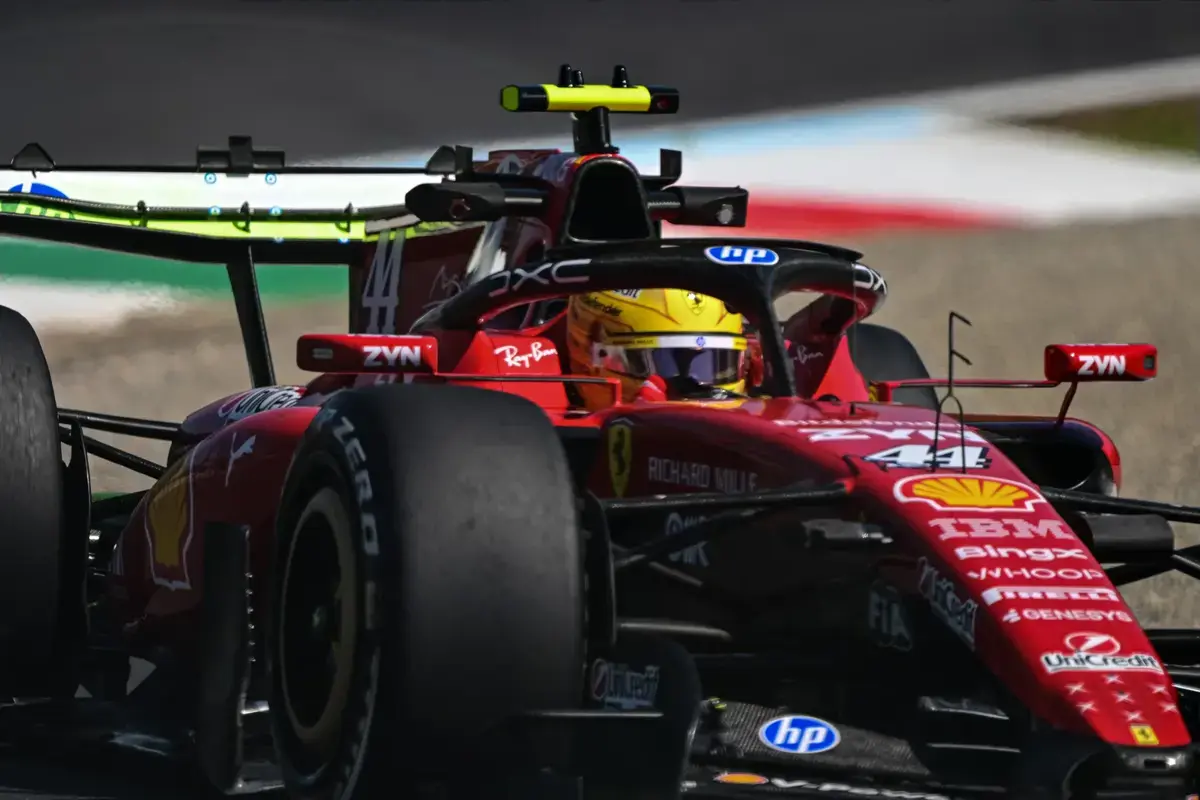

Ferrari brought a shiny new engine to its home race, the sort of upgrade you’d expect to be trumpeted from the top of Monza’s banking. Instead, Lewis Hamilton spent Friday evening explaining why it isn’t nearly enough. The problem, according to the man himself, is speed. Not cornering speed, not tyre wear, just plain old straight-line speed, and Mercedes apparently has bags of it.
The Deficit Hamilton Can’t Explain Away
Mercedes and Ferrari traded blows across Friday’s two practice sessions at Monza, with Charles Leclerc leading a Ferrari 1-2 in FP1 before George Russell hit back to top FP2 by 0.120 seconds from Leclerc, a result already covered in detail elsewhere on this site. Hamilton finished fifth in that session, 0.457 seconds off Russell’s pace, and it wasn’t the lap time alone that bothered him. It was where he was losing it.
“Straightline speed, it’s considerable to worry about,” Hamilton said. “Just looking at the deltas just there, I was losing something like six tenths to George, just in the straights. Which is something we need to look into.”
Six tenths on the straights at a track built almost entirely of straights is not a rounding error. It’s the difference between fighting for pole and fighting for a seat in the queue behind someone else’s slipstream, which, as it happens, is exactly the plan Hamilton is already resorting to.
An Upgrade That Was Supposed to Fix This
Ferrari arrived at its home round with a new power unit permitted under the ADUO regulations, reportedly worth around 15bhp and expected to roughly halve the straight-line gap to Mercedes. Hamilton gave it his blessing in principle. He just isn’t convinced it has done the job yet.
“The engine is an improvement which I’m really grateful for the guys back at the factory for working on,” Hamilton said. “But our deployment schedule is different to the others, our competitors.”
That’s a polite way of saying Ferrari might have more raw power available but isn’t using it the same way Mercedes and the rest are, whether by choice, by strategy, or by simply not having sorted it out yet. Fifteen extra horsepower is meaningless if it’s being deployed at the wrong point of the lap, and Hamilton clearly suspects that’s part of the story.
Team principal Fred Vasseur, never one to let an engine take all the blame, pointed elsewhere. “It seems like they maybe have less drag for the straights, so that’s something we need to definitely look at,” Vasseur said. “You have to keep in mind the performance in the straight line. It’s the drag, it’s the weight of the car, it’s everything. It’s not just the engine. We did a step for sure and we didn’t bring ADUO2 for nothing. But I think we still have a decent gap,” Vasseur told the media, as reported by Motorsport.com.
Reading between those two statements, you get a Ferrari that upgraded its engine, still trails on top speed, and now isn’t entirely sure whether the problem is horsepower, aerodynamics, weight, or all three at once. That’s not exactly the crushing home-race statement the tifosi were promised.
The Balance Problem Nobody Mentioned Before Friday
On top of the speed worry, Hamilton also struggled to get the car working underneath him. “It was really, really hard to pull the lap out of the car,” he said. “It was not an easy one to drive in FP2 for some reason. So we made a couple of changes but it shouldn’t have really been bad. So we might revert, but we’re going to look and see if we can make the car better.”
Translated from racing driver to reality, that’s a car that went backwards after a setup change nobody expected to hurt, on a weekend where Ferrari can least afford confusion. Hamilton finished the session 0.337 seconds slower than teammate Leclerc, which tends to happen when one side of the garage finds a working direction and the other doesn’t.
Antonelli Sees It Differently, and He Has Nothing to Lose
Not everyone shares Hamilton’s alarm. Championship leader Kimi Antonelli, who will start Sunday’s race from the back after a grid penalty for exceeding his allocation of engine parts, reckons Ferrari’s straight-line disadvantage has already evaporated. “Ferrari definitely took a step forward with the new engine and now the speeds are the same,” Antonelli said. “We know how good their car is in the corner and for sure it’s going to be a tight fight for pole tomorrow.”
It’s worth noting Antonelli has rather less reason to talk Ferrari’s pace down. Starting from the back gives him every incentive to make Sunday sound competitive and unpredictable rather than a straightforward Mercedes cruise, and Mercedes chose this exact race for that penalty because the long Monza straights offer him the best shot at clawing back positions. Whether that optimism about parity survives qualifying is another matter entirely.
Qualifying Turns Into a Slipstream Lottery
With straight-line speed this decisive, Saturday’s session at Monza is shaping up to be less about outright pace and more about who finds the best tow. Hamilton, who has the choice of running before or after Leclerc in qualifying, was refreshingly blunt about his priorities. “The tow is everything here so likely to be looking for the tow,” he said.
That’s an admission that raw car performance might not decide pole position at all this year, and it opens the door to the kind of scrappy, controversial qualifying session where drivers backing off to find a slipstream partner becomes the story rather than a footnote. Given Lando Norris’s already tetchy Friday after his near miss with Lance Stroll, the stewards may well be busy again come Saturday.
Qualifying gets underway at 14:00 UTC on Saturday, with the race following on Sunday at 13:00 UTC. Check the calendar for your local time before either session.
A Home Upgrade That Raised More Questions Than It Answered
Ferrari came to Monza wanting a statement. What it got was a driver openly questioning whether the deployment strategy behind its new engine actually works, a team principal blaming drag and weight almost as much as power, and a championship leader claiming the gap has already closed while starting from the back with nothing to lose by saying so. If Ferrari can’t settle on a single explanation for its own top speed by Saturday afternoon, Mercedes won’t need one. It’ll just drive past.