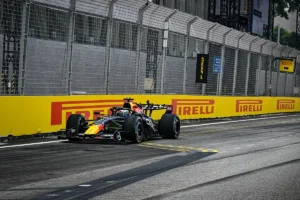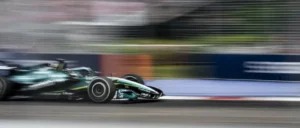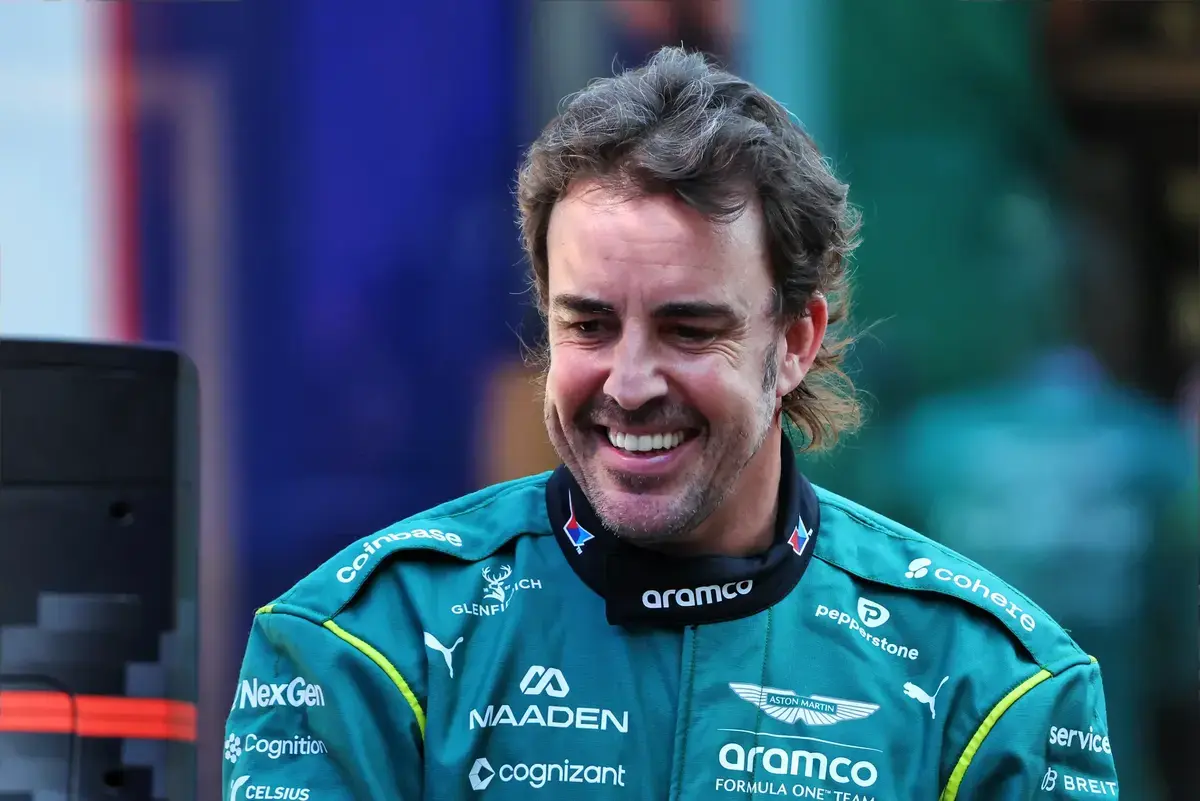

Aston Martin has quietly closed the book on its 2026 car. No more wings, no more floors, no more fresh aero parts of any kind. The only thing left to sort is the weight, and even that job has a deadline: Baku.
That is the headline admission from chief technical officer Enrico Cardile, who used the team’s Undercut interview feature ahead of the Italian Grand Prix to lay out exactly where development stands for the rest of this season and, more interestingly, where it is heading for 2027. It is a rare moment of a team saying the quiet part out loud: this car is what it is now, and the real project has already moved on.
The Upgrades Stop Here
Aston Martin threw a genuinely significant package at the Hungarian Grand Prix, effectively a B-spec car built around a new, lighter chassis and a revised front wing concept. Zandvoort brought further tweaks on top: revised floor fences and a modified diffuser winglet. Between the two, the team has introduced 34 updates this season, the joint-fourth-highest total on the grid, and second only to Ferrari when you strip it down to performance-related parts alone. By The Race’s estimate, nobody has spent more chasing lap time this year.
According to Cardile, that spending spree is now over.
“Those will be the last planned aero developments for this car.” – Enrico Cardile
There is a theoretical escape clause: if Aston Martin stumbles across something in 2027 development that’s worth track-testing now to sharpen correlation data, it might sneak onto the car. But as things stand, the cupboard is bare. “As of now, nothing more is scheduled,” Cardile added, which is about as final a full stop as an F1 technical director puts on a sentence.
The Only Job Left Is Losing Weight
The one area still moving is mass, not aero. Cardile confirmed the weight-saving programme remains unfinished and is targeted to wrap up by the Azerbaijan Grand Prix on September 24-26, after which Aston Martin will run what he called “the final version of the car for the rest of the season”.
Nobody at the team has put an official number on how overweight the AMR26 has been, but the working estimate is that the original version was carrying somewhere in the region of 10-15kg it shouldn’t have been. Cardile wouldn’t give a precise figure either, but was clear about the scale of the gain.
“It depends on what you choose as your reference race, but it’s a significant number, enough to dramatically improve lap time.” – Enrico Cardile
He described the process as part fine detail, part fundamental rethink. “Sometimes it comes from changing individual parts. Other times, it means rethinking how something was engineered in the first place, even the chassis. It’s a mix of small details and big structural ideas,” he said. By Baku, he expects the car to be “very, very close” to the minimum weight limit, which is exactly where every engineer on the grid wants to sit and precisely where Aston Martin has not been sitting for most of 2026.
2027: a Clean Sheet, on Purpose
This is where Cardile’s comments get properly interesting. Aston Martin’s recent uptick, the kind that let Fernando Alonso score a season-best ninth at Zandvoort, only his second points finish of the year, has apparently shifted the conversation inside the garage away from fixing the present and firmly onto next year.
“Now though, a lot of the conversation with them is about looking ahead. We’re asking: what are the limitations of the 2026 car, and how do we make sure we take another big step for 2027?” – Enrico Cardile
What follows is not a gentle evolution. Cardile was explicit that nothing from this year’s chassis is making the trip into next year’s regulations cycle. “Every single part will be new,” he said. “Everything will have been improved. But conceptually, it will be an evolution of the direction we took with this year’s car.” In other words: same philosophy, none of the actual hardware.
He went further, framing it as a deliberate refusal to be boxed in by what has, by most measures, been a difficult season. “We’re on the right path now, but we’re not tied to it. When it comes to tackling the ’27 project, we haven’t placed any constraints on ourselves in terms of trying to carry anything over from the previous car. In this sense, it will be a completely new car, and it gives us the freedom and mindset to achieve what we want.”
It’s the kind of statement that sounds encouraging until you notice what it’s really admitting: that the current package, weight problems and all, wasn’t worth building on. Given Aston Martin currently sits tenth in the constructors’ standings with 3 points, that’s not exactly a controversial conclusion, but it’s a rare case of a technical director confirming it in public rather than leaning on the usual talk of “learnings” carrying forward.
Honda’s Side of the Bargain
None of this happens in isolation from the engine supplier. Honda brought its spec 2 power unit to the Dutch Grand Prix, and Cardile was happy to credit it: “We’ve made a double step, if you like: a big increase in raw performance and a big improvement in driveability.”
Honda’s F1 chief engineer Shintaro Orihara has been blunter about where the limits now sit, a subject covered in more detail elsewhere, but on the development roadmap specifically, he confirmed at Zandvoort that the Zandvoort update is essentially the last major step of the year. Countermeasures developed at Honda’s Sakura facility may follow, and small calibration gains are possible, but nothing on the scale of a fresh hardware spec. “This is the only major update for this year,” Orihara said. “But if we found something, a good solution to improve our performance by small modification, that can be on the table. But there won’t be a major update before 2027.”
What This Actually Buys Aston Martin
Add it up and the picture is straightforward. Aston Martin has stopped throwing aero parts at a car it has already decided has hit its ceiling, is spending its remaining energy shedding kilograms it should never have been carrying in the first place, and has mentally checked out of 2026 in favour of a 2027 project with no sentimental attachment to anything currently in the garage. Honda, for its part, has one more round of software tinkering and not much else before the engine rules reset.
That’s a coherent strategy, and arguably the sensible one given where the team sits in the standings. But it also means the remaining 11 races of this season are, by the team’s own admission, essentially a data-gathering exercise dressed up as competition. Alonso’s ninth-place finish at Zandvoort was nice for the mood; it was never going to be the start of something. Aston Martin has effectively told everyone, in its own words, that the real fight starts next year.