
Helmut Marko does not scare easily. He has watched drivers crash for decades, mostly with a cigar in hand and barely a flicker of concern. So when the man himself admits he was startled, you know something properly hairy happened at Zandvoort.
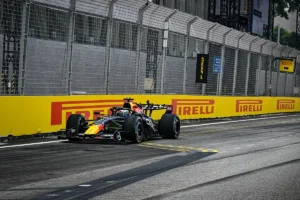
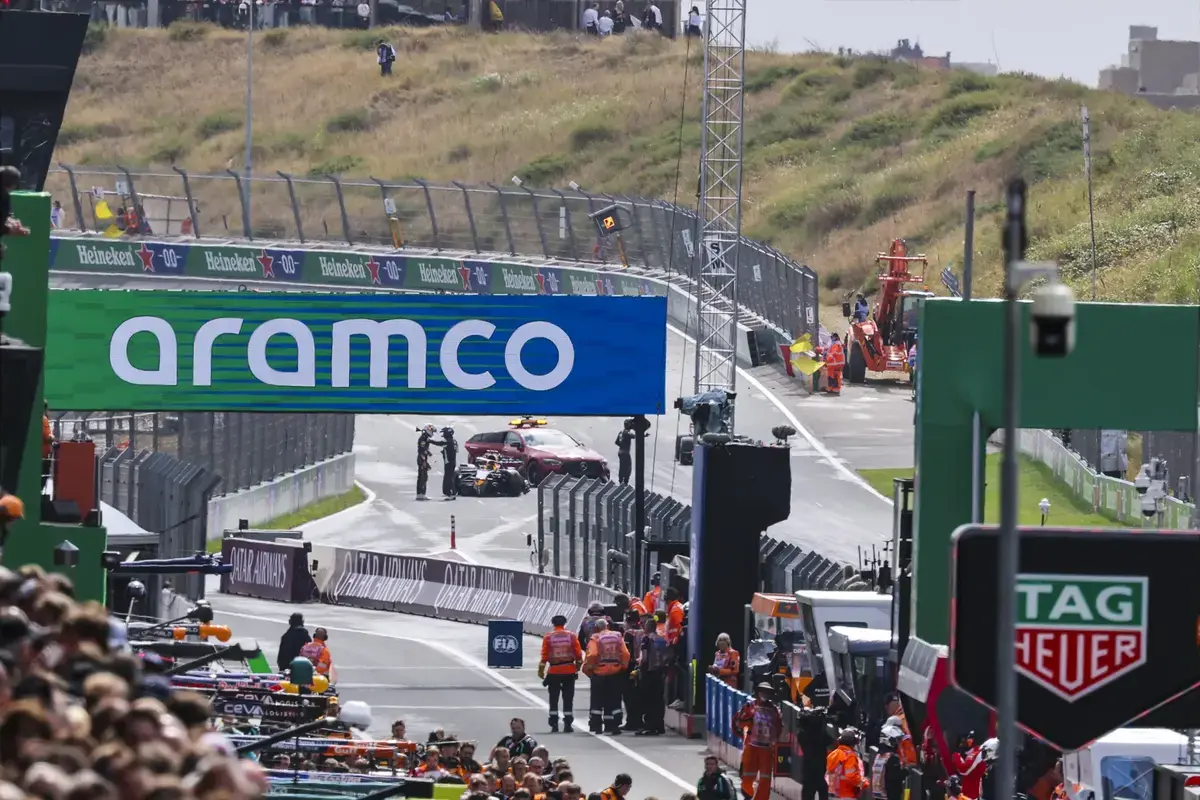
That something was Max Verstappen’s opening-lap spin at the final corner of what was likely his last home race in front of his own fans. The RB22 snapped sideways, left the four-time champion stranded across the circuit, and briefly turned him into a stationary target for the rest of the field bearing down at full speed. It could have ended very badly. It did not, but only just.
Marko’s Own Words Tell You How Close It Was
Speaking to Austrian outlet oe24, as relayed by RacingNews365, Marko did not dress this up as a routine off. He described the genuine alarm of watching his former driver stuck sideways on a live circuit.
“I was definitely startled when the car was sideways. Fortunately, there was some distance to the rest of the field, and fortunately, Liam Lawson reacted very well. If someone drives into a car that’s sitting sideways, it can get really dangerous.” – Helmut Marko
Note the two “fortunatelys” in one sentence. That is not the language of a man describing a minor scare. That is the language of someone who watched a near-miss unfold in real time and understood exactly how it could have gone. Had the gap not been there, had Liam Lawson reacted a beat slower, the story from Zandvoort would not have been about a disappointing result for the home favourite. It would have been about a stricken car being hit at speed on a circuit not exactly famous for run-off room.
Lawson’s Reflexes Did the Job Race Control Should Never Have to Rely On
Lawson, deputising for the injured Isack Hadjar at Zandvoort, gets the credit here, and rightly so. He was among the drivers who had to take evasive action to avoid ploughing into Verstappen’s stricken car, and his reaction is the only reason this article is about a fright rather than a genuine crisis. It is worth remembering that Lawson has now stepped in for Hadjar again for the upcoming Italian Grand Prix, so his sharpness behind the wheel is not exactly a one-off virtue this season.
Motorsport has a habit of treating these moments as routine because nobody got hurt. But the absence of an injury is not proof the danger wasn’t real. It is proof the danger was avoided, which is a different thing entirely and one that deserves rather less shrugging than it usually gets.
Checking on Verstappen From the Garage
Once the car came to a rest, Marko’s attention shifted from alarm to assessment. He said he could read Verstappen’s condition almost immediately just from how the Dutchman was moving in the cockpit.
“I could tell right away from the movement of his head that Max was stable. Then came all his comments: ‘I’m okay’ and ‘Sorry!'” – Helmut Marko
That apology tells you plenty about how Verstappen himself viewed the incident. Drivers rarely apologise for something they consider a pure racing accident or a mechanical gremlin beyond their control. A driver saying sorry after a spin at his own home race, on the opening lap, suggests he knew exactly whose fault this one was, even if the wider conversation around Red Bull’s underperforming package will inevitably try to muddy that.
A Season Where Red Bull Keeps Finding New Ways to Wince
Zandvoort was not an isolated blip in an otherwise serene campaign. Verstappen sits sixth in the standings on 112 points, and Red Bull currently trail Mercedes by close to 240 points in the constructors’ table. The RB22 has been a car that promises little and occasionally delivers chaos, and a driver of Verstappen’s calibre spinning sideways into oncoming traffic on home soil fits the pattern of a season that has refused to go smoothly.
Marko has been vocal elsewhere about what he sees as unfair FIA engine regulations holding Red Bull back, and about the RB22’s chassis development drifting the wrong way after a promising start. Both arguments conveniently locate the blame somewhere other than the cockpit. Neither explains why the car snapped sideways at the final corner with nobody else involved.
The Uncomfortable Bit Nobody Wants to Dwell On
Formula 1 loves a good near-miss story once it is safely in the past tense. Pundits call it drama, fans call it a talking point, and everyone moves on by the next race weekend. But Marko’s own choice of words, genuinely startled, potentially very dangerous, suggests this was closer to a serious accident than the sport’s collective shrug afterwards implied.
Verstappen walked away, said sorry, and the paddock carried on as normal. That is the best possible outcome. It does not, however, make the moment any less alarming, and it is worth asking why a car sliding sideways into a flat-out final corner, with the rest of the grid still arriving at speed, gets filed away as a talking point rather than a warning.