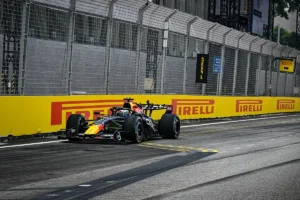

Red Bull has, on paper, the best internal combustion engine on the grid. On track, it has spent the season getting beaten by cars running what everyone insists is a lesser power unit. If that sounds like nonsense, that’s because it is, and David Coulthard has said so out loud.
The FIA’s ADUO system, the Additional Development and Upgrade Opportunities mechanism that decides which manufacturers get to tweak their engines, has ruled for a second time that Red Bull Ford Powertrains has the strongest combustion engine in Formula 1. The consequence is blunt: Red Bull stays frozen while Ferrari, Mercedes, Audi and Honda get to keep developing. Ferrari is even bringing an upgraded power unit to Monza, a week after Honda rolled out its own new package, as covered by this site’s report on Ferrari’s ADUO token.
A Test That Measures Half the Story
Coulthard’s problem isn’t really with the result. It’s with the method. ADUO only measures the output of the internal combustion engine, not the electrical side of the power unit, even though most people in the paddock reckon the electrical deployment and harvesting is where the real performance gap lives these days.
“There’s an old expression in Formula 1, that aero is king, and that’s always been the sort of mantra. We always tend to talk about aero rather than the horsepower per se, and there have been examples of teams winning world championships not with the most powerful engine.” – David Coulthard
Fine, nobody is claiming horsepower wins titles on its own. But Coulthard’s actual complaint, made on the Up to Speed Podcast, is that the FIA has built a measuring stick that only checks one part of a very complicated machine, and then handed out development rights based on it.
“What I think feels a bit like there’s been a missed opportunity, and it has been explained by the FIA, it was requested by the teams to have as simple a mechanism as possible, which fell to being only the internal combustion engine element of the power unit, which that to me just isn’t about being fair if they’ve all agreed to it. It’s like, why?” – David Coulthard
He didn’t stop there, reaching for an analogy that, while a bit clumsy, makes the point better than any press release ever could.
“It’s like saying we’re going to, I don’t know, set some kind of limit based on one body part or something in athletics, even though the whole body’s used. Even though the whole body’s used in the actual competition.” – David Coulthard
Everyone Agreed to This, Which Somehow Makes It Worse
Here’s the uncomfortable bit for anyone tempted to blame the FIA alone: the teams themselves asked for a simple mechanism. They wanted something clean and measurable, and they got it. What they got is a system that ignores the electrical storage and deployment side of the power unit entirely, despite that side being, in Coulthard’s words, massively complex and arguably decisive.
“So, the power unit as a whole isn’t just about the internal combustion. It’s also about the electrical storage capacity.” – David Coulthard
That matters because the electrical package is precisely where Mercedes is widely believed to hold its advantage, an advantage that shows up clearly in the standings rather than in any FIA dyno report. Toto Wolff has already admitted as much, and it lines up neatly with what’s happening on track: Mercedes sits top of the constructors’ table on 425 points, comfortably clear of Ferrari on 338 and McLaren on 263, while Red Bull languishes fourth on 186. If the combustion engine really were the decisive factor, Red Bull wouldn’t be where it is.
McLaren’s Data Headache Adds to the Case
Coulthard also pointed to a wrinkle that undermines the FIA’s simplicity argument even further. Customer teams don’t always get the information they need in time to exploit whatever advantage a power unit supplier might have.
“We know from McLaren at the beginning of the year that they were frustrated that they were getting the same power unit, but they were getting all the information on the power unit the week before the race, and it just wasn’t enough time to be able to run the simulations to work out the best way to deploy the energy.” – David Coulthard
So even if the combustion engine numbers were meaningful in isolation, teams still can’t always turn that into lap time without the right data at the right moment. Coulthard’s conclusion lands somewhere between bafflement and resignation.
“So, what we find is we’re in this classic sort of scenario where we all have to sit there going, ‘This doesn’t seem really the best.'” – David Coulthard
Red Bull’s Wider Problem Isn’t Just the Rulebook
It’s worth noting that even Red Bull’s own former advisor doesn’t think a rule change would suddenly fix things. The car has had balance issues on multiple circuits this season, and a tight budget cap makes correcting a wrong development direction painfully slow once you’re already behind. That’s a separate headache to the ADUO row, but it explains why nobody at Red Bull expects a quick fix even if the FIA’s methodology gets challenged again.
Max Verstappen has still managed three podiums this season despite all this, sitting sixth in the drivers’ championship on 112 points, some way adrift of leader Kimi Antonelli on 242. That gap alone tells you Red Bull’s engine, whatever the FIA’s paperwork says about it, is not the thing carrying this team.
A Rule Nobody Seems Willing to Defend on Merit
What’s striking is how few people in the paddock are actually standing up to defend ADUO on its substance. The teams signed off on it, the FIA implemented exactly what was requested, and now a former grand prix winner is publicly wondering aloud whether it’s the best anyone in a sport obsessed with technology could come up with. Red Bull has disputed the findings, unsurprisingly, but disputing a result is not the same as fixing a flawed test.
If a measuring system produces an outcome that contradicts what almost everyone watching the sport can see with their own eyes, the problem probably isn’t the eyes. Until the FIA agrees to look at the whole power unit rather than half of it, Red Bull gets to keep the hollow crown of best combustion engine while everyone else quietly upgrades the part that actually seems to matter.