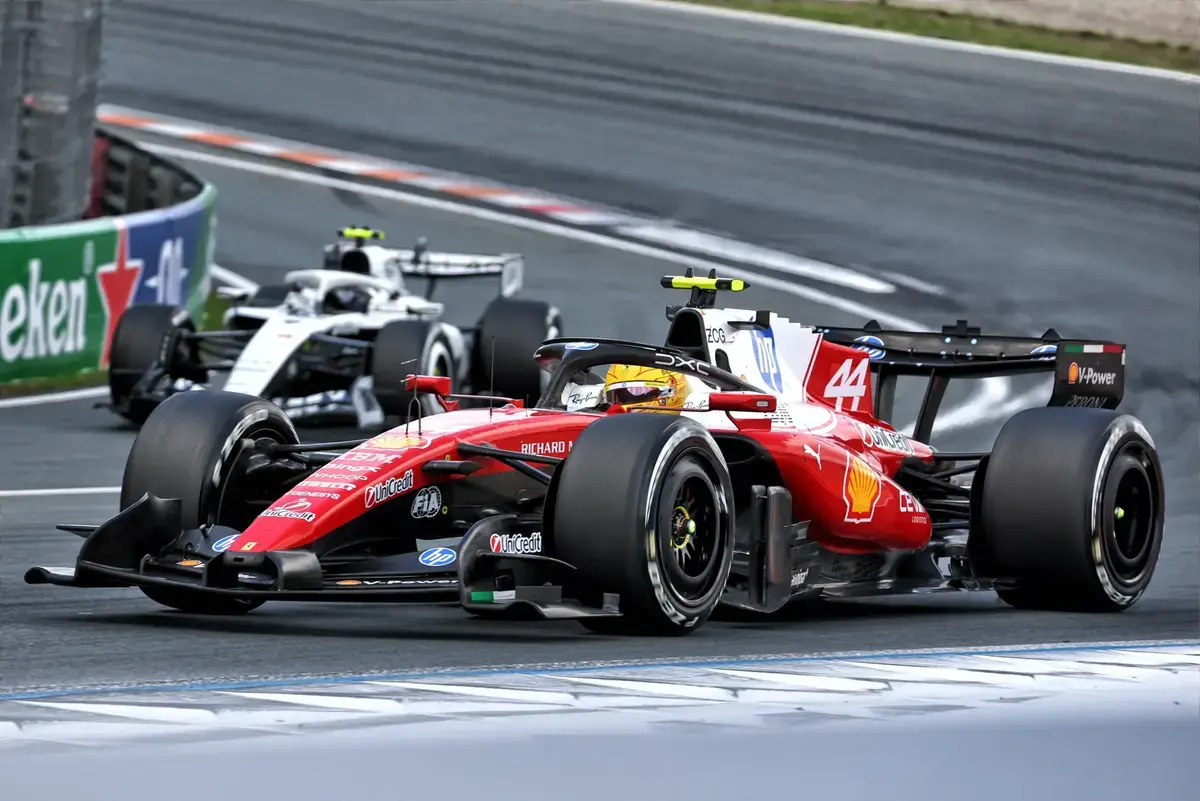

Lewis Hamilton didn’t get everything he wanted at Ferrari. There it is, straight from the top: Ferrari boss Fred Vasseur has confirmed that the seven-time champion’s list of demands after his miserable 2025 season wasn’t followed to the letter, which rather complicates the cosy story of a team bending entirely to its new star’s will.
The Mountain-Moving Myth, Slightly Deflated
Earlier this year Hamilton praised Vasseur for having ‘moved mountains’ to make him comfortable at Maranello, a phrase that’s been repeated so often it practically became Ferrari’s marketing tagline for 2026. It sounded great. A struggling seven-time champion arrives, team listens, team changes, driver flourishes. Tidy narrative, minimal friction, everyone smiling for the cameras.
Except that’s not quite how it went. Asked directly whether he’d been able to act on every single request Hamilton made, Vasseur didn’t dress it up.
“Yes, but we didn’t do everything that he wanted. But suggestions are always welcome. That’s true for Lewis; it’s true for Charles. It’s true for every single driver. After every single event, they are coming with a list of things that they would like to improve.” – Fred Vasseur, told Autosport
So the mountains got moved, some of them anyway. Others, it turns out, were simply not going anywhere, cost cap or common sense getting in the way.
What Actually Changed: the Brakes
The most concrete example to emerge from Hamilton’s list was brakes, of all things. Throughout a brutal first season in red, Hamilton complained repeatedly about feel underfoot, and it later came out that he’d specifically pushed for Carbon Industrie discs rather than the Brembo hardware Ferrari has used for years. From the Japanese Grand Prix in March, he got his wish and switched to the CI material he’d grown used to during twelve years and 84 wins at Mercedes, where six of his seven titles were won.
Charles Leclerc wasn’t far behind him. After struggling through Canada and Monaco, Leclerc adopted the same brake set-up Hamilton had fought for. Funny how that works: one driver spends a season complaining, gets his way, and suddenly his team-mate wants in too. It’s not exactly a ringing endorsement of Ferrari’s original set-up, is it?
Where Vasseur Drew the Line
But brakes were evidently the easy bit. Vasseur was clear that plenty of what lands on his desk after a race weekend simply isn’t feasible, whether that’s down to budget, regulation, or basic team logistics.
“On this list, some are out of scope, because you can’t do this for the team, and they can understand very quickly that, from a team perspective, it makes no sense for the cost cap or whatever it is. Sometimes they don’t have the full vision of the situation, but at least it’s good for me to understand where they feel we are weak.” – Fred Vasseur
That’s a diplomatic way of saying: drivers don’t run the cost cap spreadsheet, and sometimes their demands are simply wishful thinking dressed up as insight. Vasseur is polite enough to frame it as a two-way education process rather than drivers overstepping, but the subtext is fairly obvious. Hamilton, brilliant as he is, doesn’t get a blank cheque just because he’s won six titles somewhere else.
Shaking the System, on Vasseur’s Terms
Where Vasseur is happy to give Hamilton credit is in the broader cultural jolt his arrival provided. A team that hadn’t tasted a drivers’ title in its current era suddenly had someone in the building who knew, intimately, what winning consistently actually looks like.
“It’s good to shake the system a little bit. If you stay in your bubble all your life with the same people, at one stage you will struggle to improve. It’s true for the drivers. It’s true for the engineers when you recruit people from other teams.” – Fred Vasseur
It’s a reasonable point, and not a new one in Formula 1. Fresh eyes tend to spot problems that insiders have simply learned to live with. Whether that justifies every headline about mountains being moved is another matter, but Vasseur clearly sees value in the disruption itself, separate from whether every individual request got ticked off.
Leclerc Gets the Same Treatment
Vasseur was careful to stress this isn’t a Hamilton-only phenomenon. Leclerc, tipped to become Ferrari’s senior driver by 2027, apparently goes through the same process of pitching ideas that sometimes land and sometimes don’t.
“One of the key qualities of drivers is to be able to contribute to the development of the team. The worst-case scenario is that when you start the discussion and you have the feeling that the other is trying to find an excuse, but when you have a good relationship, it’s never an excuse.” – Fred Vasseur
That last line is doing some heavy lifting. Vasseur is essentially saying that as long as everyone stays friendly, unmet demands don’t curdle into resentment. Whether that holds up when Ferrari inevitably has another difficult weekend is a different question entirely, and one Vasseur will presumably be asked again before this season is out.
Results Suggest Something Is Working
Whatever the sales pitch, the results this year have at least given Vasseur some cover. Hamilton sits third in the standings on 183 points, Leclerc fifth on 155, with Ferrari second in the constructors’ standings behind a dominant Mercedes. Hamilton has taken a win in Barcelona, Leclerc in Britain. It’s not the title assault either driver signed up for, but it’s a considerable improvement on the version of Ferrari that had Hamilton grumbling about brake feel a season ago.
None of that proves every rejected suggestion on Hamilton’s list was a bad idea. It just proves that Vasseur, rightly or wrongly, gets to decide which mountains are worth moving and which ones stay exactly where they are. For a driver used to getting his way at Mercedes, that’s probably the biggest adjustment of all.