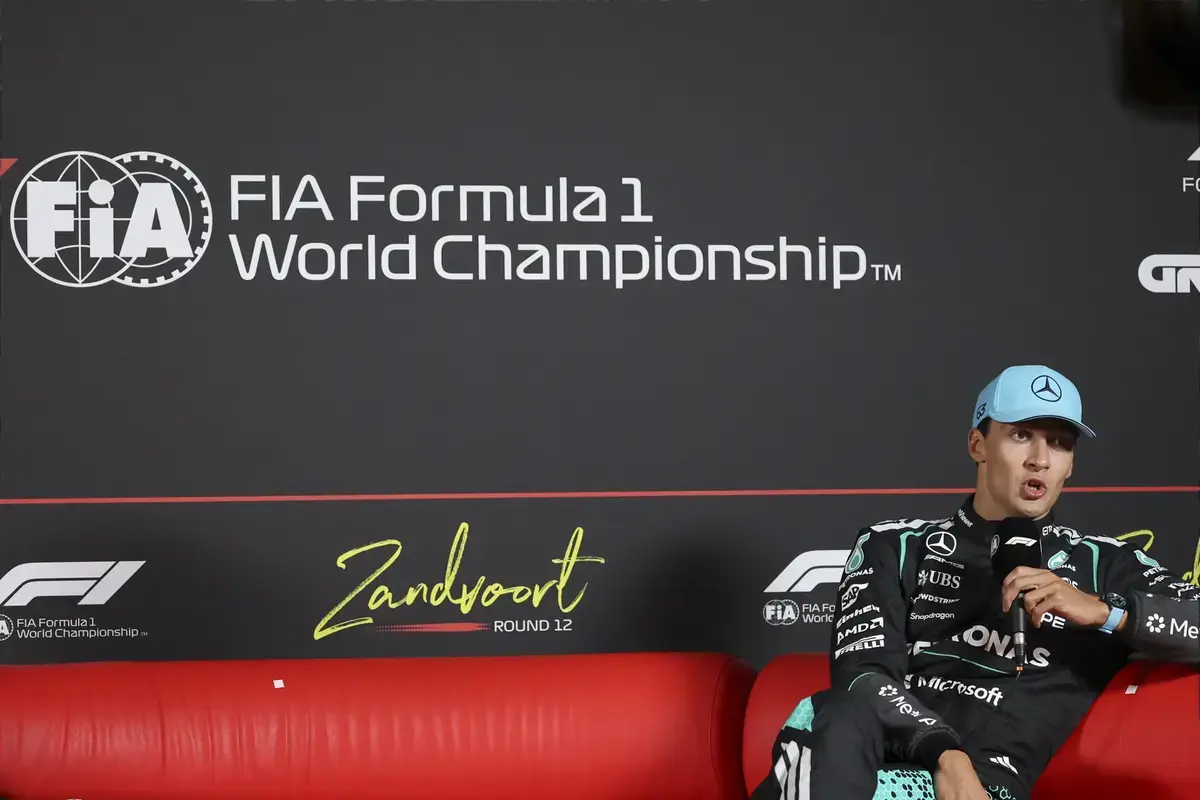

George Russell doesn’t need a good weekend at Monza. He needs a perfect one, and even then it might not be enough. That’s the blunt assessment from Jolyon Palmer, who reckons the Mercedes man has precisely one route left to keep his championship alive, and it involves beating his own team-mate from a grid he isn’t even starting on level terms with.
Speaking on the F1 Nation podcast, the former Renault driver laid out the maths in terms that leave no room for the usual PR fudge about ‘staying in the fight’ or ‘taking it race by race’. Russell trails Kimi Antonelli by 59 points after twelve rounds. His team-mate is about to take a grid penalty at his home race. And Palmer’s verdict is that if Antonelli wins from the back anyway, the title fight is effectively finished before Russell has even had a chance to capitalise.
A Penalty That Should Be an Opportunity
On paper, Antonelli’s grid drop at Monza looks like exactly the kind of gift Russell needs. A power unit change means the championship leader starts from further back than his rivals, in theory handing Russell a free run at closing the gap. Palmer isn’t so sure it works out that neatly.
“He could win it because the way that he’s been driving, I think Mercedes are the sure-fire favourites for Monza still.” – Jolyon Palmer
That’s the problem in a sentence. Even hobbled by a grid penalty, Antonelli remains the man to beat in what is still, by common consent, the fastest car on the grid. Reliability chaos, safety cars and strategy roulette could easily hand Antonelli a route through the field regardless of where he starts, and Monza’s long straights and slipstream battles are hardly a natural bottleneck for a car with Mercedes’ straight-line pace.
Why Palmer Doesn’t Buy the Verstappen Comparison
Every time a title favourite starts from the back, someone reaches for the Max Verstappen comeback-win comparison. Palmer got there before anyone else could and dismantled it.
“When you reference Max’s comeback wins, that’s largely against Checo, isn’t it? Who was a lot further away from Max’s pace than George is of Kimi’s. And George was better in Zandvoort.” – Jolyon Palmer
It’s a fair point, and one that flatters Russell rather more than it flatters the comparison itself. Verstappen’s charges through the field usually came against a team-mate operating in a different postcode, performance-wise. Russell is not that. By Palmer’s reckoning, he generally outdrove Antonelli in the Netherlands, even if the result didn’t reflect it.
Zandvoort Was Proof, Not Just an Excuse
Russell’s Dutch Grand Prix was a mess of bad starts rather than bad pace, and Palmer was careful to draw that distinction.
“I know he still didn’t put the race together. He had two bad first laps that set him apart. And his race pace wasn’t quite as good as Kimi’s either. But I don’t think in a clean race Kimi will come from 10th or 11th to beat George if George is anywhere near form from pole position.” – Jolyon Palmer
That last sentence is doing a lot of work. It’s a conditional built on two ifs: a clean race, and Russell starting from pole. Neither is guaranteed at a circuit where reliability, as Palmer notes, is about to become the story of the weekend rather than pure pace.
The Nightmare Scenario
Palmer didn’t hedge on what a Monza win for Antonelli, penalty and all, would actually mean.
“If Kimi wins in Monza with a grid penalty, he is champion. I’ll go as far as saying that. It’ll be such a crushing blow. He will have won his home race with a load of overtaking, huge aplomb, and it will suck the life out of George to not take points out of him in Monza. George has to win this.” – Jolyon Palmer
Calling a driver champion with eleven races still to run is a bold claim on its own, but Palmer’s logic isn’t really about the maths at that exact moment. It’s about momentum. An Antonelli win at Monza, in an Italian car at Ferrari’s backyard, carved out from a penalty, would be the kind of story that ends title fights psychologically long before it ends them mathematically.
Mercedes’ Priorities Are No Secret
None of this is happening in a vacuum, either. Former Haas boss Guenther Steiner has suggested on the Red Flags podcast that Mercedes has already made its pecking order clear to Russell, framing his role for the rest of the season as one of support rather than equal billing. Steiner’s reasoning was that picking a favourite is simply the smarter way to win a title, pointing to how McLaren’s decision to let both Lando Norris and Oscar Piastri race freely in 2025 nearly cost them the championship. Russell already experienced the sharp end of team orders at the Dutch Grand Prix, and it’s hard to imagine Monza offering him a completely clean slate if Mercedes decides protecting Antonelli’s lead matters more than letting Russell race for the win outright.
A Long Shot Dressed Up as a Must-Win
Russell sits level on points with Lewis Hamilton in the standings, both 59 adrift of Antonelli, which tells its own story about how far this title fight has already drifted from a two-horse Mercedes battle. Antonelli has won six of the last twelve races and leads comfortably; Russell’s own recent form, a podium finish, a distant seventh and a retirement across the last three rounds, hardly reads like a driver surging into contention. Calling Monza a must-win for Russell isn’t dramatic license from Palmer, it’s simply where the numbers point. Whether Mercedes’ own internal hierarchy even allows him to chase it unopposed is a different question entirely, and one Russell may not get to answer on his own terms.