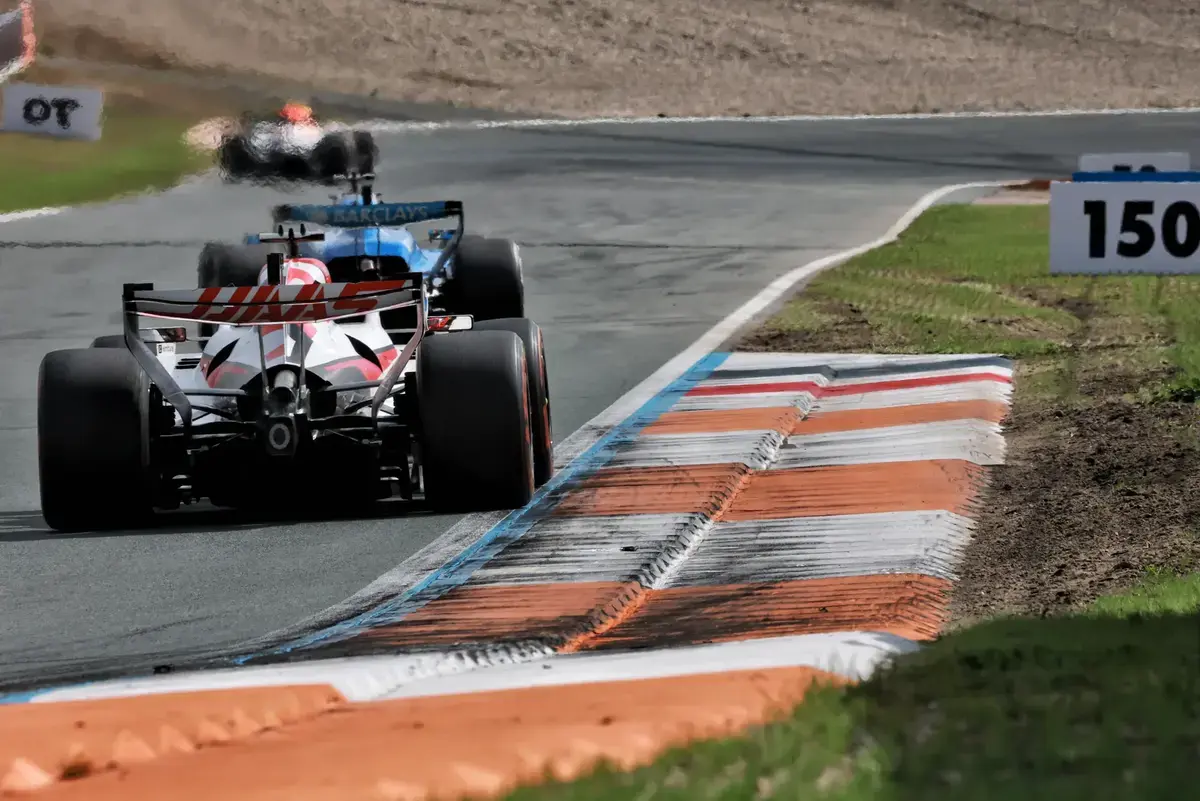

Esteban Ocon did everything right at the start of the Dutch Grand Prix. He got a good jump, found a gap, and passed Alexander Albon fair and square while the lights were green. Then Max Verstappen crashed, a red flag came out, and the FIA quietly rewound the race to how it looked at the end of lap one, as if Ocon’s overtake had never happened. It had, but apparently that’s not the point.
An Overtake That Never Was
Under current regulations, when a red flag is thrown, the running order reverts to the classification at the end of the previous lap rather than wherever cars happened to be when the flag dropped. In this case that meant Ocon, who had legitimately passed Albon, was shoved back behind him. Verstappen’s crash came after Turn 5, well into the second sector, but none of that mattered once the paperwork kicked in.
Ocon was blunt about it afterwards. “I overtook Alex, yeah, but I had the right because it was green,” he said of the move, as PlanetF1 reported. “What was a big shame is that you have to take all these risks, you are playing with either getting a penalty or not. I was not having a penalty, but it was very tight because I just passed him when he was green, and then they put you back at the race start.”
It’s a fair complaint dressed up as a shrug. Overtaking at the start of a Grand Prix carries genuine risk, wheel banging, track limits, the whole lottery of an opening lap scramble, and Ocon took that risk and won. Only for a red flag several corners later to erase it because of a regulation that treats “end of lap one” as some kind of sacred checkpoint, regardless of what actually happened between the two.
The Rule Nobody Questions
What makes this sting more is Ocon’s own timeline. “I mean, it’s been like that forever, but really, if I was 20 meters earlier than I would have had the place, but we still raced for one and a half sectors,” he explained. “So we passed Sector 1, and we were, you know, getting into Sector 2 so I should have started in front of Alex because that changed my race.”
He’s right that it’s been like that forever, and that’s exactly the problem. F1 loves to trumpet its technological arms race, its DRS tweaks, its sprint format experiments, yet a rule this blunt, this arbitrary, gets waved through year after year because reverting to “last lap” is administratively tidy. Tidy for the stewards, maybe. Not so tidy for a driver who took a genuine risk and then watched it get filed under “didn’t happen.”
There’s an obvious counterargument: freezing the order at a fixed point avoids chaos and prevents teams gaming red flag scenarios. Fine. But if the FIA can review a hundred marginal track limits calls a race weekend, surely it can find a cleaner cutoff than “wherever we happened to be one lap ago,” especially when the incident causing the red flag occurs well beyond that point.
A Retirement That Overshadowed the Argument
Ocon’s afternoon didn’t get any better from there. He retired from the race, his first DNF of the season, in a car he had otherwise found “bulletproof” all year. That reliability record now has an asterisk next to it, and Ocon knows the strategy call didn’t help either.
“After that, obviously, you know, there’s a lot of things that maybe we could have done differently with strategy,” he admitted. “I think Fernando did a really, really good strategy. I don’t think we could have done the same one without degradation. But there are things that we can look into to do a better job. But it’s the first reliability problem so far this season. It’s been bulletproof on that side.”
He’s referring, of course, to Fernando Alonso, whose Aston Martin got the tyre strategy spot on while Haas fluffed its lines. Ocon didn’t hide his frustration that it was “the two cars” affected, a rare reliability blip for a team that had otherwise gone the whole season without one. “Obviously, it’s the two cars, so it’s not ideal, you know, for this race, but we’ll look into everything, and hopefully next weekend, there should be some upgrades,” he said, looking ahead to the Italian Grand Prix, which gets underway this week at Monza. “We should be more competitive. I hope. So let’s see if we can get everything together.”
The Numbers Don’t Flatter Haas
Context matters here. Ocon sits on three points this season, a stark drop for a driver who scored at least 23 points in each of his previous eight full seasons in the sport. Haas as a team have banked 21 points and sit seventh in the constructors’ standings, some way adrift of the midfield pack above them. A weekend where the team’s reliability finally cracked, on the same day a legitimate overtake got wiped by a technicality, is about as bad as it gets without anyone actually crashing into anyone else.
Haas will point to upgrades arriving at Monza and hope that’s enough to arrest the slide. But Ocon’s complaint about the red flag rule deserves more than a shrug from the paddock. If overtakes made in good faith, under green flag conditions, can simply be deleted because of when a completely unrelated crash happens to occur, then the sport is asking drivers to take real risks for rewards it reserves the right to cancel. That’s not a technicality worth defending, it’s a rule worth fixing.