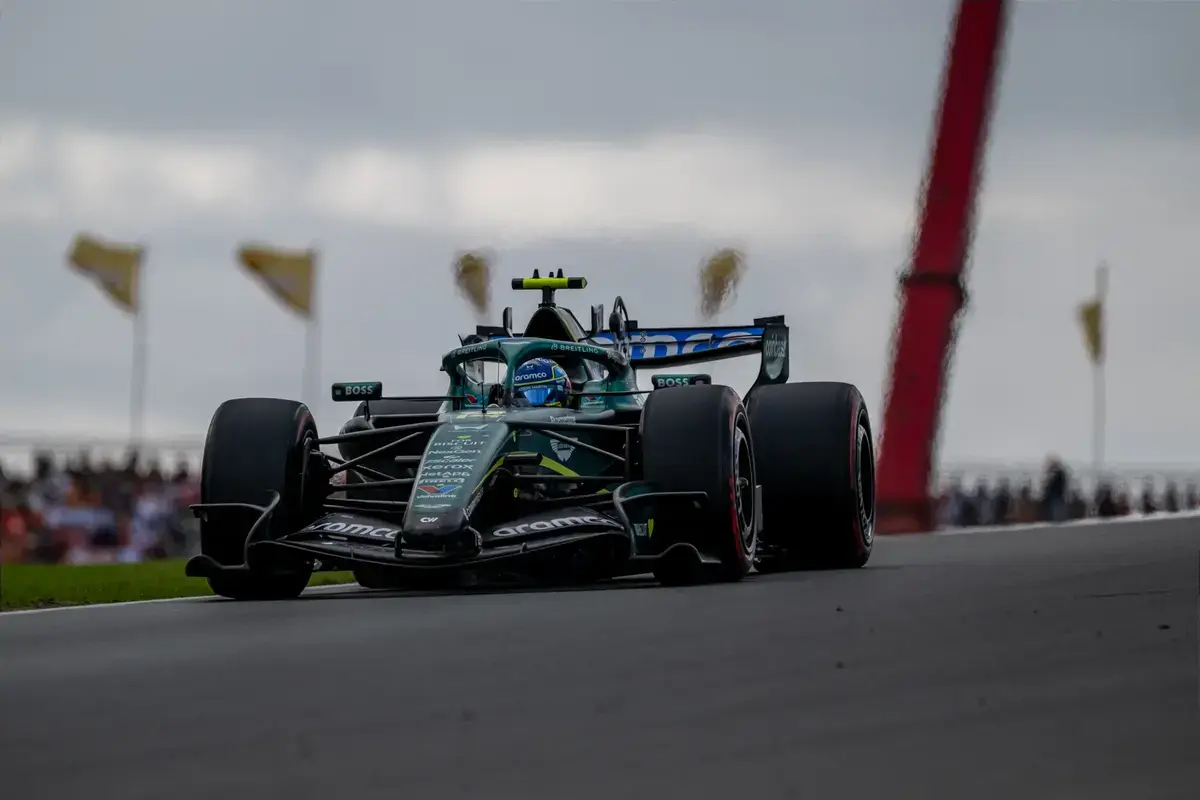

Fernando Alonso’s rear wing decided not to open at Zandvoort, and suddenly Pirelli is admitting something F1 would rather you didn’t dwell on: nobody quite knows what happens if this new active aero system breaks properly, mid-race, at full speed.
The failure itself was almost comically unglamorous. During Sprint qualifying at the Dutch Grand Prix, Fernando Alonso‘s Straight Line Mode refused to activate on his Aston Martin, leaving him dragging around Zandvoort with more resistance than intended. The result was about as humiliating as it gets: slowest of all 22 drivers. Not a crash, not fireworks, just a car that wouldn’t do what it was designed to do, and a driver stuck looking foolish through no fault of his own.
A System Built on Simulations, Tested by Accident
Straight Line Mode exists because the 2026 power units demanded it. With the new engines splitting output 50:50 between the combustion engine and battery, a fixed wing simply creates too much drag and too much downforce for the energy deployment to make sense. Active aero solves that on paper. In practice, it means the car is now dependent on a mechanical system working exactly as intended every single lap, and if it doesn’t, the consequences are not cosmetic.
Pirelli, who design their tyres around the loads generated when SLM lifts on the straights, suddenly had a real-world data point they didn’t ask for. Alonso’s failure told them something their simulations couldn’t: what actually happens to tyre loading when the system fails rather than performs.
“Honestly, we are checking because, for us, it’s interesting to gather this kind of data because it’s not really [something that happens] really often.” – Simone Berra
Berra, speaking to media including RacingNews365, made clear Alonso wasn’t an isolated case either. Other teams reportedly ran into similar issues in Free Practice, with front or rear wings not opening fully under test conditions. That is not one freak glitch, that is a pattern, and patterns in a safety-critical system tend to get expensive attention eventually.
Why Nobody’s Sending a Meatball Flag Yet
Here is the part that should raise an eyebrow: there is currently no mechanism to force a car into the pits if SLM fails mid-race. In theory, the black and orange meatball flag exists precisely for mechanical issues that could endanger a driver, and a stuck rear wing at 300 km/h arguably qualifies. Yet using it for an SLM failure isn’t on the table for the remainder of the 2026 season.
Berra didn’t dress that up as a triumph of caution, he simply confirmed it’s shelved for now, with an appetite to revisit it later.
“We can reopen the discussions, because the discussions were open in the middle of the season, so I think it is going more towards next season, and probably we can decide to reopen the discussions with the teams and the FIA. At the moment, there are no open points on this topic, it is closed. But for the future, I think we can discuss again.” – Simone Berra
Translated into plain terms without the corporate hedging: F1 talked about this mid-season, shelved it, and is now only reconsidering because a driver got embarrassingly lucky rather than genuinely hurt. That’s not exactly proactive governance, it’s reactive housekeeping dressed up as diligence.
Front, Rear or Both, All Bad News
Berra was at least specific about where the real danger sits. A rear wing failing to open is the most critical scenario for the rear axle, while a front-and-rear combination failure hits the front axle hardest. His own words left little room for spin.
“Very critical.” – Simone Berra
That’s not the language of an engineer downplaying a footnote. That’s the language of someone who has looked at the data and doesn’t love what he’s seeing, even if the sport isn’t yet ready to legislate around it.
A Problem F1 Can Postpone, Not Erase
None of this changes the championship picture, obviously. Kimi Antonelli still leads Mercedes‘s procession at the top, and Alonso’s own season, sitting well adrift of the front-runners, was never going to be defined by one qualifying session gone wrong. But this story isn’t really about Alonso’s grid slot, it’s about what F1 built into the 2026 regulations without fully pressure-testing the failure modes. Active aero was sold as the clever fix for the new power unit split; nobody seemed eager to talk publicly about what happens when the cleverness breaks.
Pirelli’s willingness to reopen talks is sensible, even overdue. But shelving a safety conversation mid-season because it was inconvenient, only to revisit it after a driver got away with an awkward qualifying result rather than a genuine accident, isn’t the reassuring outcome F1’s press office will want it to sound like. Sooner or later, someone won’t be as lucky as Alonso was at Zandvoort, and by then “we can discuss again” will look like exactly the kind of sentence nobody wants read back to them.