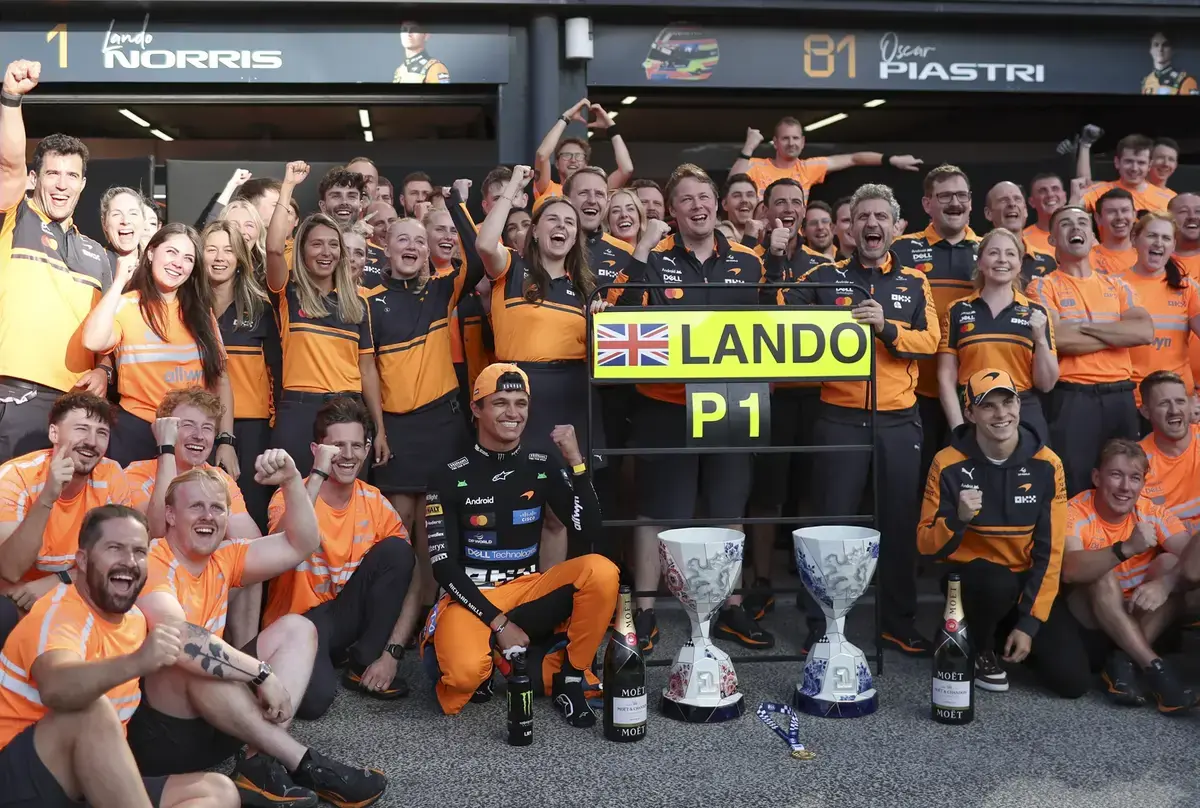

Lando Norris took pole and won the Dutch Grand Prix for McLaren. His own team boss was not there to see it. Zak Brown was in Washington D.C., watching an IndyCar race instead, and he is not remotely sorry about it.
There is something quietly brutal about a CEO admitting, on camera, that his team runs perfectly well without him. But that is exactly what Brown told Will Buxton in an interview with SPEED, explaining why he chose the inaugural IndyCar street race in the American capital over watching Lando Norris take McLaren to victory at Zandvoort.
Double Triple Top Secret, Apparently
Brown’s justification leaned heavily on charm rather than substance, which is fairly on brand. He described dialling into Zandvoort via what he called his “double-triple top-secret laptop,” as though following a Grand Prix from a hotel room in D.C. required MI6-level clearance rather than a decent WiFi connection and F1 TV.
“I’d like to be at both, but I’ve not been able to figure that out. My role is to go where I can have the most impact on our racing teams, where’s the most commercial activity, the biggest growth for the different racing series we’re in and the teams.” – Zak Brown
Fair enough, in theory. Except the underlying admission is the interesting bit. Brown openly conceded that his three racing operations “can survive just fine” when he skips a race weekend, which is either refreshing honesty or a slightly awkward thing for a CEO to say out loud, as reported by Motorsport.com.
Pole Position Envy
Brown’s comments were recorded before Norris took the chequered flag at Zandvoort, but he had already seen the McLaren driver claim pole and joked that he could not exactly take credit for that from a different continent. His solution was to lean on his own IndyCar drivers instead, telling them someone needed to grab pole in Washington so he would have something to boast about on home soil. Nobody obliged. Arrow McLaren’s Christian Lundgaard finished second in the Freedom 250, behind race winner Kyle Kirkwood, while Nolan Siegel and Pato O’Ward trailed in further back. No pole, no bragging rights, and Brown still flew home having missed a McLaren Grand Prix win.
The Real Reason: Money, Obviously
Strip away the jokes about secret laptops and what is left is a straightforward commercial calculation. The Washington race drew several high-profile business figures and, according to Brown, the president of the United States himself. FOX reported it as the most-watched non-Indy 500 IndyCar race since 1995, pulling in over 3.2 million viewers. For a CEO whose job increasingly resembles running a diversified sports conglomerate rather than just a Formula 1 outfit, that kind of audience and that room full of new sponsors is not something you skip for a race your team was heavily favoured to win anyway.
“At the end of the day, that’s why I’m here. We’ve got great partners in Holland, but this is new, so we have a lot of first-time partners here, a lot of prospects here.” – Zak Brown
Translate that out of corporate-speak and it reads as: Zandvoort is a known quantity, Washington was a room full of new money. When McLaren is comfortably third in the constructors’ standings and Norris is doing the winning without needing a pep talk from the boss, the calculation that “presence in Holland is optional” starts to make a certain cold sense.
What This Says About McLaren’s Priorities
None of this is really about one missed race weekend. It is about where McLaren, and by extension Brown himself, sees its future growth. The team has spent the year locking in commitments elsewhere, from extending Norris’s contract to 2030 to expanding its footprint across multiple championships. IndyCar’s push into new American markets fits neatly into that broader ambition of turning McLaren Racing into a genuine multi-series commercial empire rather than a single-minded Formula 1 outfit.
That is a defensible business strategy. It is also a slightly awkward look when your Formula 1 team, sitting well clear in the championship battle behind Mercedes and Ferrari, delivers a pole and a win and the man at the top is elsewhere congratulating himself on someone else’s crowd numbers.
The Bottom Line
Brown gets to have it both ways here. He praises Zandvoort as “epic,” calls the win nice, then explains why he was hundreds of miles away for it. Modern F1 team principals increasingly behave like this, treating race weekends as just one commitment among many rather than the sacred obligation fans imagine them to be. Maybe that is the honest state of the sport now: even the man running one of its biggest teams has decided a Grand Prix win is not appointment viewing when there is a bigger commercial story unfolding somewhere else. Norris probably didn’t mind the trophy arriving without an audience from upstairs. Whether fans should feel quite as relaxed about it is another question entirely.