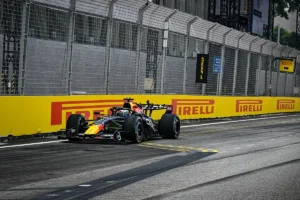

Max Verstappen staying at Red Bull until 2030 is old news now, covered when the announcement landed at Zandvoort on Thursday morning. But strip away the initial headlines and there is a bigger story sitting underneath, one that concerns legacy, record books and what this commitment actually means for the sport over the next half-decade.
Because this is not simply a driver renewing his contract with a team he likes. This is the architecture of an F1 career that, if it runs its course, will stand as arguably the most singular sporting partnership the paddock has ever produced.
The Record in His Sights
Numbers first. Max Verstappen joined the Red Bull programme in 2015 and made his debut with the senior team in 2016. If he sees out the new deal to the end of 2030, that is fifteen years at the same organisation. The current benchmark for the longest driver-team partnership in F1 history belongs to Lewis Hamilton and Mercedes, who shared twelve extraordinary years together. Verstappen is targeting a record that sits three years beyond that, and he is doing it with a team that is, at this precise moment, fourth in the constructors’ standings and yet to win a race in 2026.
That context matters enormously. Records set during periods of dominance are impressive. Records built through loyalty during difficult times carry a different weight entirely. Verstappen is not cosying up to the best car on the grid. He is making a bet on Red Bull’s recovery, and on his own ability to drive that recovery from the front.
A Promise to a Dead Man
What gives the decision its emotional texture is the thread that runs back to Dietrich Mateschitz, the Red Bull co-founder who died in October 2022. Verstappen had told Mateschitz, while he was still alive, that his ambition was to finish his career at Red Bull. That was not a contractual clause. It was a stated intention, made to the man who arguably built the team around him.
As reported by The Race, Verstappen addressed that directly on Thursday:
“I always said, and I said this when Dietrich was still alive, I said, my goal and target is to finish my career in this team. We’re getting closer to that. There’s still a lot of years ahead, but that’s still the target.” – Max Verstappen
That is not PR language. That is a man trying to honour something personal. It also reframes the entire narrative around the talks with McLaren and the contract speculation. Those conversations, real as they may have been, were always operating in the shadow of an older, deeper commitment.
What Red Bull Actually Gains
The sporting implications for Red Bull extend well beyond having a fast driver in the car. Verstappen is, at this point, woven into the team’s culture in a way that goes far beyond lap times. He has been at the organisation for over a decade. He is involved in high-level strategic conversations. He has relationships across every department. His presence on the driver roster makes Red Bull a more attractive destination for engineers, technical staff and commercial partners alike.
Team principal Laurent Mekies was admirably direct about this when explaining the significance of the deal. He described it as one of three pillars required to restart Red Bull’s winning cycle, the others being the talent pool at Milton Keynes and a series of undisclosed strategic decisions involving a new wind tunnel and other unspecified developments. Verstappen’s signature provides the public anchor for a project that needs credibility as much as it needs horsepower.
“When you are able to say that the fastest driver in the world, more than the drivers, for the team he is with us, it’s a massive stability element. It’s a massive ambition element.” – Laurent Mekies
That is a fair point, even if Mekies is obviously incentivised to say it. A team that is currently outpaced by Mercedes, Ferrari and McLaren retains a legitimate claim to being a title contender so long as Verstappen is in one of its cars. Remove him, and that argument collapses entirely.
The V8 Wildcard
One element of the deal that has not received enough attention is what the 2030 end date potentially signals beyond the contract itself. V8 engines are currently pencilled in for 2031, a shift that Verstappen has publicly endorsed. His deal running to 2030 is not accidental framing. It leaves the door open for a conversation about racing an entirely different type of F1 car, one that by all accounts is closer to what he actually wants to be driving.
Verstappen was characteristically blunt about the current hybrid formula. He has never hidden his frustration with the 2026-specification cars, and the early months of this season pushed him close to walking away from the sport altogether, as we covered when Verstappen admitted retirement was closer than a team switch. The improvement trajectory matters here. The FIA has made in-season adjustments, with further shifts planned for 2027 and 2028 that will gradually move the power split further towards the combustion engine. Verstappen says he can live with that, and the prospect of V8s beyond his current deal makes the long-term arithmetic more palatable.
What the Legacy Actually Looks Like
Compare Verstappen’s career arc to the drivers who preceded him at the top of the sport. Schumacher left Ferrari, went to Mercedes, achieved very little and complicated what had been a pristine second chapter of his story. Hamilton left Mercedes for Ferrari in search of a dream that, so far in 2026, has delivered a championship contention but not the dominance he once commanded at Brackley. Both men chose movement. Verstappen has chosen roots.
There is an argument that staying through a difficult period and dragging a team back to the top is a more compelling legacy than leaving for a better car. If Red Bull recover and Verstappen wins a fifth, sixth or seventh title with them, the narrative writes itself. If they do not recover, he will have stayed loyal through failure, which carries its own kind of reputation.
Either way, the record for the longest driver-team partnership in F1 history is now a realistic target. That is not nothing. In a sport that churns through driver moves and contract dramas with industrial regularity, fifteen years at one address would be extraordinary. And given everything Verstappen admitted about wanting to quit the sport entirely after the first few races of 2026, the fact that we are now talking about him potentially being here until 2031 and beyond is quite the turnaround.
Red Bull had better deliver on the promises they made. Because if they do, this extension could be the foundation of the greatest driver-team story the sport has ever told. And if they do not, Verstappen has his exit clauses, just like every contract before this one. The loyalty is real. It is just not unconditional. For further context on where the 2027 driver market stands following Verstappen’s commitment, the ripple effects across the grid are already being felt.