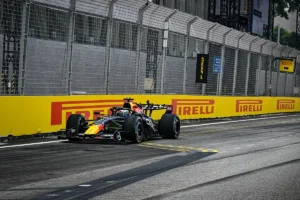
The FIA’s International Court of Appeal has set a date to hear the appeals lodged by McLaren and Red Bull over Pierre Gasly being reinstated to third place at the Monaco Grand Prix. Mark your calendars: 25 August, at FIA headquarters in Paris. The hearing will be held behind closed doors, which is handy, because what happens inside those walls will be every bit as uncomfortable as what unfolded on the streets of Monte Carlo.
How Did We Get Here?
The short version: the 2026 Monaco Grand Prix was blighted by a malfunctioning pit lane timing loop. The system, designed to detect drivers exceeding the 60 km/h pit lane speed limit, was recording speeds that were simply wrong. Overstated. Fictitious, if you want to be blunt about it. Multiple drivers were penalised during the race as a direct result.
George Russell, Oscar Piastri, Lewis Hamilton and Franco Colapinto all received in-race penalties and served them at their next pit stop. Because those penalties were served during the race, they cannot be undone. There is no appeals process available to them. The time was lost. The positions were lost. End of story.
Gasly, however, crossed the line in third before two five-second post-race penalties dropped him to seventh. Because those penalties were applied to his finishing time rather than served at a pit stop, they were legally contestable. Alpine did their homework, dug into the data, and proved that Gasly had not actually exceeded the speed limit. Formula One Management subsequently admitted the timing system had errors. The stewards, left with little choice, overturned Gasly’s penalties and restored him to third place.
Isack Hadjar, who had inherited that podium position in the results, was bumped back down. McLaren and Red Bull, understandably furious, lodged appeals with the International Court of Appeal, as reported by PlanetF1.com.
The Injustice at the Heart of This
Here is where the story stops being a mere administrative headache and starts being a genuine governance embarrassment. The Monaco timing system was wrong. That much is not in dispute. Every driver it flagged was penalised on the basis of faulty data. Yet the only driver who gets relief is the one whose penalty happened to be applied after the finish line rather than during the race.
That is not justice. That is a procedural coin flip. Russell, Piastri, Hamilton and Colapinto were penalised for something that the evidence now suggests did not happen, and they have absolutely no recourse. The rules, as written, offer them nothing. Gasly gets his podium back, they get a shrug.
It is worth noting that Isack Hadjar is already dealing with enough, having been sidelined at Zandvoort through injury, and watching his Monaco podium reinstated and then potentially challenged again at a Paris court hearing adds an unwelcome layer of chaos to his season.
What McLaren and Red Bull Are Actually Arguing
The precise legal grounds of the appeal have not been made public, which is consistent with the behind-closed-doors nature of the hearing. However, the commercial logic is straightforward enough.
McLaren have Piastri, who is currently seventh in the drivers’ championship, fighting for every point in a title battle he cannot afford to lose ground in. Red Bull have Hadjar, who was handed a podium, built some momentum around it, and now faces having it stripped away by a court ruling on a technicality that was never his fault in the first place.
Neither team is arguing out of principle alone. This is the championship implications, expressed through legal channels.
The Wider Problem That No Court Can Fix
Whatever the International Court of Appeal decides on 25 August, it cannot actually solve the fundamental problem here. A broken timing system produced faulty penalties. Some of those penalties are reversible. Most are not. The rules were not designed to handle a scenario where the underlying data was wrong from the start.
The FIA’s governance credibility has taken a battering in 2026, and this saga does it no favours. The stewards were not to blame for acting on the data available to them in real time. FOM admitted the system failed. Yet the consequences fall unevenly on the drivers involved, with no mechanism to make the affected parties whole.
If the court rules in favour of McLaren and Red Bull, what does that actually mean? Does Gasly lose the podium again? Does Hadjar get it back? Can anything be done for the four drivers whose in-race penalties remain immovable on the official record? The hearing may produce a verdict, but it is unlikely to produce a clean answer.
What Happens Next
The hearing takes place in Paris on 25 August, behind closed doors at the request of all parties. A decision will be published as soon as possible after the hearing concludes. Given the championship stakes, expect the teams to have their lawyers sharpened and their data presentations ready. Alpine, for their part, will be defending a result they fought hard to reclaim through legitimate means.
The Italian Grand Prix weekend begins on 5 September, which gives the court very little time to publish a ruling before the paddock reconvenes and the whole Monaco saga becomes paddock conversation again.
A Mess of Formula 1’s Own Making
Credit to Alpine for doing the analytical work and proving what the timing system got wrong. That was proper, diligent scrutiny of the kind teams should always apply to penalty decisions. But the broader lesson here is not about one team’s due diligence. It is about a sport that relies on automated systems whose failures cascade through the results in ways the rulebook was never designed to address.
A court date in Paris is the right process. Whether the outcome will feel like justice to the four drivers who served their penalties and had no comparable avenue of appeal is a very different question. Do not hold your breath for a satisfying answer.