
Ferrari arrived in Hungary with arguably the best chassis for the job. They left with fourth and fifth. If you needed a single image to summarise the SF-26’s 2026 identity crisis, Budapest just handed it to you.
The Car That Surprised Everyone, Including Ferrari
Rivals openly concede the SF-26 is the most agile chassis on the grid. McLaren boss Andrea Stella even admitted his car was not yet Ferrari’s equal. The Hungaroring, tight and twisty, should have been a Ferrari playground. On Friday, it was. Charles Leclerc topped FP1, then Lewis Hamilton led a Ferrari 1-2 in FP2. Then something went wrong, and nobody in red seems entirely sure what.
By Sunday evening, both Ferraris were behind the podium. Leclerc was blunt about it.
“Out of the last three races, there were two where we expected to struggle and finished first and second. The race where we expected to do well, we finished fourth and fifth.” – Charles Leclerc
That is not a quirky stat. That is a fundamental problem with understanding your own car.
A Cascade of Self-Inflicted Wounds
Team principal Frederic Vasseur did not dress it up. Hamilton received a grid penalty for impeding Oscar Piastri in qualifying, as covered in our piece on Hamilton’s three-place penalty. That dropped him to fifth on the grid, the dirty side, and compromised his entire race before it started.
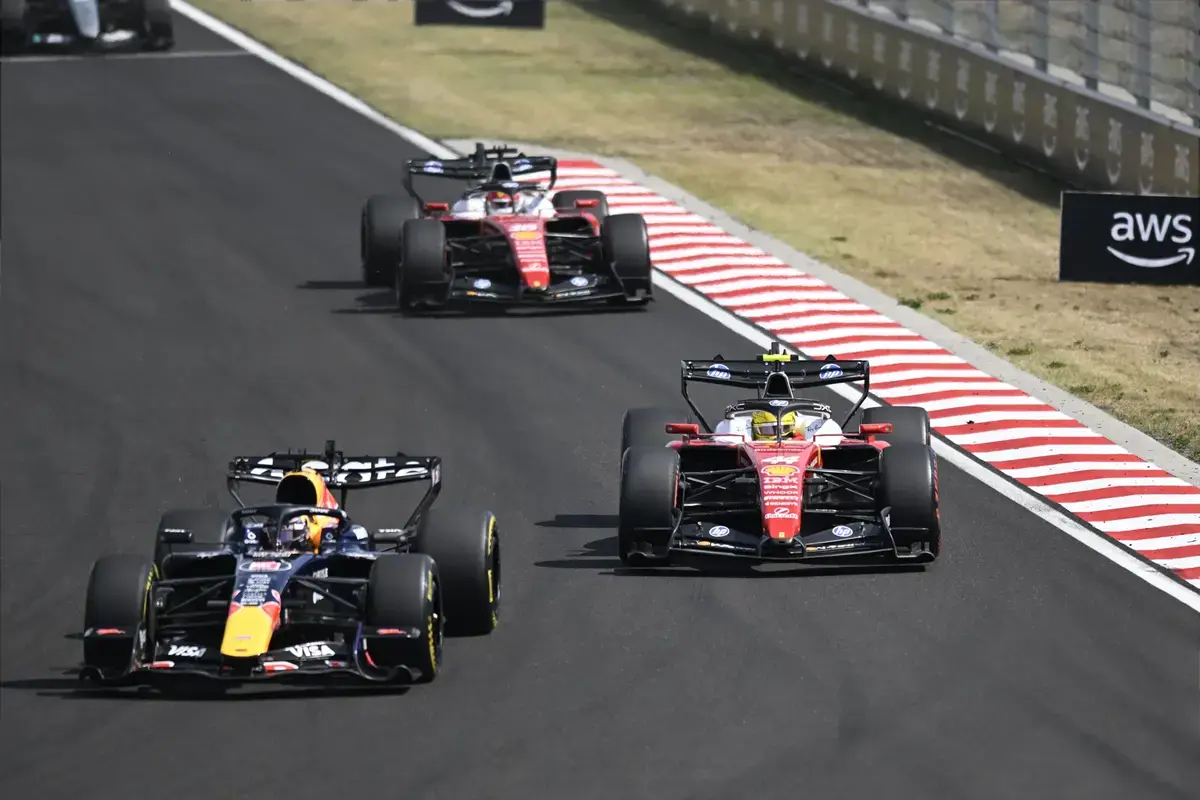
From there, it got worse. Hamilton undercut past Verstappen but emerged behind Liam Lawson. While he was dealing with that traffic, Verstappen simply drove around the outside at Turn 1. Hamilton admitted he never saw it coming. As he put it himself, his race went downhill from there.
The final pitstop, called during a late Virtual Safety Car, cost Hamilton the track position he had managed to claw back. He locked up at his pit box, missed his marks, and then released the speed limiter a fraction too early, earning a five-second penalty for exceeding the pit lane limit by 0.1 km/h. You genuinely could not script it.
“I’m not really sure why we stopped at the end. I got the call right before the pit lane entry, so I didn’t have time to debate it.” – Lewis Hamilton
Vasseur Defends the Strategy, Sort Of
Vasseur insisted Ferrari’s tyre calls were justified given what the team knew at the time, noting Verstappen’s ability to run 37 laps on scrubbed softs caught everyone off guard. Ferrari had the oldest hard tyres in the field and felt the undercut was the only aggressive lever available after the poor start. Fair enough. But staying out on hards, as Leclerc eventually accepted might have been the better call for Hamilton, was at least worth the conversation.
The Deeper Problem Nobody Wants to Name
Leclerc pointed to something more troubling than bad luck or a rough Sunday. The SF-26 appears genuinely erratic across stints, compounds, and even between the two drivers. Some stints are strong, others are baffling, and the correlation between setup choices and actual grip levels seems loose at best. As he noted, the team set the car up for a certain grip level and the track delivered far less. Wheelspin, understeer, unpredictability. On a circuit where track position is everything, that is a ruinous combination.
With the summer break now here, Ferrari has time to dig into the data before the second half of the season resumes. After a weekend where Lando Norris won convincingly and Mercedes extended its championship lead, Ferrari cannot afford another Hungary. The question is whether the problem is fixable quickly, or whether the SF-26 will keep surprising its own drivers for the rest of the year.