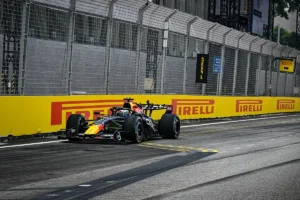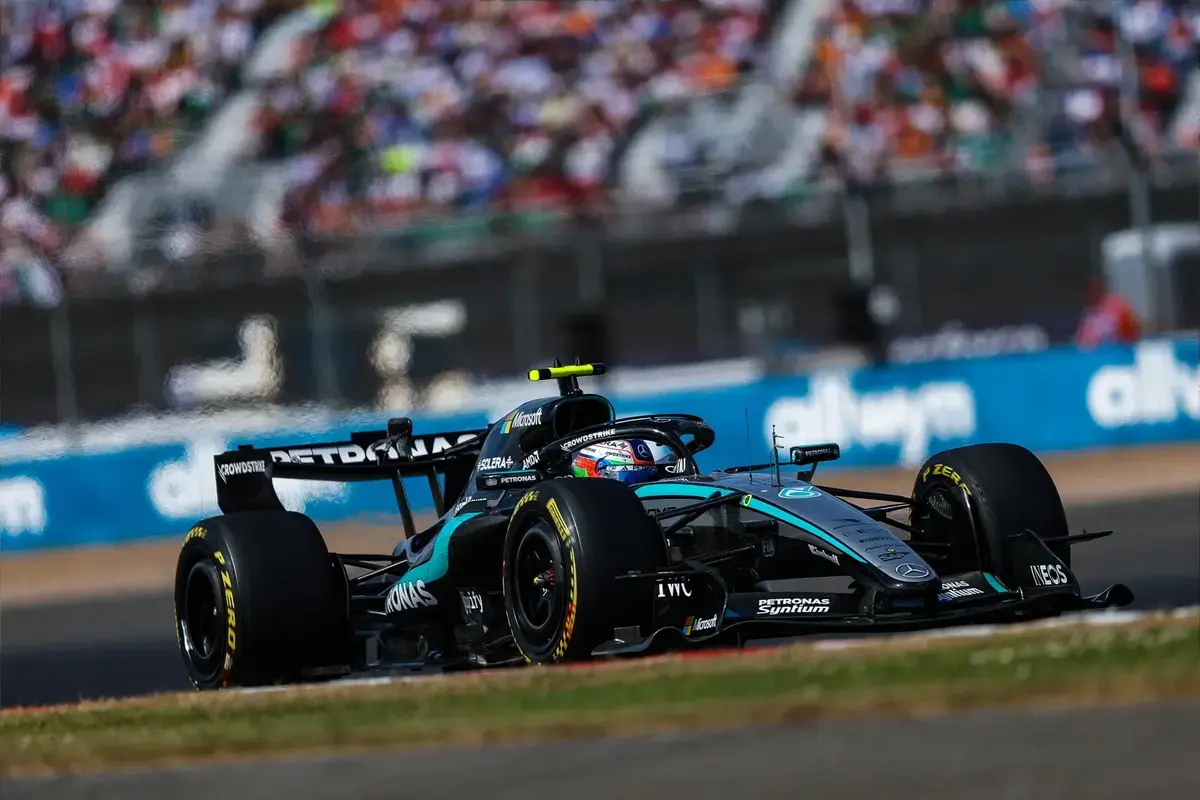

Mercedes has issued its verdict on Kimi Antonelli‘s Silverstone disaster, and the message is essentially: one small part, catastrophic consequences. The team has confirmed that a single brake duct component, specifically the wheel shield on the left front, was entirely responsible for the handling nightmare that cost their championship leader a potential race win and left him 16th. No hidden damage. No deeper rot. Just one rogue piece of carbon doing an extraordinary amount of harm.
One Part, Nearly Uncontrollable Car
Deputy technical chief Simone Resta explained it plainly. The component failed around ten laps from the finish, immediately compromising the suspension geometry, the steering feel, and the aerodynamic balance on the entire left side of the car. Antonelli was, by Resta’s own admission, driving something almost undriveable, shedding 100 aerodynamic efficiency points on one side while simultaneously cooking his own brakes.
He stayed out, fought on, went off multiple times, collected a five-second penalty for track limits violations, and ultimately slid from ninth to 16th when the safety car sealed his fate. You can argue the tactics. You cannot argue the effort.
As we covered in detail after the race, Antonelli himself suspected there might be more wrong with the car. Mercedes have now closed that question: there was not.
Wolff’s Honest Gamble
Toto Wolff, to his credit, is not hiding behind corporate reassurance. His position is refreshingly direct: he would rather have a quick car with occasional reliability gremlins than a bulletproof car that cannot win. With seven victories from nine races this season, it is difficult to argue with the logic. The luxury of performance, he notes, means Mercedes can dial the engine back slightly while they chase a fix, something you simply cannot do when you are already behind on pace.
The upgrade philosophy follows the same thread. While Ferrari and Red Bull have arrived at recent rounds with sizeable development packages, Mercedes has opted for smaller, consistent increments. Andrew Shovlin insists the cumulative effect is working, pointing to the car’s rare ability to perform across genuinely different circuit types.
The Warning Nobody Wants to Hear
Then there is Ralf Schumacher, who has raised a concern that cuts deeper than brake ducts. In a recent interview, the former driver suggested that financial pressure on Mercedes-Benz Group AG, including significant job losses across the German automotive sector, could eventually cast a shadow over the works team’s future investment in Formula 1. Twenty thousand industry jobs gone, a CEO under pressure, and an F1 hype cycle that Schumacher believes cannot sustain its current valuations indefinitely.
Mercedes will rightly point to their 2026 dominance as evidence the programme is worth every euro. But the broader questions around manufacturer commitment to F1 are not going away.
Still Leading, Still Fragile
Antonelli holds a 25-point lead over George Russell with a long season remaining. Mercedes leads the constructors’ standings comfortably. One faulty bracket should not define a championship. History, however, is full of small parts that did exactly that.