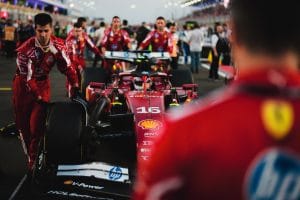
Sergio Pérez hasn’t even completed a lap in his Cadillac yet. The Mexican driver’s still a month away from Barcelona testing. But he’s already making headlines by wading into Venezuela’s extraordinary political chaos with an Instagram Story that’s raised more eyebrows than his entire 2024 season at Red Bull managed.
The six-time race winner posted a message Saturday declaring solidarity with “Venezuelan brothers and sisters” whilst encouraging them that “faith is never lost.” He finished with “Free Venezuela” accompanied by two love heart emojis in silver and red. Because nothing says “I’m focused on my F1 comeback” quite like inserting yourself into geopolitical controversies involving military operations and regime change, does it?
This comes after US President Donald Trump announced American forces conducted a pre-dawn “large-scale strike” on Venezuela, capturing President Nicolás Maduro and his wife Cilia Flores. The couple arrived in New York Saturday evening to face federal charges. Trump stated the US will “temporarily govern” Venezuela following the operation.
Pérez’s timing is spectacular. He’s about to drive for an American F1 team backed by General Motors whilst publicly commenting on US military action that’s provoked international controversy. What could possibly go wrong?
When Your National Hero Status Extends Beyond Borders
Sergio Pérez isn’t just Mexico’s racing icon anymore. The Los Angeles Times documented in 2023 how Checo’s become a proper symbol across Latin America, driving massive F1 interest throughout the region. His popularity transcends national boundaries in ways few drivers achieve.
That reach creates influence. It also creates responsibility. When political turmoil strikes Venezuela, Pérez apparently felt compelled to speak out.
“Venezuelan brothers and sisters, I send you a warm, heartfelt embrace. You are an example that faith is never lost!! My prayers are with all of you!! Free Venezuela.” – Sergio Pérez via Instagram Story
Fair play for using his platform to support people facing genuine hardship. The Venezuelan population’s endured years of economic collapse, political repression, and humanitarian crisis. Pérez’s message of solidarity isn’t controversial in isolation.
What makes this fascinating is the context. He’s driving for Cadillac in 2026. An American manufacturer. Funded by General Motors. Racing under a US commercial operation. His employer’s nationality is rather relevant when commenting on American military interventions, isn’t it?
The Instagram Diplomacy Nobody Asked For
Pérez chose Instagram Stories for his declaration. That’s the social media equivalent of shouting something provocative then watching it disappear 24 hours later. Temporary solidarity. Fleeting geopolitical commentary. Gone before anyone can properly scrutinise the implications.
The silver and red heart emojis accompanying “Free Venezuela” add lovely visual emphasis. They’re also the colours of Venezuela’s flag, which suggests Pérez’s message was carefully considered rather than spontaneous emotional reaction.
What exactly does “Free Venezuela” mean in this context? Free from Maduro’s regime that just got forcibly removed? Free from American military occupation that replaced it? Free from international interference entirely? Pérez doesn’t elaborate because Instagram Stories aren’t designed for nuanced geopolitical analysis.
When F1 Drivers Become Political Commentators
Formula 1 drivers speaking out on global issues isn’t unprecedented. Sebastian Vettel famously wore helmets protesting various causes. Lewis Hamilton’s been consistently vocal about social justice. Max Verstappen mostly stays silent except when regulations annoy him.
After Russia invaded Ukraine, the sport cancelled the Sochi Grand Prix immediately. Drivers condemned the aggression. Teams severed Russian sponsorships. That was unified, straightforward condemnation of clear military aggression.
Venezuela’s situation is considerably more complicated. Maduro’s regime has been internationally controversial for years. Some nations recognise opposition leader Juan Guaidó as legitimate president. Others maintain diplomatic relations with Maduro. The US military operation raises questions about sovereignty, intervention, and regional politics that don’t have simple answers.
Pérez’s message carefully avoids explicitly condemning the American action. But “Free Venezuela” certainly implies the country needs liberating from something. Whether that’s Maduro’s captured government or America’s temporary occupation remains diplomatically ambiguous.
The Cadillac Conundrum Nobody’s Discussing
Here’s what makes this properly awkward. Pérez signed with America’s newest F1 team specifically because they offered him a race seat after Red Bull unceremoniously dumped him mid-2025. Cadillac gave him the comeback opportunity he desperately wanted.
Now he’s commenting on US military operations in ways that could be interpreted as critical whilst representing an American manufacturer. General Motors hasn’t issued any statement about Venezuela. Trump’s administration certainly hasn’t asked F1 drivers for their geopolitical opinions.
Does Cadillac care? Probably not immediately. Pérez’s message was mild, compassionate, and disappeared within 24 hours. But it establishes precedent. If he’s willing to comment on this situation, what happens when future controversies arise involving American interests?
The Mexican driver’s popularity across Latin America is precisely why Cadillac wanted him. He brings massive fanbase, commercial appeal, and regional marketing opportunities. That same influence creates potential complications when politics and racing intersect uncomfortably.
The Comeback That Hasn’t Started Yet
Pérez spent 2025 watching from the sidelines after Red Bull Racing replaced him with Liam Lawson. Now he’s returning with Valtteri Bottas at F1’s newest operation, attempting to prove he still belongs on the grid.
His focus should be entirely on preparing for Barcelona testing in late January. Learning new team structures. Adapting to Cadillac’s engineering approach. Understanding their 2026 machinery designed to revolutionary regulations nobody’s mastered yet.
Instead, he’s posting geopolitical solidarity messages on Instagram whilst military operations unfold. Perhaps that’s admirable. Perhaps it’s distraction. Definitely it’s unexpected from someone whose F1 future depends entirely on performing brilliantly for an American team starting March.
When Faith and Politics Intersect Uncomfortably
Pérez referenced faith prominently in his message. “You are an example that faith is never lost.” That’s consistent with his public persona as someone whose Catholic beliefs inform his worldview. Fair enough. Personal faith shouldn’t be controversial.
But invoking faith whilst commenting on military interventions and regime change adds religious dimension to already complicated political situation. It frames Venezuela’s crisis through spiritual lens that’s deeply personal to Pérez but might not resonate universally with audiences watching F1 for racing rather than theological commentary.
The prayers he’s offering are genuinely well-intentioned. Nobody doubts Pérez’s compassion for people suffering hardship. Whether F1 drivers should publicly involve themselves in active geopolitical conflicts remains the uncomfortable question nobody wants to definitively answer.
The Precedent Nobody’s Considering
What happens next time similar situations arise? Does Pérez comment on every Latin American political crisis? Only those involving US military action? What if his opinions conflict with Cadillac’s commercial interests or General Motors’ government relations?
These aren’t hypothetical concerns. F1 races in countries with controversial governments. Saudi Arabia, Abu Dhabi, Azerbaijan, China. Drivers navigate those weekends by mostly staying silent about human rights whilst pocketing appearance fees.
Pérez’s Venezuela message suggests he’s willing to speak out when situations personally resonate. That’s admirable courage. It also creates inconsistency. Why Venezuela but not other countries facing humanitarian crises? Why military intervention but not economic sanctions? Why Instagram Stories but not formal statements?
The answers probably involve genuine emotional connection to Latin American neighbours combined with spontaneous reaction to dramatic news. But precedent’s been set. Pérez has positioned himself as someone who’ll comment publicly on geopolitical matters affecting the region he represents.
Two Months Until Racing Actually Starts
Barcelona testing begins January 26th. That’s when Pérez will finally drive the Cadillac machinery designed to 2026’s revolutionary regulations. Active aerodynamics. 50/50 power split. Sustainable fuels. Everything’s changed from the Red Bull he struggled with in 2024.
His performance across those three days will generate considerably more attention than Instagram Stories about Venezuela. Either he’s still got the pace to compete against F1’s elite, or his comeback will confirm what Red Bull apparently concluded when they dropped him.
The Venezuelan situation will be forgotten by then. Instagram Stories disappear. News cycles move on. International politics fade from F1’s immediate consciousness until the next controversial race weekend arrives.
But Pérez’s willingness to comment publicly on military operations whilst representing an American F1 team has been noted. Filed away. Ready for examination next time circumstances make his dual identity as Mexican national hero and Cadillac driver uncomfortably complicated.