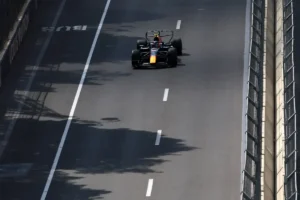
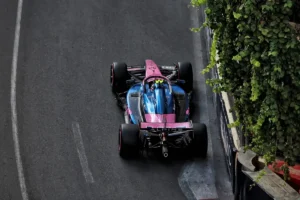
Gabriel Bortoleto had a genuinely good excuse. The stewards believed most of it. He still got hit with a 10-second penalty that shoved him from 13th to 15th in the Azerbaijan Grand Prix classification, which tells you everything about how unforgiving a waved yellow flag remains, no matter how scrambled the information around it gets.
Marshals, Boards and a Driver Left Guessing
The incident happened between Turns 6 and 7 on the first lap after the race restart in Baku. Marshal posts in that section were showing physical SC boards alongside waved yellow flags. Problem was, race control had not actually deployed the Safety Car at that point. Bortoleto saw the boards, saw the flags, and got no matching signal on his steering wheel. His Audi team then told him over the radio that the Safety Car had not been called. Caught between what the marshals were showing and what his own pit wall was telling him, Bortoleto decided he was not going to hand back a position for nothing, and passed Sergio Pérez’s Cadillac.
That single move triggered an FIA investigation, and the verdict, once it landed, turned into one of the more detailed stewards’ documents of the weekend.
What the Stewards Actually Accepted
Credit where it is due: the panel did not dismiss Bortoleto’s account as a convenient story. They explicitly agreed the SC boards were shown in error, and that Audi’s own information to its driver was accurate. As the verdict put it:
“The stewards accept that the conflicting information contributed significantly to the situation. In particular, as the Safety Car had not been deployed, BOR cannot be considered to have overtaken another car under Safety Car conditions.” – FIA stewards’ verdict
So on the specific charge of passing under Safety Car conditions, Bortoleto was cleared. If that were the whole story, this would be a non-event: a driver reacts sensibly to bad information, gets waved through by the stewards, everyone moves on. It is not the whole story.
The Yellow Flag Loophole That Was Not One
Bortoleto’s actual defence hinged on the idea that the waved yellow flags were bundled with the SC boards as one combined signal, and that once the Safety Car element was confirmed false, the yellow flags stopped mattering too. It is a neat piece of logic. It is also exactly the kind of reasoning the stewards were never going to accept, because it hands drivers the power to decide for themselves which flags they feel like obeying.
“The stewards do not accept this interpretation. A waved yellow flag is an instruction in its own right and must be respected irrespective of any accompanying signal. A driver cannot disregard a yellow flag based on his own assessment as to why it has been displayed or whether it should have been displayed.” – FIA stewards’ verdict
That is about as firm a rebuke as stewards’ language gets without naming names and calling someone reckless. The panel went further, noting that 2026 FIA practice treats yellow flag compliance as mandatory even when the surrounding circumstances are unusual, which in plain terms means: confusion is not a defence, it is a mitigating factor at best.
Ten Seconds, One Rule
The final ruling landed on the standard penalty for overtaking under a single yellow flag, ten seconds, applied after the fact to Bortoleto’s race time. Combined with everything else that happened in that Baku classification, it dropped him from 13th to 15th. Not a result that was ever going to trouble the podium picture, but a definite dent in a season where Audi is already scrapping for minor points against Williams and Haas rather than fighting at the sharp end.
For context, this arrived on the back of a weekend where a genuine Safety Car call from an Alexander Albon incident had already scrambled the race once. Baku, in other words, gave race control plenty of opportunities to confuse absolutely everyone, and Bortoleto was simply the driver who got caught holding the wrong assumption at the wrong moment.
Confusion Is Not a Free Pass
What makes this verdict worth dwelling on is how carefully the stewards separated the two issues. Bortoleto was not punished for reacting to bad information about the Safety Car, because that information genuinely was bad, and the stewards said so in as many words. He was punished for deciding, on his own authority, that a waved yellow flag stopped applying to him once one part of the confusing picture cleared up. That is a distinction any driver in the paddock should be taking notes on: race control’s mistakes do not buy you the right to reinterpret the rest of the signals on track.
Marshals showing SC boards that should not have been there is a legitimate grievance. It does not, however, erase a waved yellow flag, and Bortoleto’s ten-second penalty is the FIA making sure nobody in the pit lane walks away thinking otherwise.