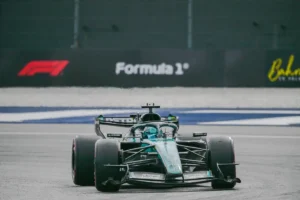
Fernando Alonso teased a mystery, and the paddock guessed wrong. Everyone assumed the 2027 ‘surprise’ involved a GT car and a shared garage with Max Verstappen. Instead, Alonso has agreed a new Aston Martin F1 deal for 2027 that comes bundled with something far stranger: a factory-backed return to the Dakar Rally.
According to Motorsport.com, the arrangement was actually struck as far back as August and only leaked via Spanish media now.
The Surprise Nobody Guessed Correctly
During the Bahrain Grand Prix, Alonso dropped cryptic hints about surprises arriving in the coming weeks. Given his fondness for Verstappen and GT racing chatter, most assumed a sportscar cameo was coming. Instead, Aston Martin is sending him back to an event that chewed him up once already: Alonso finished 13th at the Dakar in 2020 with Toyota.
This is a driver who does not do quiet retirements from a challenge. He negotiated his way into the Indianapolis 500 while sulking through a hopeless Honda-powered McLaren spell, then walked away from Formula 1 entirely between 2018 and 2021 to win Le Mans twice with Toyota and have another crack at Indy. For most drivers that would be a career epilogue. For Alonso it is apparently a pattern he intends to keep repeating.
“Yes, exactly, I had to stop. I had to switch off from Formula 1. I had to experience different formulas and different series, and learn from the specialists in those series and become a more complete driver.” – Fernando Alonso
“I love challenges. My way of understanding motorsport and my way of living is around racing cars… I try to use that strength and maybe do things that were possible in the 1960s, ’80s or ’90s and now probably no one will try. Max is the only one trying to do some GT racing. But apart from that, I like that challenge.” – Fernando Alonso
Read that last line again. Alonso notes that nobody else is attempting what he is attempting, with Max the only one trying GT racing. He is not wrong that nobody else is doing this. Whether that is admirable ambition or a driver refusing to accept he might just be an F1 driver for the remainder of his career is a matter of taste.
What Alonso Will Actually Be Driving
The car itself is an Aston Martin-branded machine built by Prodrive, based on the Dacia Sandrider that won the most recent Dakar in the hands of Nasser Al-Attiyah and co-driver Fabian Lurquin. Dacia, inconveniently for continuity, has just announced it is quitting the World Rally-Raid Championship a year early, wrapping up at the end of 2026 instead of 2027. So Aston Martin is inheriting a winning platform from a manufacturer that has already decided this category is not worth its money anymore. Make of that timing what you will.
The Sandrider itself traces back to the Prodrive Hunter, re-engined and reskinned to resemble Dacia’s Manifesto concept. That lineage apparently makes it straightforward to rebadge again, and Motorsport.com reports one option on the table is naming it the Dreadnought, styled after a virtual Aston Martin concept from Call of Duty: Modern Warfare 4. A Formula 1 constructor borrowing design cues from a video game to sell a desert rally car is the sort of detail that would be dismissed as implausible if it were not apparently true.
Prodrive’s Aston Martin ties run deep. Founder David Richards chaired the British manufacturer between 2007 and 2013, and Prodrive previously ran Aston Martin’s GT and prototype sportscar programme. First tests of the Dakar-bound Sandrider are expected within the coming weeks, and Marc Coma, Alonso’s co-driver in 2020 and a five-time Dakar motorcycle winner with KTM, is expected back alongside him.
Prodrive is reportedly planning a full works effort rather than a single entry for Alonso and Coma, with Al-Attiyah and Sebastien Loeb mentioned as possible additional drivers in Spanish reports. None of it has been officially confirmed by anyone involved, which is worth remembering before treating any of these names as locked in.
A Rally With No Fixed Address
There is a complication that makes the whole venture feel slightly absurd: nobody is entirely sure where the 2027 Dakar will even take place. The event has already wandered from its original Paris to Dakar route through West Africa, got cancelled once over security concerns in Mauritania, spent a decade in South America, and landed in Saudi Arabia from 2020 onwards.
Officially, the 2027 edition is still pencilled in for Saudi Arabia from 1 to 15 January, and organiser ASO has published a route spanning 13 stages and 5,320 kilometres. The FIA still lists Saudi Arabia as host too. But reports suggest ASO is quietly drawing up a Morocco contingency plan given the geopolitical security situation in the Middle East, potentially shrinking the event to around eight stages. No final call has been made.
So Prodrive is reportedly planning a full works effort for an event that might not happen where everyone currently assumes it will, in a format that might be cut nearly in half. That is either admirably committed planning or a fairly reckless way to spend a car manufacturer’s money, and it is not obvious which.
What This Means for Aston Martin’s 2027
None of this changes the sporting reality for Aston Martin on track. The team sits bottom but one of the constructors’ standings with 7 points, and Alonso himself has just 7 points to his name this season after finally breaking a long scoring drought in Bahrain, a result covered in detail here. Signing him to 2027 while also indulging his desert rally fantasies reflects Aston Martin’s commitment to the driver.
Whatever the on-track return, the message from Alonso is consistent with his stated approach: he intends to keep pursuing diverse racing challenges however his bosses will let him.
“I tried these things in the past and I will continue doing that. So maybe, yeah, you have more surprises in the next few weeks. There are things that people probably think that are impossible, but I want to find the limits of what is possible.” – Fernando Alonso