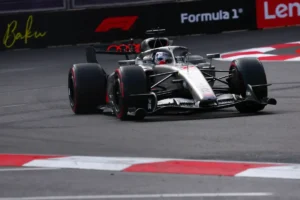
Buried underneath the farce of stalled cars and lightning delays in Malaysia was a number that matters rather more than the chaos around it. Max Verstappen’s win at Sepang was his 72nd for Red Bull, which puts him level with Michael Schumacher’s 72 wins for Ferrari. That is not a trivia footnote. That is one of the most exclusive rooms in the sport, and Verstappen just let himself in.
The chaotic Bahrain GP in Malaysia gave Max Verstappen his first win since the 2025 Abu Dhabi GP, ending a drought that had started to look less like a dip and more like a trend. It turns out the wait produced a number worth waiting for.
Schumacher Took a Decade, Verstappen Got There Quicker
Schumacher built his 72 wins for Ferrari between 1996 and 2006, a stretch that included a run of five straight drivers’ titles from 2000 to 2004. It is the kind of statistic that used to feel untouchable, a relic of an era when one team and one driver simply flattened a championship for half a decade. Verstappen matching it with Red Bull says plenty about how long he has now been doing this at the front.
What is not in doubt is the 72, confirmed by RacingNews365, and the company it now places him in.
Ten Seasons, Three Names
The Malaysia win also means Verstappen has now won a grand prix in ten successive seasons, a feat shared only with Schumacher and Hamilton. That is not a record about raw speed or a single standout year. It is a record about longevity, about staying relevant and winning races across a full decade while teams rise, fall and rebuild around you. Verstappen joining that list is arguably the bigger deal of the two statistics, because titles can be snatched away by a faster rival in a single season, but a decade of consistent winning cannot be faked or gifted.
Hamilton Still Sits Above Him, by a Distance
Here is where the celebration has to pause. Lewis Hamilton remains the only driver in grand prix history to have won more races for a single team than Verstappen has for Red Bull. Hamilton racked up 84 wins for Mercedes between his 2013 Hungarian GP victory and his 2024 Belgian GP win, a run that saw him blow past Schumacher’s old Ferrari mark with win number 73 at the 2020 Turkish Grand Prix, the same afternoon he equalled Schumacher’s seven world titles. Hamilton did not just break the record, he turned it into a title-sealing moment, which is the sort of flourish that makes a statistic properly iconic rather than just impressive.
So Verstappen’s 72 draws him level with a Ferrari legend from two decades ago, but it still leaves him 12 behind a Mercedes benchmark set within the last few years. That is the uncomfortable bit of context nobody printing celebratory graphics this week seems keen to dwell on.
The Maths on Catching Hamilton
Verstappen needs 13 more wins for Red Bull to pass Hamilton’s Mercedes tally and become the outright leader in this particular metric. Given he signed a new long-term deal with Red Bull earlier this year, nobody should assume he is short of chances to chase it down. Whether he gets there before he eventually leaves the team or hangs up the helmet is the only real question left, and it is one that will take years rather than races to answer given the current gap.
Current standings offer a useful reality check on where this season’s version of Verstappen actually sits. He trails Kimi Antonelli by 132 points in the drivers’ championship with seven races remaining, a gap that no single win closes in any meaningful way. The Bahrain GP victory was his first since the 2025 Abu Dhabi GP, and across the last three races he has taken a win, a second and a third, which is a solid recent run rather than evidence of a title charge given how far back he started.
| Driver | Team | Points | Gap to Leader |
|---|---|---|---|
| Kimi Antonelli | Mercedes | 320 | Leader |
| George Russell | Mercedes | 236 | -84 |
| Lewis Hamilton | Ferrari | 214 | -106 |
| Charles Leclerc | Ferrari | 191 | -129 |
| Lando Norris | McLaren | 188 | -132 |
| Max Verstappen | Red Bull Racing | 188 | -132 |
A Number That Outlasts the Weekend
Records like this one tend to get mentioned once and then forgotten until the next milestone arrives, but matching Schumacher’s Ferrari haul deserves more than a passing nod. It places Verstappen among a group of two other names, and leaves precisely one of them, Hamilton, still standing above him. That is a far tidier way to measure a career than any single weekend’s chaos, however memorable that weekend turned out to be at Sepang.
For now, the numbers are simple enough: 72 wins for Red Bull matches Schumacher’s Ferrari tally, ten consecutive winning seasons puts him alongside Schumacher and Hamilton, and 13 more wins would be needed to overtake Hamilton’s Mercedes record outright.